Blumenfeld Zack, Velisar Anca, Miller Koop Mandy, Hill Bruce C, Shreve Lauren A, Quinn Emma J, Kilbane Camilla, Yu Hong, Henderson Jaimie M, Brontë-Stewart Helen
Department of Neurology and Neurological Sciences, Stanford University, Stanford, California, United States of America.
Department of Neurology and Neurological Sciences, Stanford University, Stanford, California, United States of America; Department of Neurosurgery, Stanford University, Stanford, California, United States of America.
PLoS One. 2015 Mar 25;10(3):e0121067. doi: 10.1371/journal.pone.0121067. eCollection 2015.
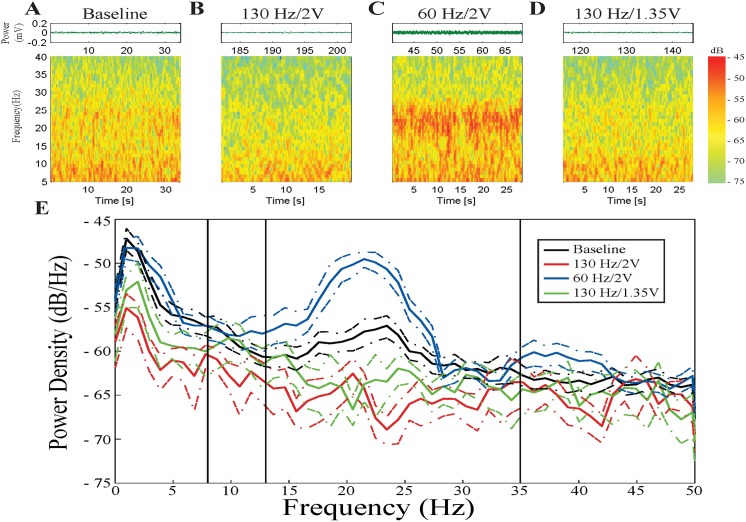
High frequency subthalamic nucleus (STN) deep brain stimulation (DBS) improves the cardinal motor signs of Parkinson's disease (PD) and attenuates STN alpha/beta band neural synchrony in a voltage-dependent manner. While there is a growing interest in the behavioral effects of lower frequency (60 Hz) DBS, little is known about its effect on STN neural synchrony. Here we demonstrate for the first time that during intra-operative 60 Hz STN DBS, one or more bands of resting state neural synchrony were amplified in the STN in PD. We recorded intra-operative STN resting state local field potentials (LFPs) from twenty-eight STNs in seventeen PD subjects after placement of the DBS lead (model 3389, Medtronic, Inc.) before and during three randomized neurostimulation sets (130 Hz/1.35V, 130 Hz/2V, 60 Hz/2V). During 130 Hz/2V DBS, baseline (no DBS) STN alpha (8-12 Hz) and beta (13-35 Hz) band power decreased (N=14, P < 0.001 for both), whereas during 60 Hz/2V DBS, alpha band and peak frequency power increased (P = 0.012, P = 0.007, respectively). The effect of 60 Hz/2V DBS opposed that of power-equivalent (130 Hz/1.35V) DBS (alpha: P < 0.001, beta: P = 0.006). These results show that intra-operative 60 Hz STN DBS amplified whereas 130 Hz STN DBS attenuated resting state neural synchrony in PD; the effects were frequency-specific. We demonstrate that neurostimulation may be useful as a tool to selectively modulate resting state resonant bands of neural synchrony and to investigate its influence on motor and non-motor behaviors in PD and other neuropsychiatric diseases.
高频丘脑底核(STN)深部脑刺激(DBS)可改善帕金森病(PD)的主要运动症状,并以电压依赖的方式减弱STNα/β频段神经同步性。虽然人们对低频(60Hz)DBS的行为效应越来越感兴趣,但对其对STN神经同步性的影响知之甚少。在此,我们首次证明,在术中60Hz STN DBS期间,PD患者STN中的一个或多个静息态神经同步频段被放大。我们在17例PD患者的28个STN中,在植入DBS电极(型号3389,美敦力公司)后,在三个随机神经刺激组(130Hz/1.35V、130Hz/2V、60Hz/2V)之前和期间记录术中STN静息态局部场电位(LFP)。在130Hz/2V DBS期间,基线(无DBS)STNα(8-12Hz)和β(13-35Hz)频段功率降低(N=14,两者均P<0.001),而在60Hz/2V DBS期间,α频段和峰值频率功率增加(分别为P=0.012,P=0.007)。60Hz/2V DBS的效果与功率等效(130Hz/1.35V)DBS相反(α:P<0.001,β:P=0.006)。这些结果表明,术中60Hz STN DBS放大了而130Hz STN DBS减弱了PD患者的静息态神经同步性;这些效应具有频率特异性。我们证明,神经刺激可能作为一种工具,用于选择性调节神经同步的静息态共振频段,并研究其对PD和其他神经精神疾病的运动和非运动行为的影响。