Constancias Florentin, Terrat Sébastien, Saby Nicolas P A, Horrigue Walid, Villerd Jean, Guillemin Jean-Philippe, Biju-Duval Luc, Nowak Virginie, Dequiedt Samuel, Ranjard Lionel, Chemidlin Prévost-Bouré Nicolas
INRA, UMR1347 Agroécologie, BP 86510, F-21000, Dijon, France.
INRA, UMR1347 Agroécologie-Plateforme GenoSol, BP 86510, F-21000, Dijon, France.
Microbiologyopen. 2015 Jun;4(3):505-17. doi: 10.1002/mbo3.255. Epub 2015 Apr 1.
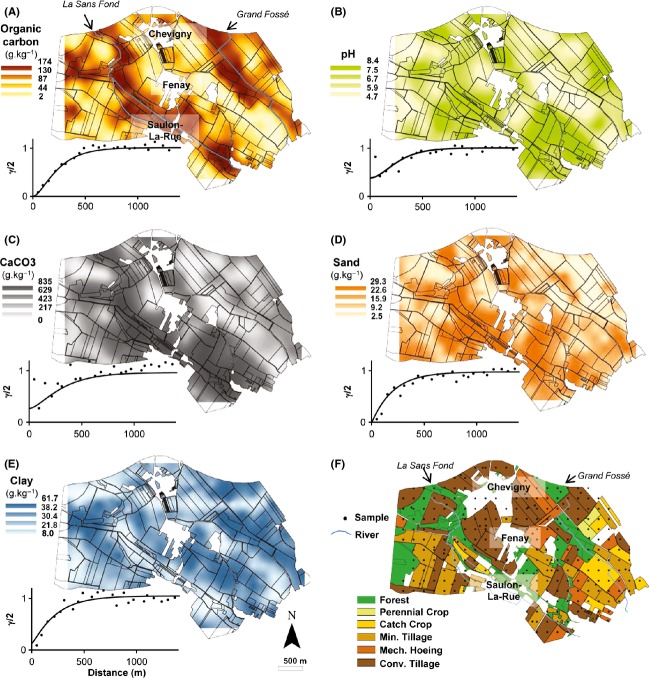
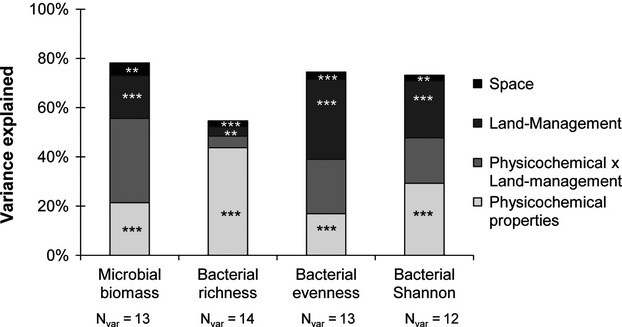
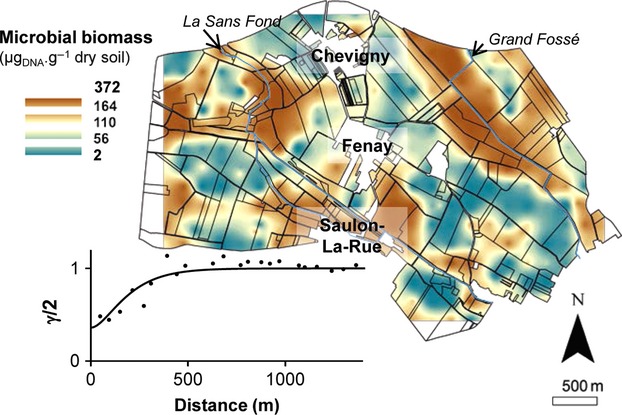
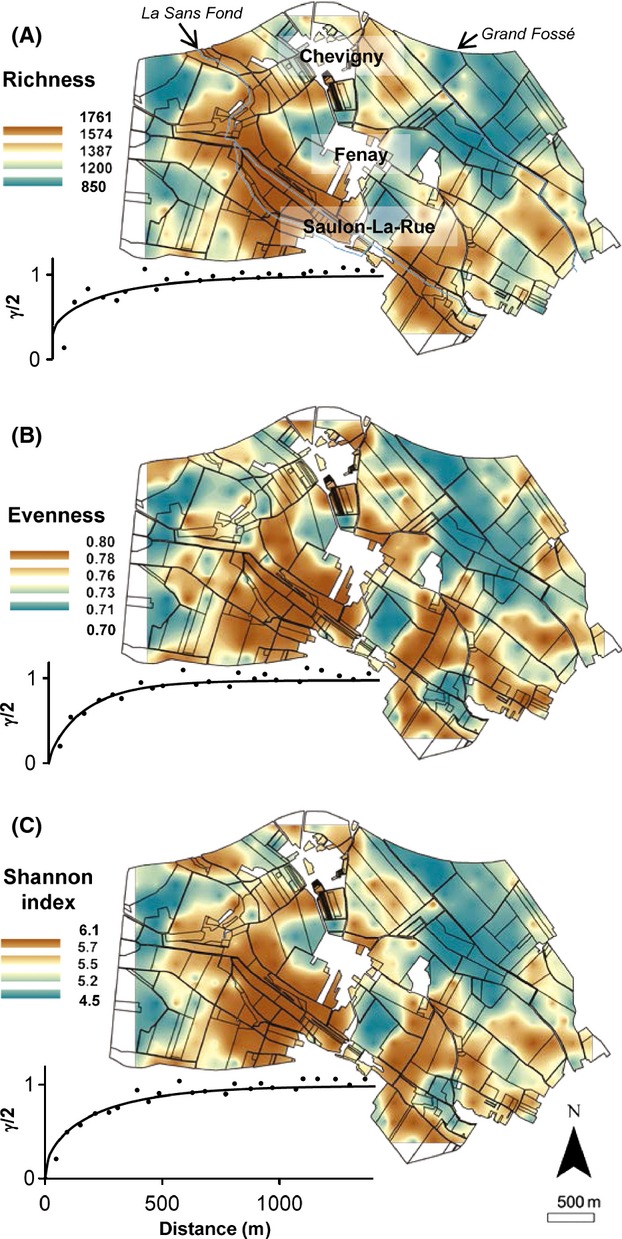
Despite the relevance of landscape, regarding the spatial patterning of microbial communities and the relative influence of environmental parameters versus human activities, few investigations have been conducted at this scale. Here, we used a systematic grid to characterize the distribution of soil microbial communities at 278 sites across a monitored agricultural landscape of 13 km². Molecular microbial biomass was estimated by soil DNA recovery and bacterial diversity by 16S rRNA gene pyrosequencing. Geostatistics provided the first maps of microbial community at this scale and revealed a heterogeneous but spatially structured distribution of microbial biomass and diversity with patches of several hundreds of meters. Variance partitioning revealed that both microbial abundance and bacterial diversity distribution were highly dependent of soil properties and land use (total variance explained ranged between 55% and 78%). Microbial biomass and bacterial richness distributions were mainly explained by soil pH and texture whereas bacterial evenness distribution was mainly related to land management. Bacterial diversity (richness, evenness, and Shannon index) was positively influenced by cropping intensity and especially by soil tillage, resulting in spots of low microbial diversity in soils under forest management. Spatial descriptors also explained a small but significant portion of the microbial distribution suggesting that landscape configuration also shapes microbial biomass and bacterial diversity.
尽管景观对于微生物群落的空间格局以及环境参数与人类活动的相对影响具有重要意义,但在此尺度上开展的调查却很少。在此,我们使用系统网格对面积达13平方公里的受监测农业景观中278个位点的土壤微生物群落分布进行了特征描述。通过土壤DNA回收估算分子微生物生物量,并通过16S rRNA基因焦磷酸测序分析细菌多样性。地统计学方法绘制出了该尺度下首张微生物群落图谱,揭示了微生物生物量和多样性呈现出异质性但具有空间结构的分布,斑块大小达数百米。方差分解表明,微生物丰度和细菌多样性分布都高度依赖于土壤性质和土地利用方式(解释的总方差范围在55%至78%之间)。微生物生物量和细菌丰富度分布主要由土壤pH值和质地决定,而细菌均匀度分布主要与土地管理有关。细菌多样性(丰富度、均匀度和香农指数)受到种植强度尤其是土壤耕作的积极影响,导致森林管理下的土壤中出现微生物多样性较低的区域。空间描述符也解释了微生物分布中一小部分但显著的部分,这表明景观格局也塑造了微生物生物量和细菌多样性。