Schoenfeld Elizabeth M, Poronsky Kye E, Elia Tala R, Budhram Gavin R, Garb Jane L, Mader Timothy J
Baystate Medical Center/Tufts School of Medicine, Department of Emergency Medicine, Boston, Massachusetts.
Baystate Medical Center/Tufts School of Medicine, Epidemiology/Biostatistics, Department of Academic Affairs, Boston, Massachusetts.
West J Emerg Med. 2015 Mar;16(2):269-75. doi: 10.5811/westjem.2015.1.23272. Epub 2015 Mar 13.
In the United States there is debate regarding the appropriate first test for new-onset renal colic, with non-contrast helical computed tomography (CT) receiving the highest ratings from both Agency for Healthcare Research and Quality and the American Urological Association. This is based not only on its accuracy for the diagnosis of renal colic, but also its ability to diagnose other surgical emergencies, which have been thought to occur in 10-15% of patients with suspected renal colic, based on previous studies. In younger patients, it may be reasonable to attempt to avoid immediate CT if concern for dangerous alternative diagnosis is low, based on the risks of radiation from CTs, and particularly in light of evidence that patients with renal colic have a very high likelihood of having multiple CTs in their lifetimes. The objective is to determine the proportion of patients with a dangerous alternative diagnosis in adult patients age 50 and under presenting with uncomplicated (non-infected) suspected renal colic, and also to determine what proportion of these patients undergo emergent urologic intervention.
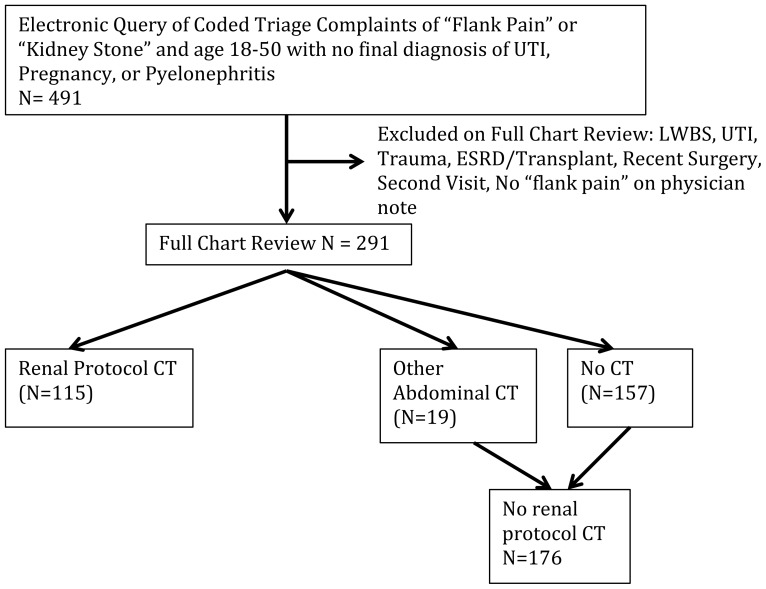
Retrospective chart review of 12 months of patients age 18-50 presenting with "flank pain," excluding patients with end stage renal disease, urinary tract infection, pregnancy and trauma. Dangerous alternative diagnosis was determined by CT.
Two hundred and ninety-one patients met inclusion criteria. One hundred and fifteen patients had renal protocol CTs, and zero alternative emergent or urgent diagnoses were identified (one-sided 95% CI [0-2.7%]). Of the 291 encounters, there were 7 urologic procedures performed upon first admission (2.4%, 95% CI [1.0-4.9%]). The prevalence of kidney stone by final diagnosis was 58.8%.
This small sample suggests that in younger patients with uncomplicated renal colic, the benefit of immediate CT for suspected renal colic should be questioned. Further studies are needed to determine which patients benefit from immediate CT for suspected renal colic, and which patients could undergo alternate imaging such as ultrasound.
在美国,关于新发肾绞痛的首次检查方法存在争议,非增强螺旋计算机断层扫描(CT)在医疗保健研究与质量局以及美国泌尿外科学会的评级中均位居榜首。这不仅基于其对肾绞痛诊断的准确性,还基于其诊断其他外科急症的能力,根据以往研究,据认为在疑似肾绞痛患者中有10% - 15%会发生此类情况。对于年轻患者,如果基于CT辐射风险,尤其是鉴于有证据表明肾绞痛患者一生中接受多次CT检查的可能性非常高,而对危险的替代诊断的担忧较低,那么尝试避免立即进行CT检查可能是合理的。目的是确定50岁及以下患有单纯性(未感染)疑似肾绞痛的成年患者中存在危险替代诊断的患者比例,并确定这些患者中接受紧急泌尿外科干预的比例。
对18 - 50岁出现“侧腹痛”的患者进行为期12个月的回顾性病历审查,排除终末期肾病、尿路感染、妊娠和创伤患者。通过CT确定危险替代诊断。
291名患者符合纳入标准。115名患者进行了肾脏CT检查,未发现替代的紧急或急症诊断(单侧95%置信区间[0 - 2.7%])。在291次就诊中,首次入院时进行了7例泌尿外科手术(2.4%,95%置信区间[1.0 - 4.9%])。最终诊断为肾结石的患病率为58.8%。
这个小样本表明,对于患有单纯性肾绞痛的年轻患者,立即进行CT检查以诊断疑似肾绞痛的益处值得质疑。需要进一步研究以确定哪些患者从立即进行CT检查以诊断疑似肾绞痛中获益,以及哪些患者可以接受替代成像检查,如超声检查。