Carpenter Francis, Manson Daniel, Jeffery Kate, Burgess Neil, Barry Caswell
Institute of Neurology, UCL, Queen Square, London WC1N 3BG, UK; Research Department of Cell and Developmental Biology, UCL, Gower Street, London WC1E 6BT, UK.
Research Department of Cell and Developmental Biology, UCL, Gower Street, London WC1E 6BT, UK; Centre for Mathematics and Physics in the Life Sciences and Experimental Biology, UCL, Gower Place, London WC1E 6BT, UK.
Curr Biol. 2015 May 4;25(9):1176-82. doi: 10.1016/j.cub.2015.02.037. Epub 2015 Apr 23.
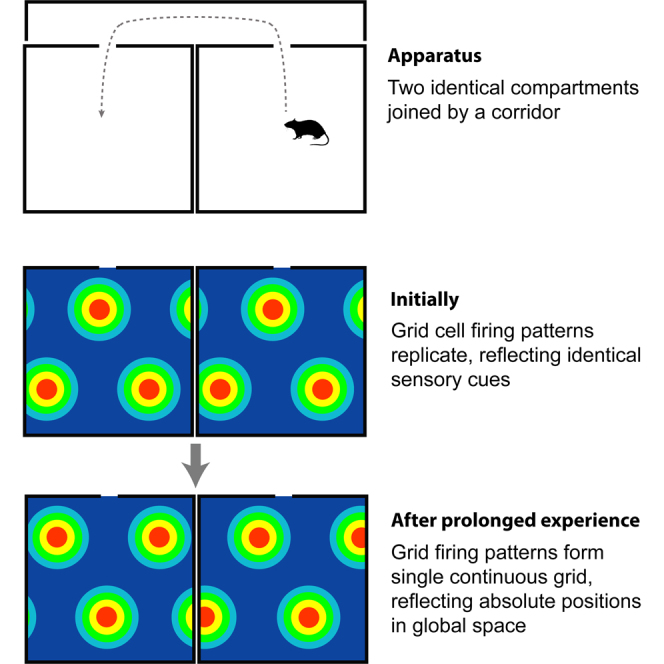
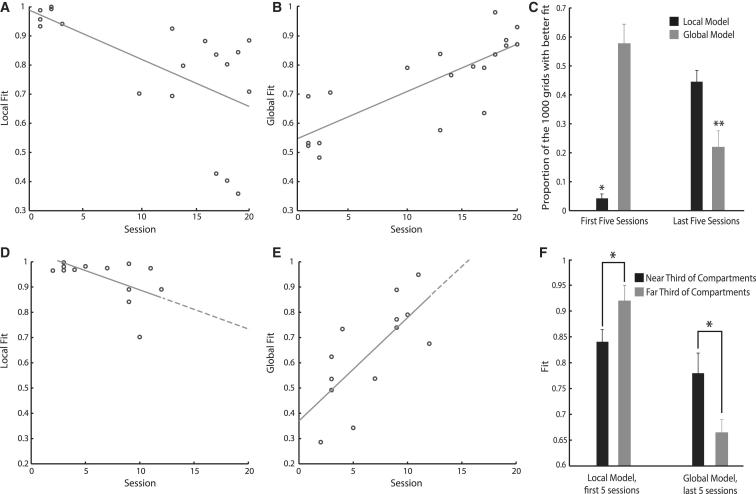
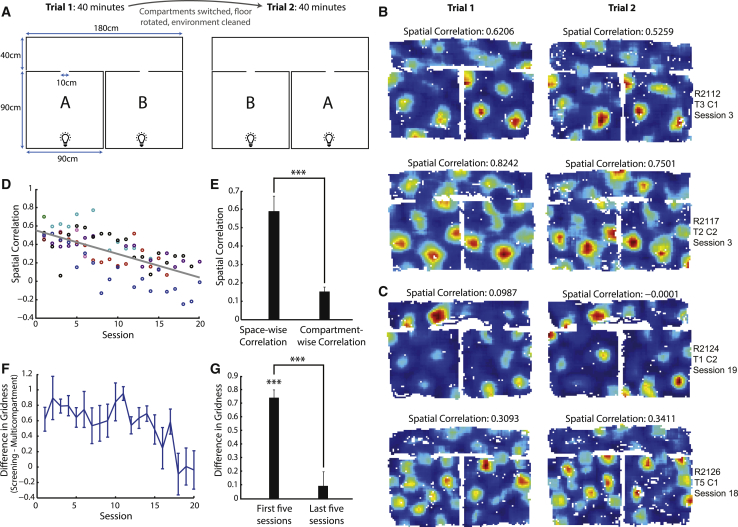
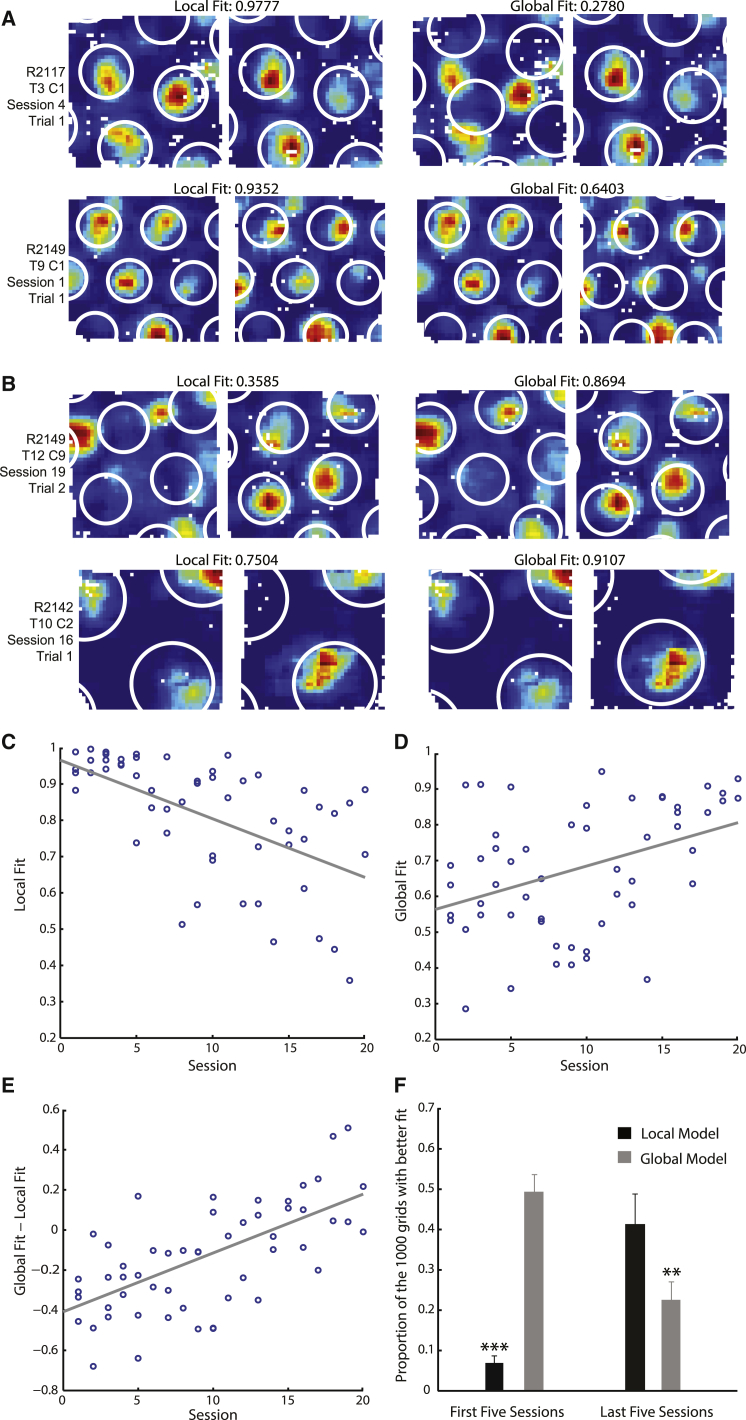
The firing patterns of grid cells in medial entorhinal cortex (mEC) and associated brain areas form triangular arrays that tessellate the environment [1, 2] and maintain constant spatial offsets to each other between environments [3, 4]. These cells are thought to provide an efficient metric for navigation in large-scale space [5-8]. However, an accurate and universal metric requires grid cell firing patterns to uniformly cover the space to be navigated, in contrast to recent demonstrations that environmental features such as boundaries can distort [9-11] and fragment [12] grid patterns. To establish whether grid firing is determined by local environmental cues, or provides a coherent global representation, we recorded mEC grid cells in rats foraging in an environment containing two perceptually identical compartments connected via a corridor. During initial exposures to the multicompartment environment, grid firing patterns were dominated by local environmental cues, replicating between the two compartments. However, with prolonged experience, grid cell firing patterns formed a single, continuous representation that spanned both compartments. Thus, we provide the first evidence that in a complex environment, grid cell firing can form the coherent global pattern necessary for them to act as a metric capable of supporting large-scale spatial navigation.
内嗅皮层(mEC)及相关脑区中的网格细胞放电模式形成三角形阵列,这些阵列将环境进行平铺[1,2],并且在不同环境之间彼此保持恒定的空间偏移[3,4]。这些细胞被认为可为大规模空间中的导航提供一种高效的度量方式[5-8]。然而,与最近关于边界等环境特征会扭曲[9-11]和分割[12]网格模式的证明相反,一种准确且通用的度量方式要求网格细胞放电模式均匀覆盖要导航的空间。为了确定网格放电是由局部环境线索决定,还是提供一种连贯的全局表征,我们在大鼠于一个包含通过走廊相连的两个在感知上相同的隔室的环境中觅食时记录了mEC网格细胞。在最初接触多隔室环境期间,网格放电模式受局部环境线索主导,在两个隔室之间重复出现。然而,随着经验的积累,网格细胞放电模式形成了一个跨越两个隔室的单一、连续的表征。因此,我们提供了首个证据,即在复杂环境中,网格细胞放电能够形成一种连贯的全局模式,使其能够作为一种支持大规模空间导航的度量方式。