N'Danikou Sognigbe, Achigan-Dako Enoch G, Tchokponhoue Dedeou A, Agossou Chaldia Oa, Houdegbe Carlos A, Vodouhe Raymond S, Ahanchede Adam
Horticulture and Genetics Unit, Faculty of Agronomic Sciences, University of Abomey-Calavi, BP: 2549, Abomey-Calavi, Republic of Benin.
Bioversity International, West and Central Africa office, 08 BP 0932, Cotonou, Republic of Benin.
J Ethnobiol Ethnomed. 2015 Apr 30;11:28. doi: 10.1186/s13002-015-0017-3.
Cultivation is the most appropriate management option when both demand and harvesting of wild plant species increase beyond natural production levels. In the current study we made the assumption that, besides the intrinsic biological and ecological characteristics of the species, the decision to cultivate and/or to conserve an overharvested wild plant species is triggered by the socioeconomic factors such as land tenure and size, origin of respondents, gender, and users' knowledge of the plant phenology.
We carried out semi-structured interviews with 178 informants involved in V. doniana exploitation. The data collected were related to socio-demographic characteristics of informants' household situation, knowledge of the biology and propagation of the species, willingness to cultivate the species, in-situ maintenance of populations, and costs associated with management of the species. According to data types we used Student's t, Spearman correlation, Kruskal-Wallis, Fisher's exact and χ2 tests to test the effects of land tenure, origin of respondents, gender and users' knowledge of plant phenology on the decision making process. Conditional inference tree models and generalized additive models were also used to identify variables which were significantly determinant in the decision to cultivate and/or to conserve the species in-situ.
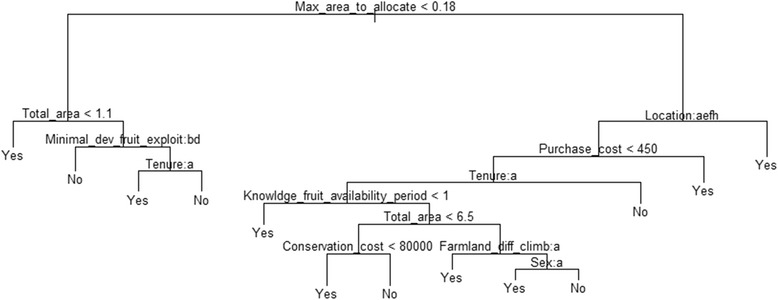
We found that men were more willing to cultivate the species than women and this is conditioned by land area available. The willingness to conserve the species in-situ depends mainly on the total land area available, the number of trees within the landscape, accessibility of the trees, land tenure, gender, location, seedling cost, and trade-off cost for conservation. People who offered more than one US dollar to acquire a seedling of V. doniana, landowners, and those who own a total land area in excess of 6.5 ha were most willing to conserve the species in-situ.
From our findings we conclude that future management and conservation initiatives for V. doniana should first target specific user groups for sustainable exploitation of the species. Also, the Cultivation Opportunity Ratio is an important indicator for quick determination of the likelihood of farmers to engage into cultivation and conservation of the species.
当野生植物物种的需求和采收量超过自然产量水平时,种植是最合适的管理选择。在本研究中,我们假设,除了物种的内在生物学和生态特征外,种植和/或保护过度采收的野生植物物种的决定还受到社会经济因素的触发,如土地所有权和面积、受访者的出身、性别以及使用者对植物物候的了解。
我们对178名参与多花紫薇开发利用的受访者进行了半结构化访谈。收集的数据涉及受访者家庭状况的社会人口特征、对该物种生物学和繁殖的了解、种植该物种的意愿、种群的原地保护以及与该物种管理相关的成本。根据数据类型,我们使用学生t检验、斯皮尔曼相关性检验、克鲁斯卡尔 - 沃利斯检验、费舍尔精确检验和卡方检验来检验土地所有权、受访者出身、性别以及使用者对植物物候的了解对决策过程的影响。条件推断树模型和广义相加模型也被用于识别在决定种植和/或原地保护该物种时具有显著决定性作用的变量。
我们发现男性比女性更愿意种植该物种,这取决于可用土地面积。原地保护该物种的意愿主要取决于可用土地总面积、景观内树木数量、树木的可达性、土地所有权、性别、位置、苗木成本以及保护的权衡成本。为一株多花紫薇苗木支付超过一美元的人、土地所有者以及拥有超过6.5公顷土地总面积的人最愿意原地保护该物种。
根据我们的研究结果,我们得出结论,未来对多花紫薇的管理和保护举措应首先针对特定用户群体,以实现该物种的可持续开发利用。此外,种植机会比率是快速确定农民参与该物种种植和保护可能性的重要指标。