Département ES, UPR AGIRs, Bureau 208, Bâtiment E TA C22/E, Centre de coopération internationale en recherche agronomique pour le développement (CIRAD), Campus international de Baillarguet, Montpellier Cedex 5, 34398, France.
Research Unit of Epidemiology and Risk Analysis applied to Veterinary Sciences (UREAR-ULg), Fundamental and Applied Research for Animal and Health, Faculty of Veterinary Medicine, University of Liege, Boulevard de Colonster 20, B42, B-4000, Liege, Belgium.
BMC Public Health. 2015 May 1;15:448. doi: 10.1186/s12889-015-1791-5.
Regular and relevant evaluations of surveillance systems are essential to improve their performance and cost-effectiveness. With this in mind several organizations have developed evaluation approaches to facilitate the design and implementation of these evaluations.
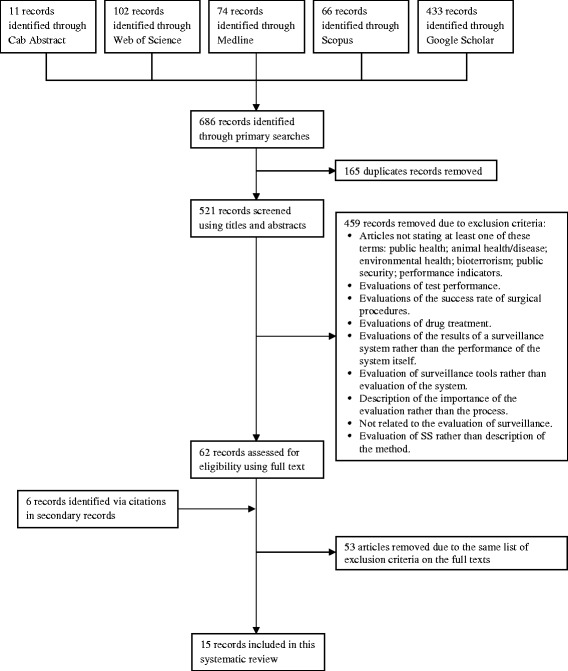
In order to identify and to compare the advantages and limitations of these approaches, we implemented a systematic review using the PRISMA guidelines (Preferred Reporting Items for Systematic Reviews and Meta-Analyses).
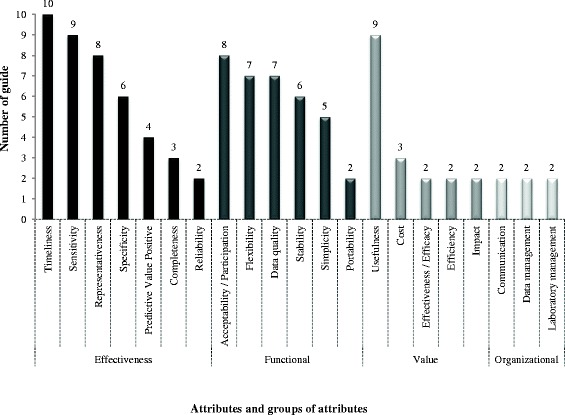
After applying exclusion criteria and identifying other additional documents via citations, 15 documents were retained. These were analysed to assess the field (public or animal health) and the type of surveillance systems targeted; the development process; the objectives; the evaluation process and its outputs; and the attributes covered. Most of the approaches identified were general and provided broad recommendations for evaluation. Several common steps in the evaluation process were identified: (i) defining the surveillance system under evaluation, (ii) designing the evaluation process, (iii) implementing the evaluation, and (iv) drawing conclusions and recommendations.
A lack of information regarding the identification and selection of methods and tools to assess the evaluation attributes was highlighted; as well as a lack of consideration of economic attributes and sociological aspects.
定期对监测系统进行评估,对于提高其性能和成本效益至关重要。有鉴于此,一些组织已经制定了评估方法,以促进这些评估的设计和实施。
为了确定并比较这些方法的优点和局限性,我们按照 PRISMA 指南(系统评价和荟萃分析的首选报告项目)进行了系统综述。
在应用排除标准并通过引文确定其他额外文件后,保留了 15 份文件。对这些文件进行了分析,以评估监测系统所针对的领域(公共卫生或动物卫生)和类型;制定过程;目标;评估过程及其输出;以及涵盖的属性。确定的大多数方法都是通用的,为评估提供了广泛的建议。评估过程中确定了几个常见步骤:(i)定义要评估的监测系统,(ii)设计评估过程,(iii)实施评估,以及(iv)得出结论和建议。
突出强调了在识别和选择评估属性的方法和工具方面缺乏信息;以及在经济属性和社会学方面考虑不足。