Alexander Dominik D, Weed Douglas L, Miller Paula E, Mohamed Muhima A
a EpidStat Institute , Evergreen , Colorado.
b EpidStat Institute , Ann Arbor , Michigan.
J Am Coll Nutr. 2015;34(6):521-43. doi: 10.1080/07315724.2014.992553. Epub 2015 May 5.
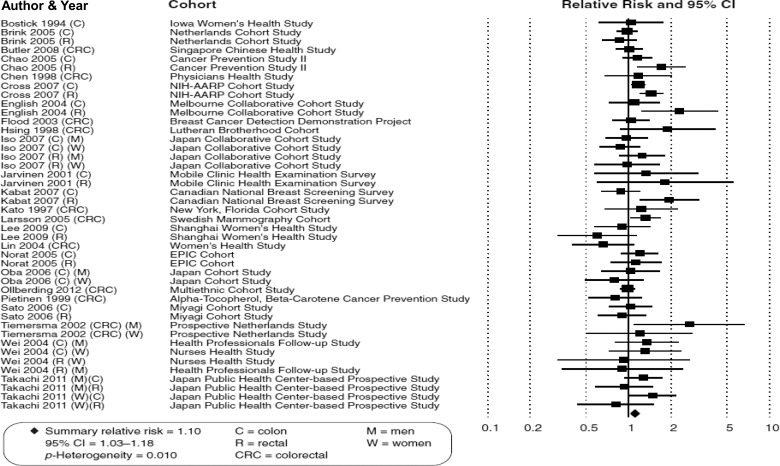
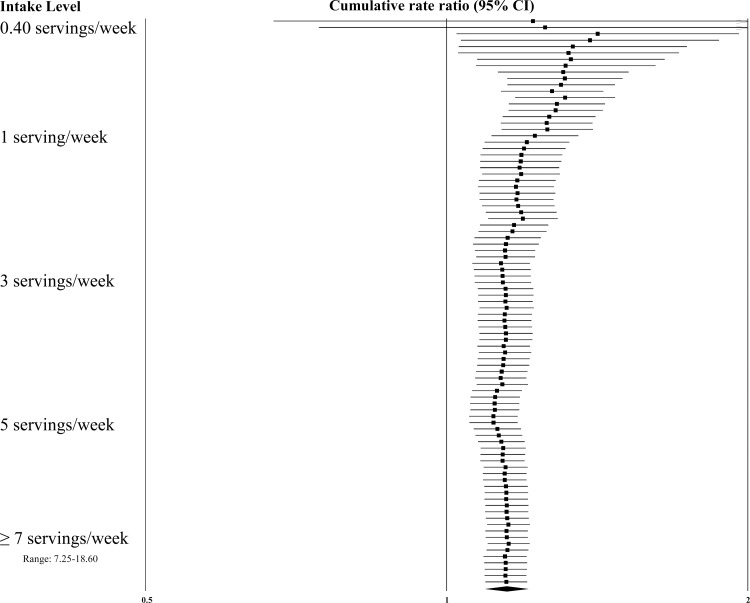
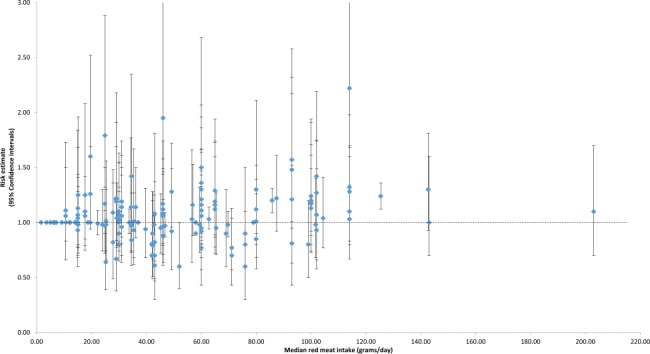
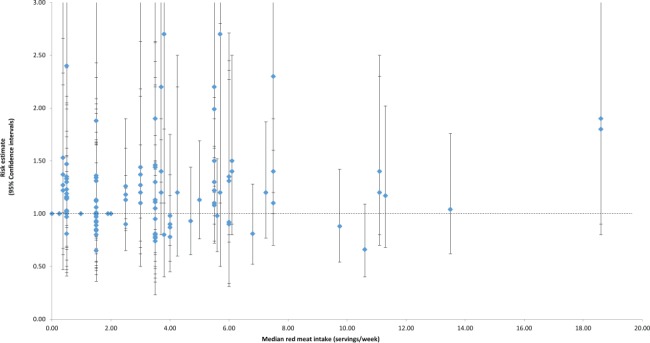
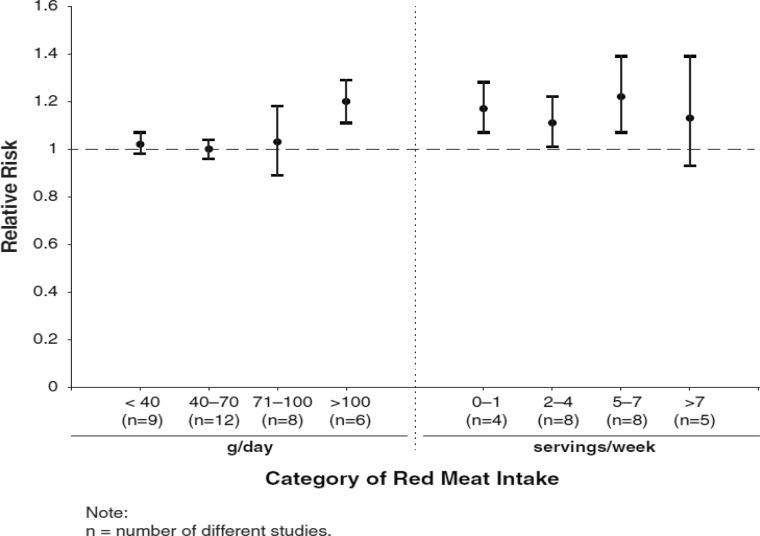
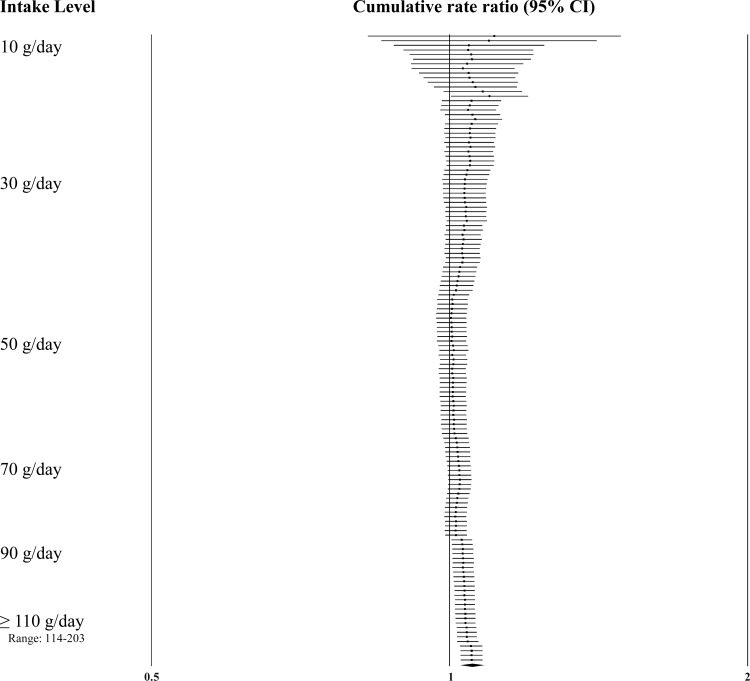
The potential relationship between red meat consumption and colorectal cancer (CRC) has been the subject of scientific debate. Given the high degree of resulting uncertainty, our objective was to update the state of the science by conducting a systematic quantitative assessment of the epidemiologic literature. Specifically, we updated and expanded our previous meta-analysis by integrating data from new prospective cohort studies and conducting a broader evaluation of the relative risk estimates by specific intake categories. Data from 27 independent prospective cohort studies were meta-analyzed using random-effects models, and sources of potential heterogeneity were examined through subgroup and sensitivity analyses. In addition, a comprehensive evaluation of potential dose-response patterns was conducted. In the meta-analysis of all cohorts, a weakly elevated summary relative risk was observed (1.11, 95% CI: 1.03-1.19); however, statistically significant heterogeneity was present. In general, summary associations were attenuated (closer to the null and less heterogeneous) in models that isolated fresh red meat (from processed meat), adjusted for more relevant factors, analyzed women only, and were conducted in countries outside of the United States. Furthermore, no clear patterns of dose-response were apparent. In conclusion, the state of the epidemiologic science on red meat consumption and CRC is best described in terms of weak associations, heterogeneity, an inability to disentangle effects from other dietary and lifestyle factors, lack of a clear dose-response effect, and weakening evidence over time. KEY TEACHING POINTS: •The role of red meat consumption in colorectal cancer risk has been widely contested among the scientific community.•In the current meta-analysis of red meat intake and colorectal cancer, we comprehensively examined associations by creating numerous sub-group stratifications, conducting extensive sensitivity analyses, and evaluating dose-response using several different methods.•Overall, all summary associations were weak in magnitude with no clear dose-response patterns.•Interpretation of findings from epidemiologic studies investigating diet and health outcomes involves numerous methodological considerations, such as accurately measuring food intake, dietary pattern differences across populations, food definitions, outcome classifications, bias and confounding, multicollinearity, biological mechanisms, genetic variation in metabolizing enzymes, and differences in analytical metrics and statistical testing parameters.
食用红肉与结直肠癌(CRC)之间的潜在关系一直是科学争论的主题。鉴于由此产生的高度不确定性,我们的目标是通过对流行病学文献进行系统的定量评估来更新科学现状。具体而言,我们通过整合新的前瞻性队列研究数据并对特定摄入类别的相对风险估计进行更广泛的评估,更新并扩展了我们之前的荟萃分析。使用随机效应模型对来自27项独立前瞻性队列研究的数据进行荟萃分析,并通过亚组分析和敏感性分析检查潜在异质性的来源。此外,还对潜在的剂量反应模式进行了全面评估。在所有队列的荟萃分析中,观察到汇总相对风险略有升高(1.11,95%CI:1.03-1.19);然而,存在统计学上显著的异质性。一般来说,在分离出新鲜红肉(与加工肉类)、针对更多相关因素进行调整、仅分析女性以及在美国以外国家进行的模型中,汇总关联减弱(更接近无效值且异质性更小)。此外,没有明显的剂量反应模式。总之,关于食用红肉与结直肠癌的流行病学科学现状最好用弱关联、异质性、无法将影响与其他饮食和生活方式因素区分开来、缺乏明确的剂量反应效应以及随着时间推移证据减弱来描述。关键教学要点:•食用红肉在结直肠癌风险中的作用在科学界一直存在广泛争议。•在当前关于红肉摄入量与结直肠癌的荟萃分析中,我们通过创建众多亚组分层、进行广泛的敏感性分析以及使用几种不同方法评估剂量反应,全面检查了关联。•总体而言,所有汇总关联的强度都很弱,没有明确的剂量反应模式。•对调查饮食与健康结果的流行病学研究结果的解释涉及众多方法学考虑因素,例如准确测量食物摄入量、不同人群的饮食模式差异、食物定义、结果分类、偏倚和混杂、多重共线性、生物学机制、代谢酶的基因变异以及分析指标和统计检验参数的差异。