Shaukat Zeeshan, Liu Dawei, Gregory Stephen
School of Biological Sciences, University of Adelaide, North Terrace, Adelaide, SA 5006, Australia.
Mediators Inflamm. 2015;2015:369286. doi: 10.1155/2015/369286. Epub 2015 Apr 8.
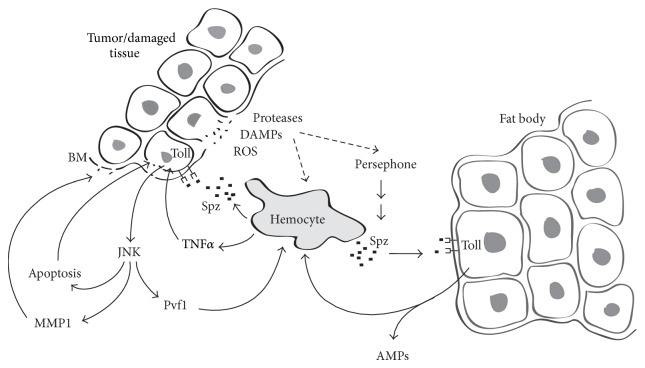
The study of immune responses in Drosophila has already yielded significant results with impacts on our understanding of vertebrate immunity, such as the characterization of the Toll receptor. Several recent papers have focused on the humoral response to damage signals rather than pathogens, particularly damage signals from tumour-like tissues generated by loss of cell polarity or chromosomal instability. Both the triggers that generate this sterile inflammation and the systemic and local effects of it are only just beginning to be characterized in Drosophila. Here we review the molecular mechanisms that are known that give rise to the recruitment of Drosophila phagocytes, called hemocytes, as well as the signals, such as TNFα, that stimulated hemocytes emit at sites of perceived damage. The signalling consequences of inflammation, such as the activation of JNK, and the potential for modifying this response are also discussed.
对果蝇免疫反应的研究已经取得了显著成果,对我们理解脊椎动物免疫产生了影响,比如Toll受体的特性。最近的几篇论文聚焦于对损伤信号而非病原体的体液反应,特别是由细胞极性丧失或染色体不稳定产生的肿瘤样组织发出的损伤信号。在果蝇中,引发这种无菌性炎症的触发因素及其全身和局部效应才刚刚开始得到表征。在这里,我们回顾了已知的导致果蝇吞噬细胞(称为血细胞)募集的分子机制,以及诸如TNFα等刺激血细胞在感知到损伤的部位发出的信号。还讨论了炎症的信号传导后果,如JNK的激活,以及改变这种反应的可能性。