Pilipenko Aleksandr S, Trapezov Rostislav O, Zhuravlev Anton A, Molodin Vyacheslav I, Romaschenko Aida G
Institute of Cytology and Genetics, Siberian Branch of Russian Academy of Sciences, Novosibirsk, Russia; Institute of Archaeology and Ethnography, Siberian Branch of Russian Academy of Sciences, Novosibirsk, Russia; Novosibirsk State University, Novosibirsk, Russia.
Institute of Cytology and Genetics, Siberian Branch of Russian Academy of Sciences, Novosibirsk, Russia; Institute of Archaeology and Ethnography, Siberian Branch of Russian Academy of Sciences, Novosibirsk, Russia.
PLoS One. 2015 May 7;10(5):e0127182. doi: 10.1371/journal.pone.0127182. eCollection 2015.
The craniometric specificity of the indigenous West Siberian human populations cannot be completely explained by the genetic interactions of the western and eastern Eurasian groups recorded in the archaeology of the area from the beginning of the 2nd millennium BC. Anthropologists have proposed another probable explanation: contribution to the genetic structure of West Siberian indigenous populations by ancient human groups, which separated from western and eastern Eurasian populations before the final formation of their phenotypic and genetic features and evolved independently in the region over a long period of time. This hypothesis remains untested. From the genetic point of view, it could be confirmed by the presence in the gene pool of indigenous populations of autochthonous components that evolved in the region over long time periods. The detection of such components, particularly in the mtDNA gene pool, is crucial for further clarification of early regional genetic history.
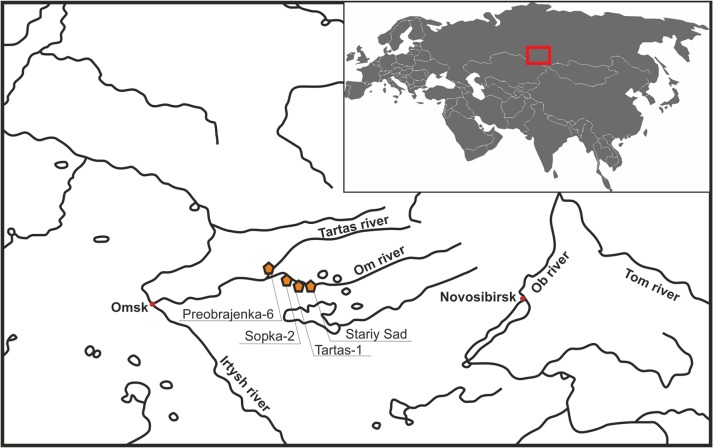
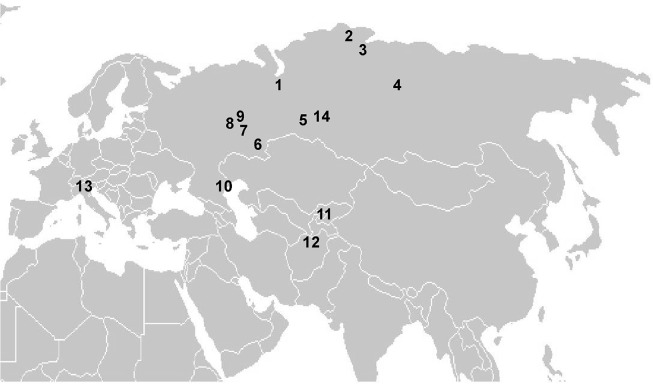
We present the results of analysis of mtDNA samples (n = 10) belonging to the A10 haplogroup, from Bronze Age populations of West Siberian forest-steppe (V-I millennium BC), that were identified in a screening study of a large diachronic sample (n = 96). A10 lineages, which are very rare in modern Eurasian populations, were found in all the Bronze Age groups under study. Data on the A10 lineages' phylogeny and phylogeography in ancient West Siberian and modern Eurasian populations suggest that A10 haplogroup underwent a long-term evolution in West Siberia or arose there autochthonously; thus, the presence of A10 lineages indicates the possible contribution of early autochthonous human groups to the genetic specificity of modern populations, in addition to contributions of later interactions of western and eastern Eurasian populations.
西西伯利亚土著人群的颅骨测量特异性,无法完全通过公元前2千纪初该地区考古记录的西、东欧亚人群的基因相互作用来解释。人类学家提出了另一种可能的解释:古代人类群体对西西伯利亚土著人群基因结构的贡献,这些群体在其表型和基因特征最终形成之前就从西、东欧亚人群中分离出来,并在该地区长期独立进化。这一假设尚未得到验证。从基因角度来看,该地区长期进化的本土成分存在于土著人群的基因库中可以证实这一点。检测到这些成分,尤其是在线粒体DNA基因库中,对于进一步阐明早期区域基因历史至关重要。
我们展示了对属于A10单倍群的线粒体DNA样本(n = 10)的分析结果,这些样本来自西西伯利亚森林草原青铜时代人群(公元前1千纪上半叶),是在对一个大型历时样本(n = 96)的筛选研究中鉴定出来的。在所有研究的青铜时代群体中都发现了在现代欧亚人群中非常罕见的A10谱系。古代西西伯利亚和现代欧亚人群中A10谱系的系统发育和系统地理学数据表明,A10单倍群在西西伯利亚经历了长期进化或在那里本土起源;因此,A10谱系的存在表明,除了后来西、东欧亚人群相互作用的贡献外,早期本土人类群体可能对现代人群的基因特异性做出了贡献。