Florez Sergio L, Erwin Rachel L, Maximova Siela N, Guiltinan Mark J, Curtis Wayne R
Department of Chemical Engineering, The Pennsylvania State University, University Park, PA, 16802, USA.
Department of Plant Science and Huck Institute of Life Sciences, The Pennsylvania State University, University Park, PA, 16802, USA.
BMC Plant Biol. 2015 May 16;15:121. doi: 10.1186/s12870-015-0479-4.
Theobroma cacao, the chocolate tree, is an important economic crop in East Africa, South East Asia, and South and Central America. Propagation of elite varieties has been achieved through somatic embryogenesis (SE) but low efficiencies and genotype dependence still presents a significant limitation for its propagation at commercial scales. Manipulation of transcription factors has been used to enhance the formation of SEs in several other plant species. This work describes the use of the transcription factor Baby Boom (BBM) to promote the transition of somatic cacao cells from the vegetative to embryonic state.
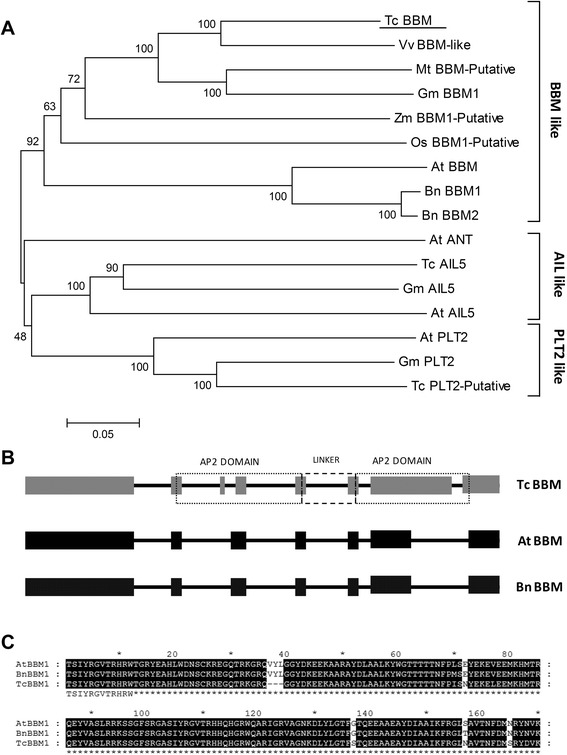
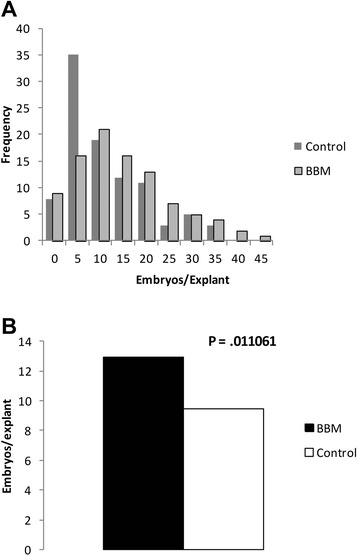
An ortholog of the Arabidopsis thaliana BBM gene (AtBBM) was characterized in T. cacao (TcBBM). TcBBM expression was observed throughout embryo development and was expressed at higher levels during SE as compared to zygotic embryogenesis (ZE). TcBBM overexpression in A. thaliana and T. cacao led to phenotypes associated with SE that did not require exogenous hormones. While transient ectopic expression of TcBBM provided only moderate enhancements in embryogenic potential, constitutive overexpression dramatically increased SE proliferation but also appeared to inhibit subsequent development.
Our work provides validation that TcBBM is an ortholog to AtBBM and has a specific role in both somatic and zygotic embryogenesis. Furthermore, our studies revealed that TcBBM transcript levels could serve as a biomarker for embryogenesis in cacao tissue. Results from transient expression of TcBBM provide confirmation that transcription factors can be used to enhance SE without compromising plant development and avoiding GMO plant production. This strategy could compliment a hormone-based method of reprogramming somatic cells and lead to more precise manipulation of SE at the regulatory level of transcription factors. The technology would benefit the propagation of elite varieties with low regeneration potential as well as the production of transgenic plants, which similarly requires somatic cell reprogramming.
可可树是东非、东南亚以及南美洲和中美洲的一种重要经济作物。通过体细胞胚胎发生(SE)已实现优良品种的繁殖,但效率低下和基因型依赖性仍然是其在商业规模繁殖中的一个重大限制。在其他几种植物物种中,转录因子的调控已被用于促进体细胞胚胎的形成。这项工作描述了利用转录因子“婴儿潮”(BBM)促进可可体细胞从营养状态转变为胚胎状态。
在可可树(TcBBM)中鉴定出拟南芥BBM基因(AtBBM)的一个直系同源基因。在整个胚胎发育过程中均观察到TcBBM的表达,与合子胚胎发生(ZE)相比,在体细胞胚胎发生期间其表达水平更高。在拟南芥和可可树中过表达TcBBM会导致与体细胞胚胎发生相关的表型,且无需外源激素。虽然TcBBM的瞬时异位表达仅适度提高了胚胎发生潜力,但组成型过表达显著增加了体细胞胚胎的增殖,但似乎也抑制了后续发育。
我们的工作证实了TcBBM是AtBBM的直系同源基因,并且在体细胞和合子胚胎发生中都具有特定作用。此外,我们的研究表明,TcBBM转录水平可作为可可组织胚胎发生的生物标志物。TcBBM瞬时表达的结果证实,转录因子可用于增强体细胞胚胎发生,而不会影响植物发育并避免转基因植物的产生。这种策略可以补充基于激素的体细胞重编程方法,并在转录因子的调控水平上更精确地操纵体细胞胚胎发生。该技术将有利于低再生潜力优良品种的繁殖以及转基因植物的生产,而转基因植物的生产同样需要体细胞重编程。