• 文献检索
  • 文档翻译
  • 深度研究
  • 学术资讯
  • Suppr Zotero 插件Zotero 插件
  • 邀请有礼
  • 套餐&价格
  • 历史记录
应用&插件
Suppr Zotero 插件Zotero 插件浏览器插件Mac 客户端Windows 客户端微信小程序
定价
高级版会员购买积分包购买API积分包
服务
文献检索文档翻译深度研究API 文档MCP 服务
关于我们
关于 Suppr公司介绍联系我们用户协议隐私条款
关注我们

Suppr 超能文献

核心技术专利:CN118964589B侵权必究
粤ICP备2023148730 号-1Suppr @ 2026

文献检索

告别复杂PubMed语法,用中文像聊天一样搜索,搜遍4000万医学文献。AI智能推荐,让科研检索更轻松。

立即免费搜索

文件翻译

保留排版,准确专业,支持PDF/Word/PPT等文件格式,支持 12+语言互译。

免费翻译文档

深度研究

AI帮你快速写综述,25分钟生成高质量综述,智能提取关键信息,辅助科研写作。

立即免费体验

一组代表性氧化物纳米材料的综合体外毒性测试:迈向智能测试策略的第一步。

Comprehensive In Vitro Toxicity Testing of a Panel of Representative Oxide Nanomaterials: First Steps towards an Intelligent Testing Strategy.

作者信息

Farcal Lucian, Torres Andón Fernando, Di Cristo Luisana, Rotoli Bianca Maria, Bussolati Ovidio, Bergamaschi Enrico, Mech Agnieszka, Hartmann Nanna B, Rasmussen Kirsten, Riego-Sintes Juan, Ponti Jessica, Kinsner-Ovaskainen Agnieszka, Rossi François, Oomen Agnes, Bos Peter, Chen Rui, Bai Ru, Chen Chunying, Rocks Louise, Fulton Norma, Ross Bryony, Hutchison Gary, Tran Lang, Mues Sarah, Ossig Rainer, Schnekenburger Jürgen, Campagnolo Luisa, Vecchione Lucia, Pietroiusti Antonio, Fadeel Bengt

机构信息

Division of Molecular Toxicology, Institute of Environmental Medicine, Karolinska Institutet, Stockholm, Sweden.

Department of Clinical and Experimental Medicine, University of Parma, Parma, Italy.

出版信息

PLoS One. 2015 May 21;10(5):e0127174. doi: 10.1371/journal.pone.0127174. eCollection 2015.

DOI:10.1371/journal.pone.0127174
PMID:
25996496
原文链接:https://pmc.ncbi.nlm.nih.gov/articles/PMC4440714/
Abstract

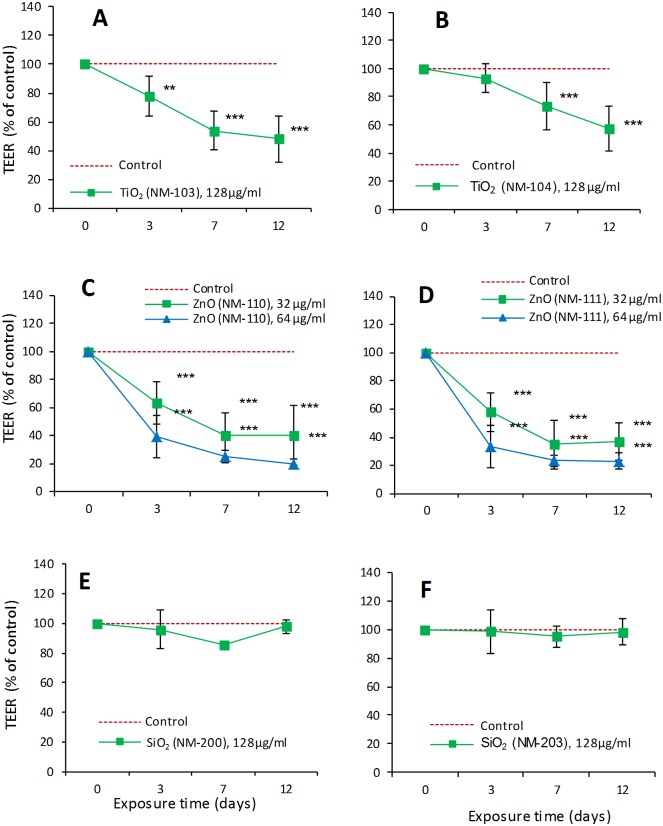
Nanomaterials (NMs) display many unique and useful physico-chemical properties. However, reliable approaches are needed for risk assessment of NMs. The present study was performed in the FP7-MARINA project, with the objective to identify and evaluate in vitro test methods for toxicity assessment in order to facilitate the development of an intelligent testing strategy (ITS). Six representative oxide NMs provided by the EC-JRC Nanomaterials Repository were tested in nine laboratories. The in vitro toxicity of NMs was evaluated in 12 cellular models representing 6 different target organs/systems (immune system, respiratory system, gastrointestinal system, reproductive organs, kidney and embryonic tissues). The toxicity assessment was conducted using 10 different assays for cytotoxicity, embryotoxicity, epithelial integrity, cytokine secretion and oxidative stress. Thorough physico-chemical characterization was performed for all tested NMs. Commercially relevant NMs with different physico-chemical properties were selected: two TiO2 NMs with different surface chemistry - hydrophilic (NM-103) and hydrophobic (NM-104), two forms of ZnO - uncoated (NM-110) and coated with triethoxycapryl silane (NM-111) and two SiO2 NMs produced by two different manufacturing techniques - precipitated (NM-200) and pyrogenic (NM-203). Cell specific toxicity effects of all NMs were observed; macrophages were the most sensitive cell type after short-term exposures (24-72h) (ZnO>SiO2>TiO2). Longer term exposure (7 to 21 days) significantly affected the cell barrier integrity in the presence of ZnO, but not TiO2 and SiO2, while the embryonic stem cell test (EST) classified the TiO2 NMs as potentially 'weak-embryotoxic' and ZnO and SiO2 NMs as 'non-embryotoxic'. A hazard ranking could be established for the representative NMs tested (ZnO NM-110 > ZnO NM-111 > SiO2 NM-203 > SiO2 NM-200 > TiO2 NM-104 > TiO2 NM-103). This ranking was different in the case of embryonic tissues, for which TiO2 displayed higher toxicity compared with ZnO and SiO2. Importantly, the in vitro methodology applied could identify cell- and NM-specific responses, with a low variability observed between different test assays. Overall, this testing approach, based on a battery of cellular systems and test assays, complemented by an exhaustive physico-chemical characterization of NMs, could be deployed for the development of an ITS suitable for risk assessment of NMs. This study also provides a rich source of data for modeling of NM effects.

摘要

纳米材料(NMs)具有许多独特且有用的物理化学性质。然而,需要可靠的方法来对纳米材料进行风险评估。本研究是在FP7-MARINA项目中开展的,目的是识别和评估用于毒性评估的体外测试方法,以促进智能测试策略(ITS)的开发。欧洲委员会联合研究中心纳米材料库提供的六种代表性氧化物纳米材料在九个实验室进行了测试。在代表6种不同靶器官/系统(免疫系统、呼吸系统、胃肠道系统、生殖器官、肾脏和胚胎组织)的12种细胞模型中评估了纳米材料的体外毒性。使用10种不同的细胞毒性、胚胎毒性、上皮完整性、细胞因子分泌和氧化应激检测方法进行毒性评估。对所有测试的纳米材料进行了全面的物理化学表征。选择了具有不同物理化学性质的具有商业相关性的纳米材料:两种具有不同表面化学性质的二氧化钛纳米材料——亲水性(NM-103)和疏水性(NM-104),两种形式的氧化锌——未涂层的(NM-110)和涂有三乙氧基辛基硅烷的(NM-111),以及两种通过两种不同制造技术生产的二氧化硅纳米材料——沉淀法(NM-200)和热解法(NM-203)。观察到了所有纳米材料的细胞特异性毒性作用;短期暴露(24 - 72小时)后,巨噬细胞是最敏感的细胞类型(氧化锌>二氧化硅>二氧化钛)。长期暴露(7至21天)在存在氧化锌的情况下显著影响细胞屏障完整性,但二氧化钛和二氧化硅则不然,而胚胎干细胞试验(EST)将二氧化钛纳米材料归类为潜在的“弱胚胎毒性”,氧化锌和二氧化硅纳米材料归类为“非胚胎毒性”。可以为测试的代表性纳米材料建立危害等级(氧化锌NM-110 > 氧化锌NM-111 > 二氧化硅NM-203 > 二氧化硅NM-200 > 二氧化钛NM-104 > 二氧化钛NM-103)。在胚胎组织的情况下,该等级有所不同,其中二氧化钛显示出比氧化锌和二氧化硅更高的毒性。重要的是,所应用的体外方法可以识别细胞和纳米材料特异性反应,不同测试方法之间观察到低变异性。总体而言,这种基于一系列细胞系统和测试方法,并辅以纳米材料详尽物理化学表征的测试方法,可用于开发适用于纳米材料风险评估的智能测试策略。本研究还为纳米材料效应建模提供了丰富的数据来源。
https://cdn.ncbi.nlm.nih.gov/pmc/blobs/025d/4440714/299ac2d44bd5/pone.0127174.g010.jpg
https://cdn.ncbi.nlm.nih.gov/pmc/blobs/025d/4440714/b1d6268ed973/pone.0127174.g001.jpg
https://cdn.ncbi.nlm.nih.gov/pmc/blobs/025d/4440714/81f7aeee0275/pone.0127174.g002.jpg
https://cdn.ncbi.nlm.nih.gov/pmc/blobs/025d/4440714/5943d2357cd5/pone.0127174.g003.jpg
https://cdn.ncbi.nlm.nih.gov/pmc/blobs/025d/4440714/6a41df9c6df6/pone.0127174.g004.jpg
https://cdn.ncbi.nlm.nih.gov/pmc/blobs/025d/4440714/709b1a738eee/pone.0127174.g005.jpg
https://cdn.ncbi.nlm.nih.gov/pmc/blobs/025d/4440714/8cd1b05891e7/pone.0127174.g006.jpg
https://cdn.ncbi.nlm.nih.gov/pmc/blobs/025d/4440714/0584137e930a/pone.0127174.g007.jpg
https://cdn.ncbi.nlm.nih.gov/pmc/blobs/025d/4440714/9043277fe7c8/pone.0127174.g008.jpg
https://cdn.ncbi.nlm.nih.gov/pmc/blobs/025d/4440714/59a18b3278e7/pone.0127174.g009.jpg
https://cdn.ncbi.nlm.nih.gov/pmc/blobs/025d/4440714/299ac2d44bd5/pone.0127174.g010.jpg
https://cdn.ncbi.nlm.nih.gov/pmc/blobs/025d/4440714/b1d6268ed973/pone.0127174.g001.jpg
https://cdn.ncbi.nlm.nih.gov/pmc/blobs/025d/4440714/81f7aeee0275/pone.0127174.g002.jpg
https://cdn.ncbi.nlm.nih.gov/pmc/blobs/025d/4440714/5943d2357cd5/pone.0127174.g003.jpg
https://cdn.ncbi.nlm.nih.gov/pmc/blobs/025d/4440714/6a41df9c6df6/pone.0127174.g004.jpg
https://cdn.ncbi.nlm.nih.gov/pmc/blobs/025d/4440714/709b1a738eee/pone.0127174.g005.jpg
https://cdn.ncbi.nlm.nih.gov/pmc/blobs/025d/4440714/8cd1b05891e7/pone.0127174.g006.jpg
https://cdn.ncbi.nlm.nih.gov/pmc/blobs/025d/4440714/0584137e930a/pone.0127174.g007.jpg
https://cdn.ncbi.nlm.nih.gov/pmc/blobs/025d/4440714/9043277fe7c8/pone.0127174.g008.jpg
https://cdn.ncbi.nlm.nih.gov/pmc/blobs/025d/4440714/59a18b3278e7/pone.0127174.g009.jpg
https://cdn.ncbi.nlm.nih.gov/pmc/blobs/025d/4440714/299ac2d44bd5/pone.0127174.g010.jpg

相似文献

1
Comprehensive In Vitro Toxicity Testing of a Panel of Representative Oxide Nanomaterials: First Steps towards an Intelligent Testing Strategy.一组代表性氧化物纳米材料的综合体外毒性测试:迈向智能测试策略的第一步。
PLoS One. 2015 May 21;10(5):e0127174. doi: 10.1371/journal.pone.0127174. eCollection 2015.
2
Morphological observation of embryoid bodies completes the in vitro evaluation of nanomaterial embryotoxicity in the embryonic stem cell test (EST).胚状体的形态学观察完善了胚胎干细胞试验(EST)中纳米材料胚胎毒性的体外评估。
Toxicol In Vitro. 2015 Oct;29(7):1587-96. doi: 10.1016/j.tiv.2015.06.015. Epub 2015 Jun 17.
3
Multilaboratory evaluation of 15 bioassays for (eco)toxicity screening and hazard ranking of engineered nanomaterials: FP7 project NANOVALID.针对工程纳米材料的(生态)毒性筛选和危害分级的15种生物测定法的多实验室评估:FP7项目NANOVALID
Nanotoxicology. 2016 Nov;10(9):1229-42. doi: 10.1080/17435390.2016.1196251. Epub 2016 Jun 28.
4
Genotoxicity testing of different surface-functionalized SiO, ZrO and silver nanomaterials in 3D human bronchial models.不同表面功能化的 SiO2、ZrO2 和银纳米材料的 3D 人支气管模型的遗传毒性测试。
Arch Toxicol. 2017 Dec;91(12):3991-4007. doi: 10.1007/s00204-017-2015-9. Epub 2017 Jun 22.
5
Thermodynamic Parameters at Bio-Nano Interface and Nanomaterial Toxicity: A Case Study on BSA Interaction with ZnO, SiO, and TiO.生物-纳米界面的热力学参数与纳米材料毒性:以 BSA 与 ZnO、SiO 和 TiO 的相互作用为例。
Chem Res Toxicol. 2020 Aug 17;33(8):2054-2071. doi: 10.1021/acs.chemrestox.9b00468. Epub 2020 Jul 15.
6
An in-depth multi-omics analysis in RLE-6TN rat alveolar epithelial cells allows for nanomaterial categorization.深入的多组学分析在 RLE-6TN 大鼠肺泡上皮细胞中实现了纳米材料的分类。
Part Fibre Toxicol. 2019 Oct 25;16(1):38. doi: 10.1186/s12989-019-0321-5.
7
Comparative lung toxicity of engineered nanomaterials utilizing in vitro, ex vivo and in vivo approaches.利用体外、离体和体内方法对工程纳米材料进行肺毒性比较研究。
J Nanobiotechnology. 2014 Nov 26;12:47. doi: 10.1186/s12951-014-0047-3.
8
An in vitro assessment of panel of engineered nanomaterials using a human renal cell line: cytotoxicity, pro-inflammatory response, oxidative stress and genotoxicity.采用人肾细胞系对一系列工程纳米材料进行体外评估:细胞毒性、促炎反应、氧化应激和遗传毒性。
BMC Nephrol. 2013 Apr 25;14:96. doi: 10.1186/1471-2369-14-96.
9
Application of short-term inhalation studies to assess the inhalation toxicity of nanomaterials.应用短期吸入研究评估纳米材料的吸入毒性。
Part Fibre Toxicol. 2014 Apr 4;11:16. doi: 10.1186/1743-8977-11-16.
10
Regulatory ecotoxicity testing of nanomaterials - proposed modifications of OECD test guidelines based on laboratory experience with silver and titanium dioxide nanoparticles.监管用生态毒理学测试纳米材料——基于银和二氧化钛纳米粒子的实验室经验对 OECD 测试指南的拟议修正。
Nanotoxicology. 2016 Dec;10(10):1442-1447. doi: 10.1080/17435390.2016.1229517. Epub 2016 Sep 20.

引用本文的文献

1
Amniotic membrane-encapsulated chitosan-lecithin nanoparticles promote the regenerative potential of mesenchymal stromal cells and fibroblasts.羊膜包裹的壳聚糖-卵磷脂纳米颗粒可促进间充质基质细胞和成纤维细胞的再生潜能。
Nanoscale Adv. 2025 Jun 26. doi: 10.1039/d5na00222b.
2
Application of transgenic zebrafish for investigating inflammatory responses to nanomaterials: Recommendations for new users.转基因斑马鱼在纳米材料炎症反应研究中的应用:给新用户的建议
F1000Res. 2025 Jun 23;12:51. doi: 10.12688/f1000research.128851.2. eCollection 2023.
3
A refined dose metric for nanotoxicology based on surface site reactivity for oxidative potential of engineered nanomaterials.

本文引用的文献

1
An integrated approach for the in vitro dosimetry of engineered nanomaterials.一种用于工程纳米材料体外剂量测定的综合方法。
Part Fibre Toxicol. 2014 May 1;11:20. doi: 10.1186/1743-8977-11-20.
2
ITS-NANO--prioritising nanosafety research to develop a stakeholder driven intelligent testing strategy.ITS-NANO——优先开展纳米安全研究以制定由利益相关者驱动的智能测试策略。
Part Fibre Toxicol. 2014 Feb 13;11:9. doi: 10.1186/1743-8977-11-9.
3
Interlaboratory comparison of size measurements on nanoparticles using nanoparticle tracking analysis (NTA).
一种基于工程纳米材料氧化电位表面位点反应性的纳米毒理学精细剂量指标。
Nanoscale Adv. 2025 Feb 26;7(10):2929-2941. doi: 10.1039/d5na00104h. eCollection 2025 May 13.
4
A systematic review on the state-of-the-art and research gaps regarding inorganic and carbon-based multicomponent and high-aspect ratio nanomaterials.关于无机和碳基多组分及高纵横比纳米材料的最新进展和研究空白的系统综述。
Comput Struct Biotechnol J. 2024 Oct 19;25:211-229. doi: 10.1016/j.csbj.2024.10.020. eCollection 2024 Dec.
5
Comprehensive insights into mechanism of nanotoxicity, assessment methods and regulatory challenges of nanomedicines.对纳米毒性机制、纳米药物评估方法及监管挑战的全面洞察。
Discov Nano. 2024 Oct 4;19(1):165. doi: 10.1186/s11671-024-04118-1.
6
methodology for engineered nanomaterial categorization according to number, nature and oxidative potential of reactive surface sites.根据反应性表面位点的数量、性质和氧化电位对工程纳米材料进行分类的方法。
Environ Sci Nano. 2024 Jul 9;11(9):3744-3760. doi: 10.1039/d3en00810j. eCollection 2024 Sep 12.
7
Nanoparticles and Airway Epithelial Cells: Exploring the Impacts and Methodologies in Toxicity Assessment.纳米颗粒与气道上皮细胞:毒性评估中的影响与方法探索。
Int J Mol Sci. 2024 Jul 18;25(14):7885. doi: 10.3390/ijms25147885.
8
Quantitative Phase Imaging as Sensitive Screening Method for Nanoparticle-Induced Cytotoxicity Assessment.定量相位成像作为纳米颗粒诱导细胞毒性评估的敏感筛选方法。
Cells. 2024 Apr 17;13(8):697. doi: 10.3390/cells13080697.
9
Maternal exposure to zinc oxide nanoparticles causes cochlear dysfunction in the offspring.母体暴露于氧化锌纳米颗粒会导致子代出现耳蜗功能障碍。
Front Toxicol. 2024 Jan 11;6:1323681. doi: 10.3389/ftox.2024.1323681. eCollection 2024.
10
Nanomaterial genotoxicity evaluation using the high-throughput p53-binding protein 1 (53BP1) assay.使用高通量 p53 结合蛋白 1(53BP1)assay 进行纳米材料遗传毒性评价。
PLoS One. 2023 Sep 15;18(9):e0288737. doi: 10.1371/journal.pone.0288737. eCollection 2023.
使用纳米颗粒跟踪分析(NTA)对纳米颗粒尺寸测量进行实验室间比对。
J Nanopart Res. 2013;15(12):2101. doi: 10.1007/s11051-013-2101-8. Epub 2013 Nov 19.
4
Predictive value of in vitro assays depends on the mechanism of toxicity of metal oxide nanoparticles.体外试验的预测价值取决于金属氧化物纳米颗粒的毒性机制。
Part Fibre Toxicol. 2013 Oct 25;10(1):55. doi: 10.1186/1743-8977-10-55.
5
Mechanisms of nanoparticle-induced oxidative stress and toxicity.纳米颗粒诱导的氧化应激和毒性的机制。
Biomed Res Int. 2013;2013:942916. doi: 10.1155/2013/942916. Epub 2013 Aug 20.
6
Gene expression profiling of immune-competent human cells exposed to engineered zinc oxide or titanium dioxide nanoparticles.免疫活性人细胞暴露于工程氧化锌或二氧化钛纳米颗粒后的基因表达谱分析。
PLoS One. 2013 Jul 22;8(7):e68415. doi: 10.1371/journal.pone.0068415. Print 2013.
7
Toxicity screenings of nanomaterials: challenges due to interference with assay processes and components of classic in vitro tests.纳米材料的毒性筛选:因干扰经典体外试验的检测过程和成分而面临的挑战。
Nanotoxicology. 2015 May;9 Suppl 1:13-24. doi: 10.3109/17435390.2013.829590.
8
Implementation of alternative test strategies for the safety assessment of engineered nanomaterials.工程纳米材料安全性评估替代试验策略的实施。
J Intern Med. 2013 Dec;274(6):561-77. doi: 10.1111/joim.12109. Epub 2013 Jul 24.
9
Interlaboratory evaluation of in vitro cytotoxicity and inflammatory responses to engineered nanomaterials: the NIEHS Nano GO Consortium.体外细胞毒性和对工程纳米材料炎症反应的实验室间评估:NIEHS Nano GO 联盟。
Environ Health Perspect. 2013 Jun;121(6):683-90. doi: 10.1289/ehp.1306561. Epub 2013 May 6.
10
OSIRIS, a quest for proof of principle for integrated testing strategies of chemicals for four human health endpoints.奥西里斯(OSIRIS),一项针对四种人类健康终点化学品综合测试策略的原理验证探索。
Regul Toxicol Pharmacol. 2013 Nov;67(2):136-45. doi: 10.1016/j.yrtph.2013.01.007. Epub 2013 Feb 4.