Coelho Carolina G, Giatti Luana, Molina Maria D C B, Nunes Maria A A, Barreto Sandhi M
Public Health Postgraduate Program, Research Group on Epidemiology of Chronic and Occupational Diseases (GERMINAL), Universidade Federal de Minas Gerais, Belo Horizonte, 31270-901, Brazil.
Nutrition School, Universidade Federal de Ouro Preto, Ouro Preto, 35400-000, Brazil.
Int J Environ Res Public Health. 2015 May 29;12(6):6179-96. doi: 10.3390/ijerph120606179.
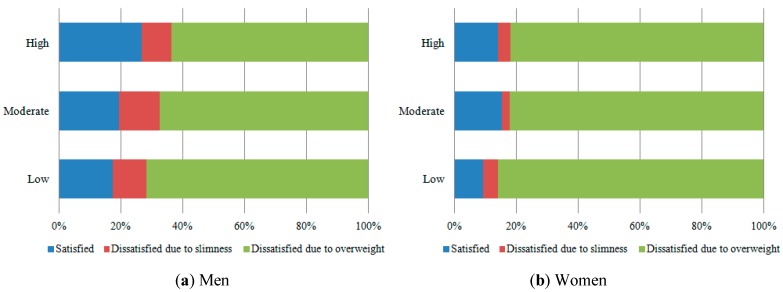
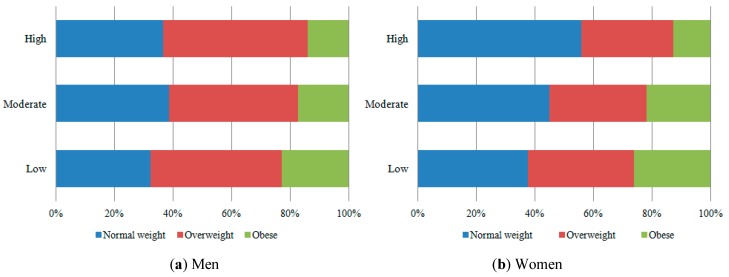
The association of body image dissatisfaction and obesity with physical activity is likely to differ according to gender. To investigate this hypothesis, we conducted a cross-sectional study among the ELSA-Brasil cohort members aged 34-65 years (n=13,286). The body image dissatisfaction was present even among normal weight individuals of both sexes and was associated with lesser chances of practicing moderate physical activity in women and intense physical activity in men. Men and women with central obesity were less prone to practice physical activity of high or moderate intensity. Overweight and obese men were more likely to report vigorous physical activity while obese women were less likely to report this level of physical activity. Body images as well as nutritional status are related to physical activity in both sexes, but the association with physical activity differs by gender.
身体形象不满和肥胖与体育活动之间的关联可能因性别而异。为了验证这一假设,我们对年龄在34至65岁之间的ELSA - 巴西队列成员(n = 13286)进行了一项横断面研究。身体形象不满在男女正常体重个体中均有出现,并且与女性进行中等强度体育活动以及男性进行高强度体育活动的可能性较小有关。患有中心性肥胖的男性和女性进行高强度或中等强度体育活动的倾向较低。超重和肥胖男性更有可能报告进行剧烈体育活动,而肥胖女性报告这种体育活动水平的可能性较小。身体形象以及营养状况在男女中均与体育活动有关,但与体育活动的关联因性别而异。