Robles Noemí, Rajmil Luis, Rodriguez-Arjona Dolors, Azuara Marta, Codina Francisco, Raat Hein, Ravens-Sieberer Ulrike, Herdman Michael
Agència de Qualitat i Avaluació Sanitàries de Catalunya (AQuAS), Roc Boronat 81-95 2nd Floor, Barcelona, 08005, Spain.
Red de Investigación en Servicios de Salud en Enfermedades Crónicas (REDISSEC), Madrid, Spain.
Health Qual Life Outcomes. 2015 Jun 3;13:72. doi: 10.1186/s12955-015-0271-z.
The objectives of the study were to develop web-based Spanish and Catalan versions of the EQ-5D-Y, and to compare scores and psychometric properties with the paper version.
Web-based and paper versions of EQ-5D-Y were included in a cross-sectional study in Palafolls (Barcelona), Spain and administered to students (n = 923) aged 8 to 18 years from 2 primary and 1 secondary school and their parents. All students completed both the web-based and paper versions during school time with an interval of at least 2 h between administrations. The order of administration was randomized. Participants completed EQ-5D-Y, a measure of mental health status (the Strengths and Difficulties Questionnaire), and sociodemographic variables using a self-administered questionnaire. Parents questionnaire included parental level of education and presence of chronic conditions in children. Missing values, and floor and ceiling effects were compared between versions. Mean score differences were computed for the visual analogue scale (VAS). Percentage of agreement, kappa index (k) and intraclass correlation coefficient (ICC) were computed to analyze the level of agreement between web-based and paper versions on EQ-5D-Y dimensions and VAS. Known groups validity was analyzed and compared between the two formats.
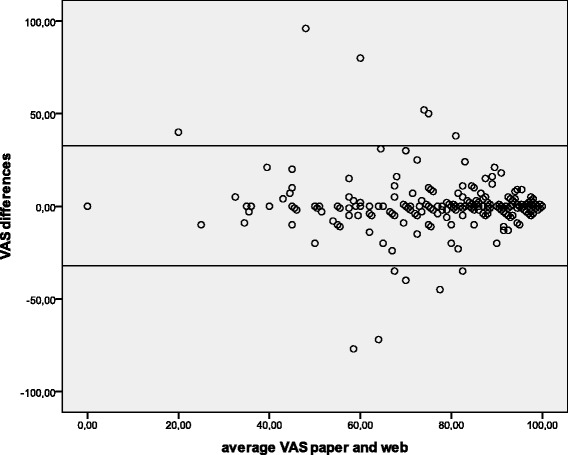
Participation rate was 77 % (n = 715). Both formats of EQ-5D-Y showed low percentages of missing values (n = 2, and 4 to 9 for web and paper versions respectively), and a high ceiling effect by dimension (range from 79 % to 96 %). Percent agreement for EQ-5D-Y dimensions on the web and paper versions was acceptable (range 89 % to 97 %), and k ranged from 0.55 (0.48-0.61, usual activities dimension) to 0.75 (0.68-0.82, mobility dimension). Mean score difference on the VAS was 0.07, and the ICC for VAS scores on the two formats was 0.84 (0.82-0.86). Both formats showed acceptable ability to discriminate according to self-perceived health, reporting chronic conditions, and mental health status.
The digital EQ-5D-Y showed almost identical VAS scores and acceptable levels of agreement on dimensions. Both formats demonstrated acceptable levels of construct validity. Availability of the Spanish and Catalan web-version will facilitate its use in HRQOL assessment and in economic evaluation.
本研究的目的是开发基于网络的西班牙语和加泰罗尼亚语版EQ-5D-Y,并将其得分和心理测量特性与纸质版进行比较。
在西班牙巴塞罗那的帕拉福尔斯进行的一项横断面研究中纳入了基于网络和纸质版的EQ-5D-Y,并将其施用于来自2所小学和1所中学的8至18岁学生(n = 923)及其父母。所有学生均在学校时间内完成基于网络和纸质版的测试,两次测试间隔至少2小时。测试顺序随机。参与者通过自填问卷完成EQ-5D-Y、心理健康状况测量工具(长处与困难问卷)以及社会人口统计学变量的填写。父母问卷包括父母的教育水平和孩子是否患有慢性病。比较两个版本之间的缺失值、地板效应和天花板效应。计算视觉模拟量表(VAS)的平均得分差异。计算一致性百分比、kappa指数(k)和组内相关系数(ICC),以分析基于网络和纸质版在EQ-5D-Y维度和VAS上的一致性水平。分析并比较两种形式之间的已知组效度。
参与率为77%(n = 715)。两种形式的EQ-5D-Y缺失值百分比均较低(网络版为2个,纸质版为4至9个),且各维度的天花板效应较高(范围为79%至96%)。网络版和纸质版EQ-5D-Y维度的一致性百分比可接受(范围为89%至97%),k值范围为0.55(0.48 - 0.61,日常活动维度)至0.75(0.68 - 0.82,行动能力维度)。VAS的平均得分差异为0.07,两种形式的VAS得分ICC为0.84(0.82 - 0.86)。两种形式在根据自我感知健康、报告慢性病和心理健康状况进行区分方面均显示出可接受的能力。
数字化EQ-5D-Y的VAS得分几乎相同,维度一致性水平可接受。两种形式均显示出可接受的结构效度水平。西班牙语和加泰罗尼亚语网络版的可用性将便于其在健康相关生活质量评估和经济评价中的应用。