Han Joon-Hee, Shim Hongsik, Shin Jong-Hwan, Kim Kyoung Su
Applied Biology Program, Division of Bioresource Sciences, Kangwon National University, Chuncheon 200-701, Korea.
Crop Protection Division, National Academy of Agricultural Science, Rural Development Administration, Wanju-gun 565-851, Korea.
Plant Pathol J. 2015 Jun;31(2):165-75. doi: 10.5423/PPJ.OA.03.2015.0036. Epub 2015 Jun 30.
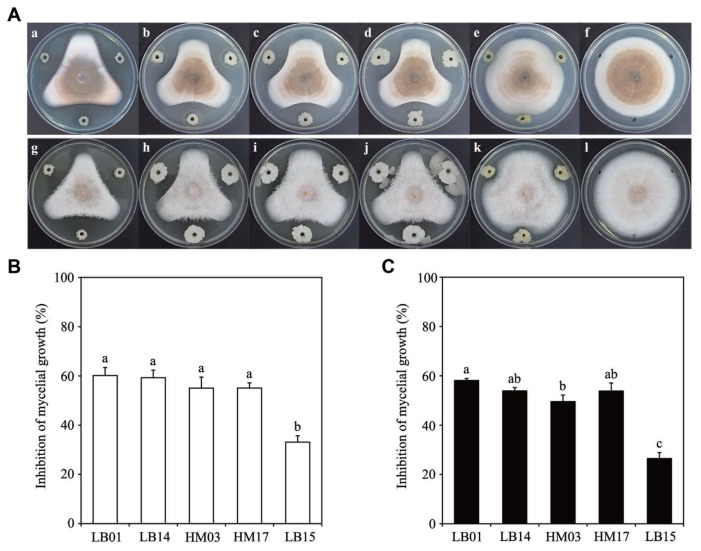
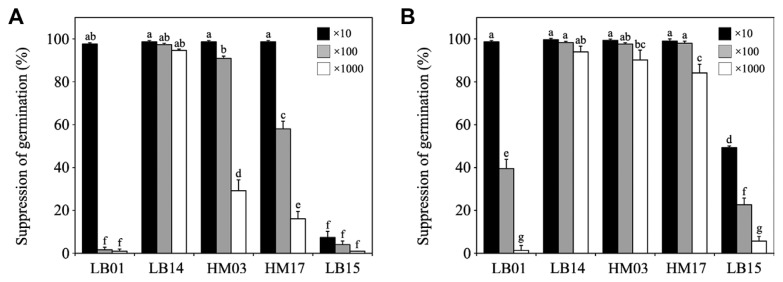
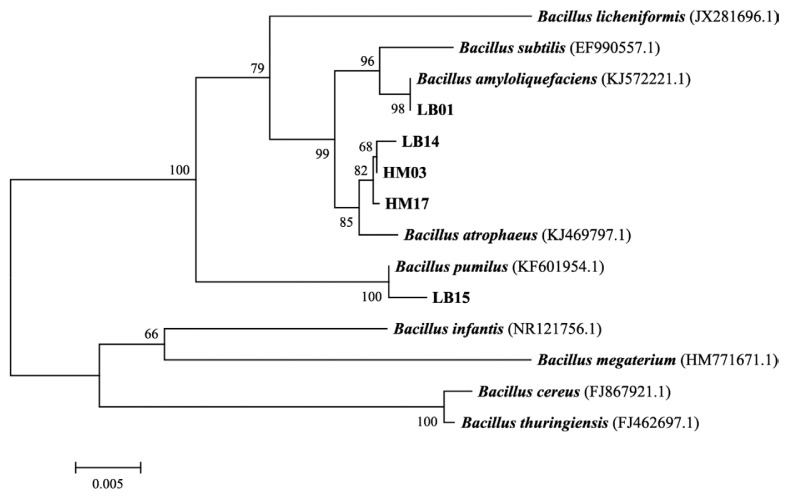
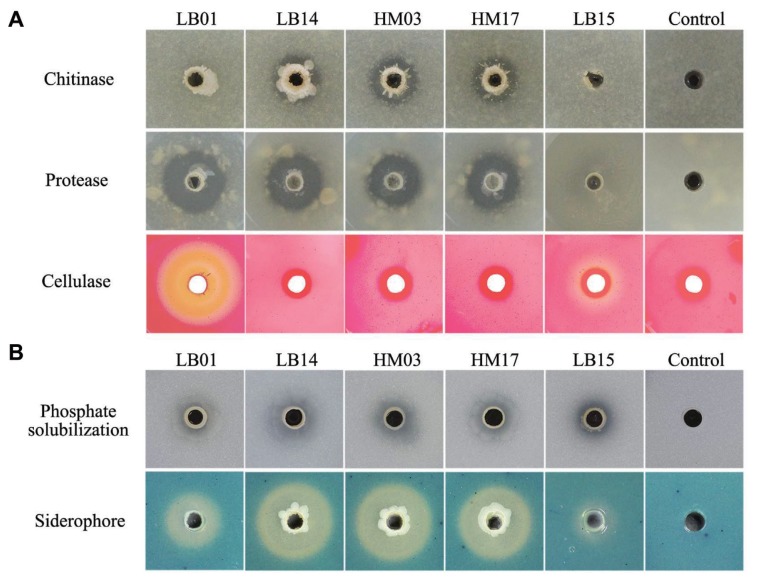
Anthracnose is a fungal disease caused by Colletotrichum species that is detrimental to numerous plant species. Anthracnose control with fungicides has both human health and environmental safety implications. Despite increasing public concerns, fungicide use will continue in the absence of viable alternatives. There have been relatively less efforts to search antagonistic bacteria from mudflats harboring microbial diversity. A total of 420 bacterial strains were isolated from mudflats near the western sea of South Korea. Five bacterial strains, LB01, LB14, HM03, HM17, and LB15, were characterized as having antifungal properties in the presence of C. acutatum and C. gloeosporioides. The three Bacillus atrophaeus strains, LB14, HM03, and HM17, produced large quantities of chitinase and protease enzymes, whereas the B. amyloliquefaciens strain LB01 produced protease and cellulase enzymes. Two important antagonistic traits, siderophore production and solubilization of insoluble phosphate, were observed in the three B. atrophaeus strains. Analyses of disease suppression revealed that LB14 was most effective for suppressing the incidence of anthracnose symptoms on pepper fruits. LB14 produced antagonistic compounds and suppressed conidial germination of C. acutatum and C. gloeosporioides. The results from the present study will provide a basis for developing a reliable alternative to fungicides for anthracnose control.
炭疽病是由炭疽菌属引起的一种真菌病害,对众多植物物种有害。使用杀菌剂防治炭疽病会对人类健康和环境安全产生影响。尽管公众关注度不断提高,但在没有可行替代方案的情况下,杀菌剂仍将继续使用。从拥有微生物多样性的泥滩中寻找拮抗菌的工作相对较少。从韩国西海附近的泥滩中总共分离出420株细菌菌株。五株细菌菌株LB01、LB14、HM03、HM17和LB15在尖孢炭疽菌和胶孢炭疽菌存在的情况下表现出抗真菌特性。三株萎缩芽孢杆菌菌株LB14、HM03和HM17产生大量几丁质酶和蛋白酶,而解淀粉芽孢杆菌菌株LB01产生蛋白酶和纤维素酶。在三株萎缩芽孢杆菌菌株中观察到两个重要的拮抗特性,即铁载体的产生和不溶性磷酸盐的溶解。病害抑制分析表明,LB14对抑制辣椒果实炭疽病症状的发生率最有效。LB14产生拮抗化合物并抑制尖孢炭疽菌和胶孢炭疽菌的分生孢子萌发。本研究结果将为开发一种可靠的炭疽病防治杀菌剂替代方案提供依据。