Creaney Jenette, Ma Shaokang, Sneddon Sophie A, Tourigny Michelle R, Dick Ian M, Leon Justine S, Khong Andrea, Fisher Scott A, Lake Richard A, Lesterhuis W Joost, Nowak Anna K, Leary Shay, Watson Mark W, Robinson Bruce W
National Centre for Asbestos Related Diseases; School of Medicine and Pharmacology; University of Western Australia ; Nedlands, Australia ; Australian Mesothelioma Tumour Bank; Sir Charles Gairdner Hospital ; Nedlands, Australia.
National Centre for Asbestos Related Diseases; School of Medicine and Pharmacology; University of Western Australia ; Nedlands, Australia.
Oncoimmunology. 2015 May 11;4(7):e1011492. doi: 10.1080/2162402X.2015.1011492. eCollection 2015 Jul.
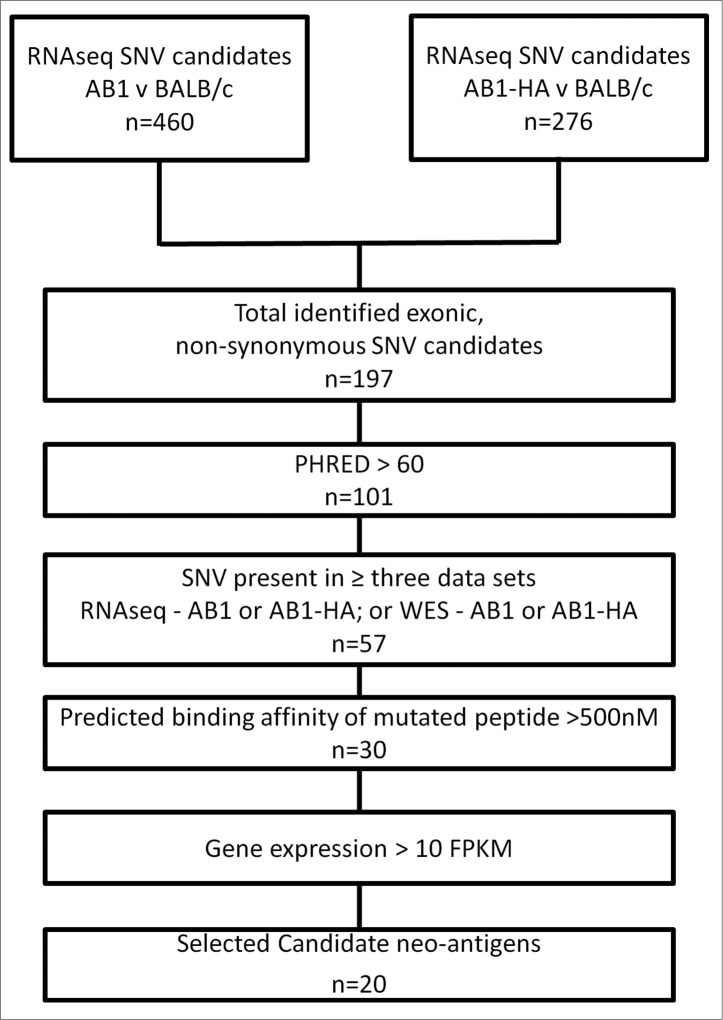
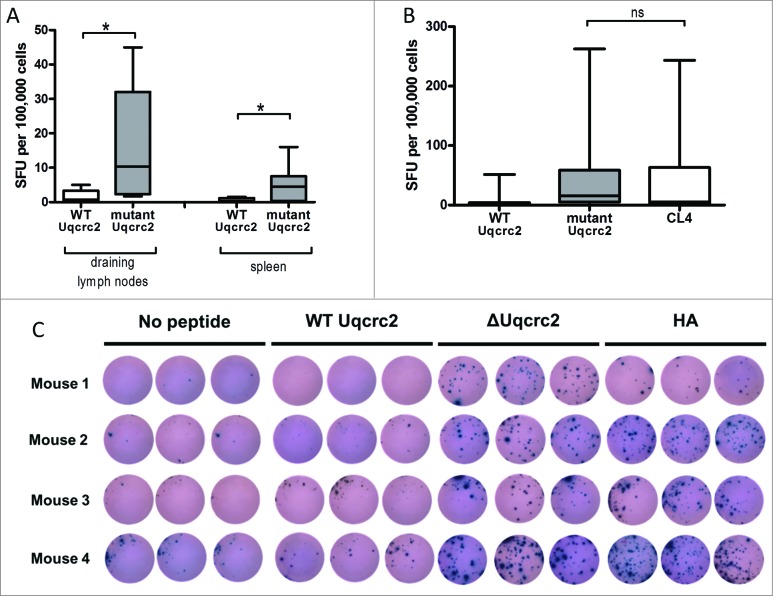
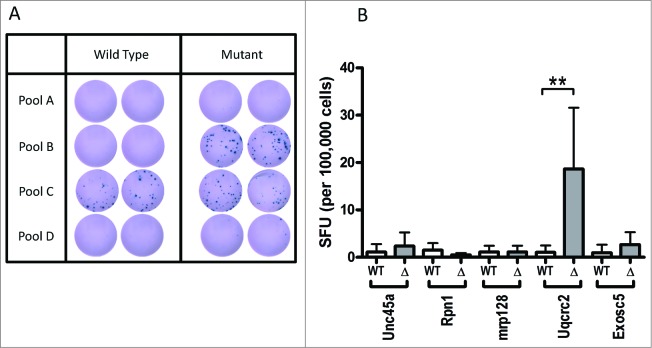
A key to improving cancer immunotherapy will be the identification of tumor-specific "neoantigens" that arise from mutations and augment the resultant host immune response. In this study we identified single nucleotide variants (SNVs) by RNA sequencing of asbestos-induced murine mesothelioma cell lines AB1 and AB1-HA. Using the NetMHCpan 2.8 algorithm, the theoretical binding affinity of predicted peptides arising from high-confidence, exonic, non-synonymous SNVs was determined for the BALB/c strain. The immunoreactivity to 20 candidate mutation-carrying peptides of increased affinity and the corresponding wild-type peptides was determined using interferon-γ ELISPOT assays and lymphoid organs of non-manipulated tumor-bearing mice. A strong endogenous immune response was demonstrated to one of the candidate neoantigens, Uqcrc2; this response was detected in the draining lymph node and spleen. Antigen reactive cells were not detected in non-tumor bearing mice. The magnitude of the response to the Uqcrc2 neoantigen was similar to that of the strong influenza hemagglutinin antigen, a model tumor neoantigen. This work confirms that the approach of RNAseq plus peptide prediction and ELISPOT testing is sufficient to identify natural tumor neoantigens.
改善癌症免疫疗法的关键在于识别由突变产生并增强宿主免疫反应的肿瘤特异性“新抗原”。在本研究中,我们通过对石棉诱导的小鼠间皮瘤细胞系AB1和AB1-HA进行RNA测序来识别单核苷酸变异(SNV)。使用NetMHCpan 2.8算法,确定了来自高可信度、外显子、非同义SNV的预测肽对BALB/c品系的理论结合亲和力。使用干扰素-γ ELISPOT检测法和未处理的荷瘤小鼠的淋巴器官,测定了对20种亲和力增加的携带突变肽及其相应野生型肽的免疫反应性。结果表明,对其中一种候选新抗原Uqcrc2存在强烈的内源性免疫反应;在引流淋巴结和脾脏中检测到了这种反应。在无瘤小鼠中未检测到抗原反应性细胞。对Uqcrc2新抗原的反应强度与强流感血凝素抗原(一种典型的肿瘤新抗原)相似。这项工作证实,RNA测序加肽预测和ELISPOT检测的方法足以识别天然肿瘤新抗原。