Rehm Jürgen, Allamani Allaman, Elekes Zsuzsanna, Jakubczyk Andrzej, Manthey Jakob, Probst Charlotte, Struzzo Pierluigi, Della Vedova Roberto, Gual Antoni, Wojnar Marcin
Centre for Addiction and Mental Health, 33 Russell Street, Toronto, ON, M5S 2S1, Canada.
Addiction Policy, Dalla Lana School of Public Health, University of Toronto, 155 College Street, 6th floor, Toronto, ON, M5T 3M7, Canada.
BMC Fam Pract. 2015 Jul 29;16:90. doi: 10.1186/s12875-015-0308-8.
Alcohol dependence (AD) in Europe is prevalent and causes considerable health burden. Recognition by general practitioners (GPs) and provision of or referral to treatment may contribute to reduce this burden. This paper studied AD prevalence in varying European primary care settings and examined who received treatment.
In a cross-sectional multi-centre study in six European countries, 358 general practitioners assessed 13,003 primary care patients between January 2013 and January 2014, of which 8,476 patients were interviewed, collecting information on socio-demographics, physical and mental problems, and on alcohol use, problems and treatment. AD diagnoses were determined by GPs' clinical judgement and a standardized interview. A wide definition for AD treatment included individual and group interventions provided by different health professionals. Descriptive as well as inferential statistics were employed.
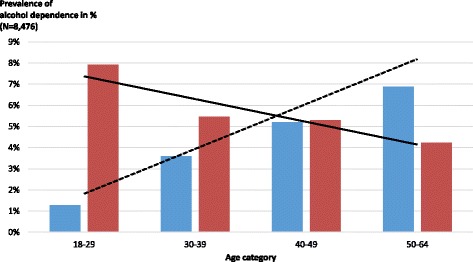
AD was prevalent among patients in European primary health care settings (8.7 %, 95 % confidence interval (CI): 8.1-9.3 %). Treatment rates were low (22.3 % of all AD cases, 95 % CI: 19.4-25.2 %). For both prevalence and treatment utilization, considerable country variations were observed. AD was associated with a number of socio-economic disadvantages (e.g. higher unemployment rate) and higher physical (e.g., liver disease, hypertension) and mental comorbidities (e.g., depression, anxiety). Liver problems, mental distress and daily amount of alcohol used were higher among treated versus untreated male patients with AD.
A minority of people identified as having AD received treatment, showing heavier drinking patterns and a higher level of co-morbidity. Different types of treatment, depending on severity of AD, should be considered.
酒精依赖在欧洲普遍存在,并造成相当大的健康负担。全科医生的识别以及提供治疗或转介治疗可能有助于减轻这一负担。本文研究了欧洲不同初级保健环境中的酒精依赖患病率,并调查了接受治疗的人群。
在一项对六个欧洲国家进行的横断面多中心研究中,358名全科医生在2013年1月至2014年1月期间对13003名初级保健患者进行了评估,其中8476名患者接受了访谈,收集了有关社会人口统计学、身体和精神问题以及饮酒、问题和治疗的信息。酒精依赖诊断由全科医生的临床判断和标准化访谈确定。酒精依赖治疗的广泛定义包括不同卫生专业人员提供的个体和团体干预。采用了描述性和推断性统计方法。
酒精依赖在欧洲初级卫生保健环境中的患者中普遍存在(8.7%,95%置信区间(CI):8.1-9.3%)。治疗率较低(占所有酒精依赖病例的22.3%,95%CI:19.4-25.2%)。在患病率和治疗利用率方面,均观察到相当大的国家差异。酒精依赖与一些社会经济劣势(如较高的失业率)以及更高的身体合并症(如肝病、高血压)和精神合并症(如抑郁症、焦虑症)相关。在接受治疗与未接受治疗的酒精依赖男性患者中,肝脏问题、精神困扰和每日饮酒量更高。
少数被确定患有酒精依赖的人接受了治疗,表现出更严重的饮酒模式和更高的合并症水平。应根据酒精依赖的严重程度考虑不同类型的治疗。