Kato Yusuke
Genetically Modified Organism Research Center, National Institute of Agrobiological Sciences , Tsukuba, Ibaraki , Japan.
PeerJ. 2015 Sep 15;3:e1247. doi: 10.7717/peerj.1247. eCollection 2015.
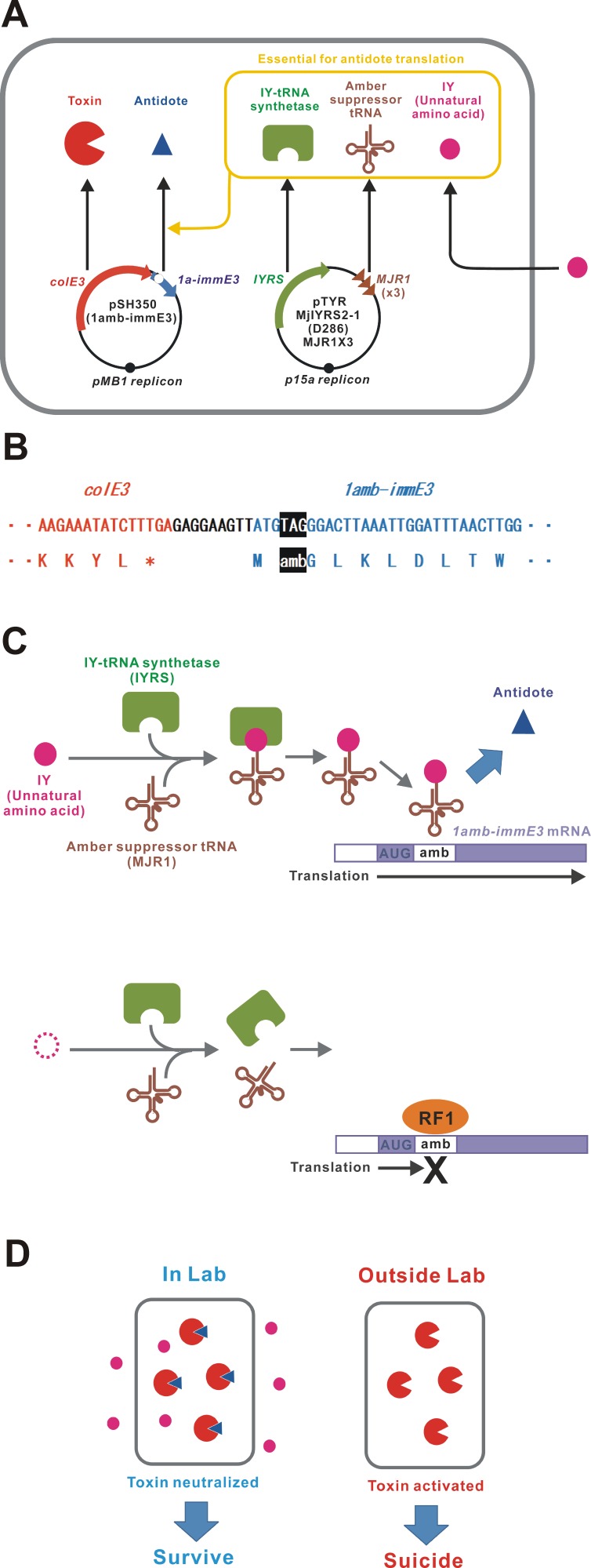
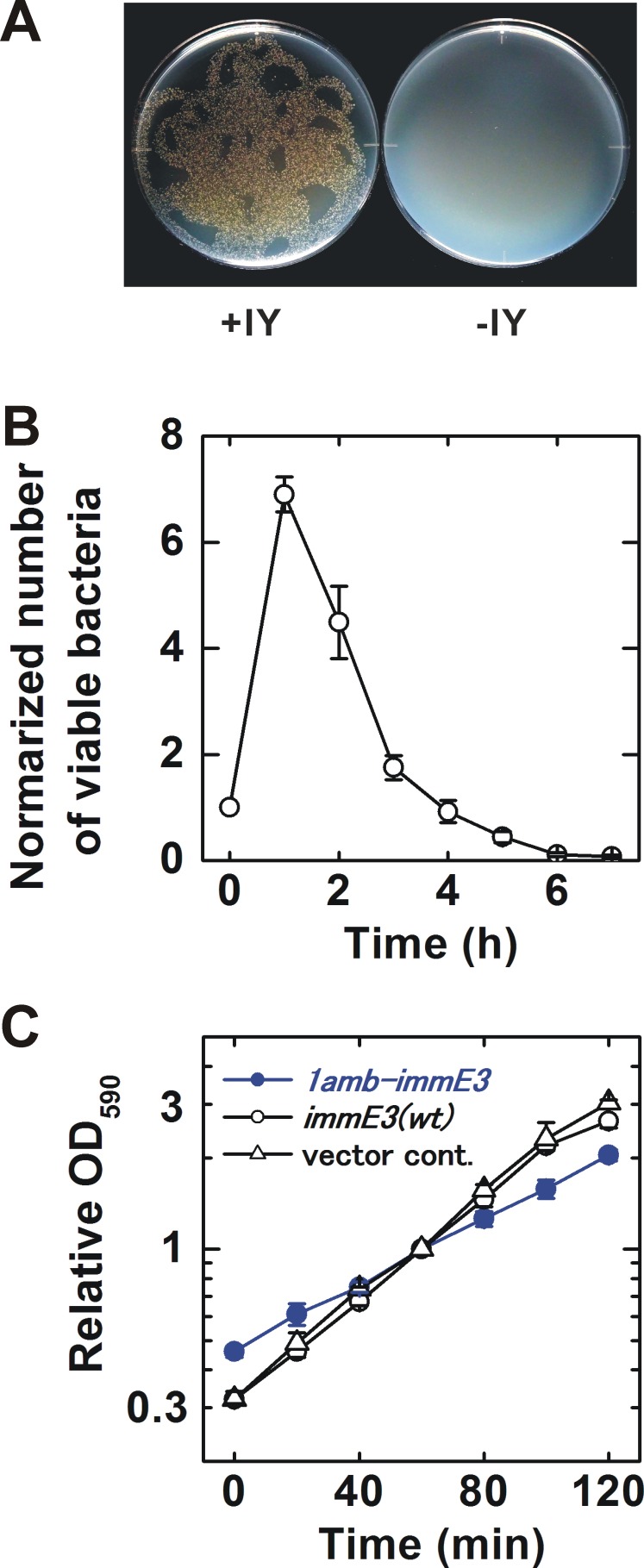
Biological containment is a genetic technique that programs dangerous organisms to grow only in the laboratory and to die in the natural environment. Auxotrophy for a substance not found in the natural environment is an ideal biological containment. Here, we constructed an Escherichia coli strain that cannot survive in the absence of the unnatural amino acid 3-iodo-L-tyrosine. This synthetic auxotrophy was achieved by conditional production of the antidote protein against the highly toxic enzyme colicin E3. An amber stop codon was inserted in the antidote gene. The translation of the antidote mRNA was controlled by a translational switch using amber-specific 3-iodo-L-tyrosine incorporation. The antidote is synthesized only when 3-iodo-L-tyrosine is present in the culture medium. The viability of this strain rapidly decreased with less than a 1 h half-life after removal of 3-iodo-L-tyrosine, suggesting that the decay of the antidote causes the host killing by activated colicin E3 in the absence of this unnatural amino acid. The contained strain grew 1.5 times more slowly than the parent strains. The escaper frequency was estimated to be 1.4 mutations (95% highest posterior density 1.1-1.8) per 10(5) cell divisions. This containment system can be constructed by only plasmid introduction without genome editing, suggesting that this system may be applicable to other microbes carrying toxin-antidote systems similar to that of colicin E3.
生物遏制是一种基因技术,可使危险生物体仅在实验室中生长,并在自然环境中死亡。对自然环境中不存在的物质的营养缺陷型是一种理想的生物遏制方式。在此,我们构建了一种大肠杆菌菌株,该菌株在缺乏非天然氨基酸3-碘-L-酪氨酸的情况下无法存活。这种合成营养缺陷型是通过有条件地产生针对剧毒酶大肠杆菌素E3的解毒蛋白来实现的。在解毒基因中插入了一个琥珀色终止密码子。解毒mRNA的翻译由一个使用琥珀色特异性3-碘-L-酪氨酸掺入的翻译开关控制。解毒剂仅在培养基中存在3-碘-L-酪氨酸时才会合成。去除3-碘-L-酪氨酸后,该菌株的活力迅速下降,半衰期不到1小时,这表明解毒剂的降解会导致在缺乏这种非天然氨基酸的情况下,活化的大肠杆菌素E3杀死宿主。被遏制的菌株生长速度比亲本菌株慢1.5倍。逃逸频率估计为每10⁵次细胞分裂发生1.4次突变(95%最高后验密度为1.1 - 1.8)。这种遏制系统仅通过质粒导入即可构建,无需进行基因组编辑,这表明该系统可能适用于其他携带类似于大肠杆菌素E3的毒素 - 解毒系统的微生物。