Borges Edson, Setti Amanda Souza, Braga Daniela Paes de Almeida Ferreira, Figueira Rita de Cassia Savio, Iaconelli Assumpto
Fertility, Centro de Fertilização Assistida, São Paulo, Brasil.
Instituto Sapientiae, Centro de Estudos e Pesquisa em Reprodução Humana Assistida, São Paulo, Brasil.
Int Braz J Urol. 2015 Jul-Aug;41(4):757-63. doi: 10.1590/S1677-5538.IBJU.2014.0186.
To investigate whether the semen quality of men undergoing conventional semen analysis is deteriorating over time.
We analyzed and compared the sperm count, motility and morphology of 2300 semen samples provided by males undergoing conventional seminal analysis, from years 2000 to 2002 and 2010 to 2012. The incidences of severe oligozoospermia and azoospermia over time were also compared.
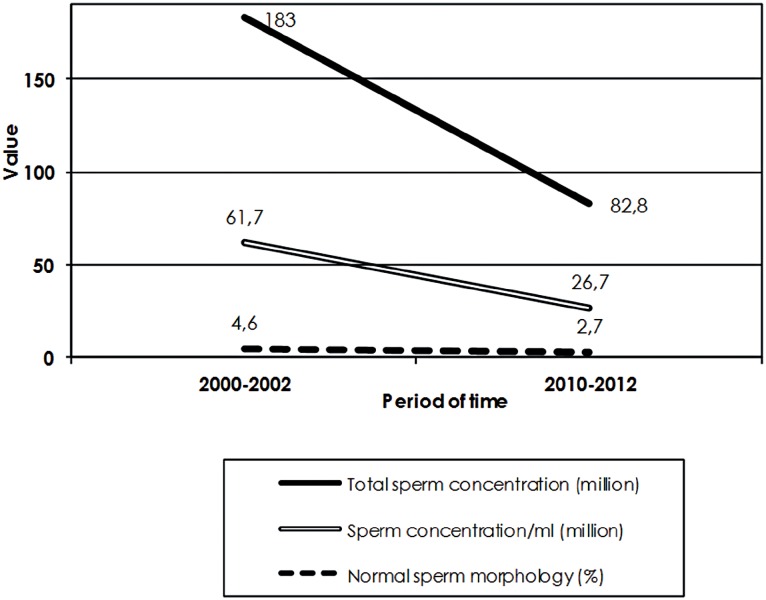
A total of 764 sperm samples were analyzed in 2000-2002 and 1536 in 2010-2012. Over time, the mean sperm concentration/ml decreased significantly from 61.7 million in 2000-2002 to 26.7 million in 2010-2012 (R2 = 11.4%, p < 0.001), the total sperm concentration decreased significantly from 183.0 million to 82.8 million (R2 = 11.3%, p < 0.001), and the percentage of normal forms decreased significantly from 4.6% to 2.7% (R2 = 9.8%, p < 0.001). The incidence of severe oligozoospermia significantly increased from 15.7% to 30.3% (OR: 1.09, p < 0.001) and the incidence of azoospermia increased from 4.9% to 8.5% (OR: 1.06, p = 0.001).
This study demonstrated a significant time-related decline in semen quality of infertile patients. This finding might have implications on fertility and emphasizes the need for further studies addressing subject's life-style in order to find and reduce the causative agents. Future prospective and multicenter studies including representative samples of the general population are needed to confirm whether semen quality is really declining.
研究接受常规精液分析的男性精液质量是否随时间推移而恶化。
我们分析并比较了2000年至2002年以及2010年至2012年期间接受常规精液分析的男性提供的2300份精液样本的精子数量、活力和形态。还比较了严重少精子症和无精子症随时间的发生率。
2000 - 2002年共分析了764份精子样本,2010 - 2012年分析了1536份。随着时间推移,每毫升平均精子浓度从2000 - 2002年的6170万显著降至2010 - 2012年的2670万(R2 = 11.4%,p < 0.001),总精子浓度从1.83亿显著降至8280万(R2 = 11.3%,p < 0.001),正常形态精子的百分比从4.6%显著降至2.7%(R2 = 9.8%,p < 0.001)。严重少精子症的发生率从15.7%显著增至30.3%(比值比:1.09,p < 0.001),无精子症的发生率从4.9%增至8.5%(比值比:1.06,p = 0.001)。
本研究表明不育患者的精液质量随时间显著下降。这一发现可能对生育有影响,并强调需要进一步研究受试者的生活方式以找出并减少致病因素。需要未来进行包括一般人群代表性样本的前瞻性多中心研究,以确认精液质量是否真的在下降。