Yadollah-Damavandi Soheila, Chavoshi-Nejad Mehdi, Jangholi Ehsan, Nekouyian Noushin, Hosseini Sahar, Seifaee Amin, Rafiee Shima, Karimi Hossein, Ashkani-Esfahani Soheil, Parsa Yekta, Mohsenikia Maryam
Young Researchers and Elite Club, Islamic Azad University, Tehran Medical Sciences Branch, Tehran, Iran.
Student Research Committee, Shahid Beheshti University of Medical Sciences, Tehran, Iran.
Evid Based Complement Alternat Med. 2015;2015:245328. doi: 10.1155/2015/245328. Epub 2015 Aug 31.
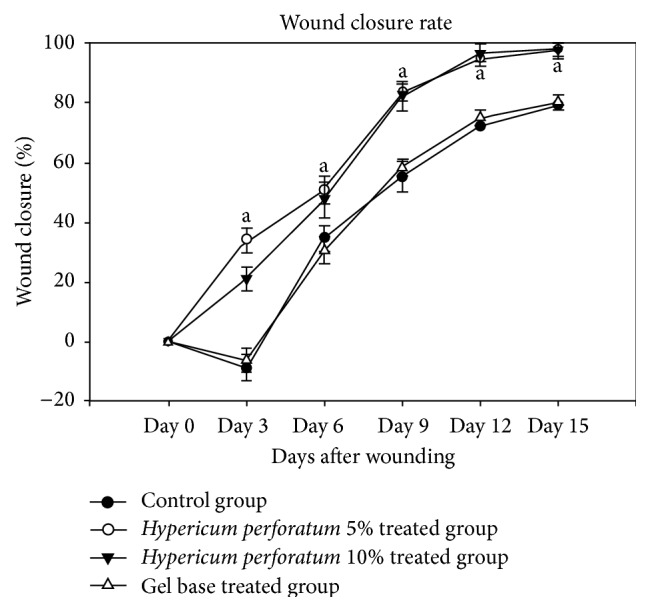
Delayed wound healing process is one of the most important concerns in diabetes. Healing of wounds has four phases, namely, hemostasis, inflammation, proliferation, and remodeling. For a successful repair, all four factors must occur properly. Hence, we aimed to evaluate the healing effects of Hypericum perforatum (HP) on full-thickness diabetic skin wounds by using stereological methods. Forty-eight female diabetic rats were randomly divided into four groups (n = 12): gel base treated group, HP 5% gel treated group, HP 10% gel treated group, and the control group which received no treatment. A circular 1 cm(2) full-thickness wound was created on the animal's neck and wound area was measured every three days. After sacrificing the animals, skin samples were fixed and prepared for stereological evaluations. Based on the results, HP treated group showed faster wound closure rate in comparison with control and vehicle groups (P < 0.05). In addition, numerical density of fibroblasts, volume density of collagen bundles, and mean diameter and volume densities of the vessels in HP group were significantly higher than control and vehicle groups. The results of this study showed that HP has the ability to improve tissue regeneration by enhancing fibroblast proliferation, collagen bundle synthesis, and revascularization.
伤口愈合延迟是糖尿病患者最为关注的重要问题之一。伤口愈合分为四个阶段,即止血、炎症、增殖和重塑。要实现成功修复,这四个阶段都必须正常进行。因此,我们旨在通过体视学方法评估贯叶连翘(HP)对糖尿病大鼠全层皮肤伤口的愈合效果。48只雌性糖尿病大鼠被随机分为四组(每组n = 12):凝胶基质处理组、5% HP凝胶处理组、10% HP凝胶处理组以及未接受任何处理的对照组。在动物颈部制造一个直径1平方厘米的全层伤口,每三天测量一次伤口面积。处死动物后,固定皮肤样本并准备进行体视学评估。结果显示,与对照组和凝胶基质组相比,HP处理组的伤口闭合速度更快(P < 0.05)。此外,HP组中成纤维细胞的数量密度、胶原束的体积密度以及血管的平均直径和体积密度均显著高于对照组和凝胶基质组。本研究结果表明,HP能够通过促进成纤维细胞增殖、胶原束合成和血管再生来改善组织再生。