Zhou Ya-Ning, Mu Yong-Ping, Fu Wen-Wei, Ning Bing-Bing, Du Guang-Li, Chen Jia-Mei, Sun Ming-Yu, Zhang Hua, Hu Yi-Yang, Liu Cheng-Hai, Xu Lie-Ming, Liu Ping
Institute of Liver Diseases, Shuguang Hospital, Shanghai University of Traditional Chinese Medicine, Shanghai, 201203, China.
Shanghai University of Traditional Chinese Medicine, Shanghai, 201203, China.
BMC Complement Altern Med. 2015 Oct 1;15:342. doi: 10.1186/s12906-015-0862-6.
Cirrhosis is associated with angiogenesis and disruption of hepatic vascular architecture. Yiguanjian (YGJ) decoction, a prescription from traditional Chinese medicine, is widely used for treating liver diseases. We studied whether YGJ or its ingredients (iYGJ) had an anti-angiogenic effect and explored possible mechanisms underlying this process.
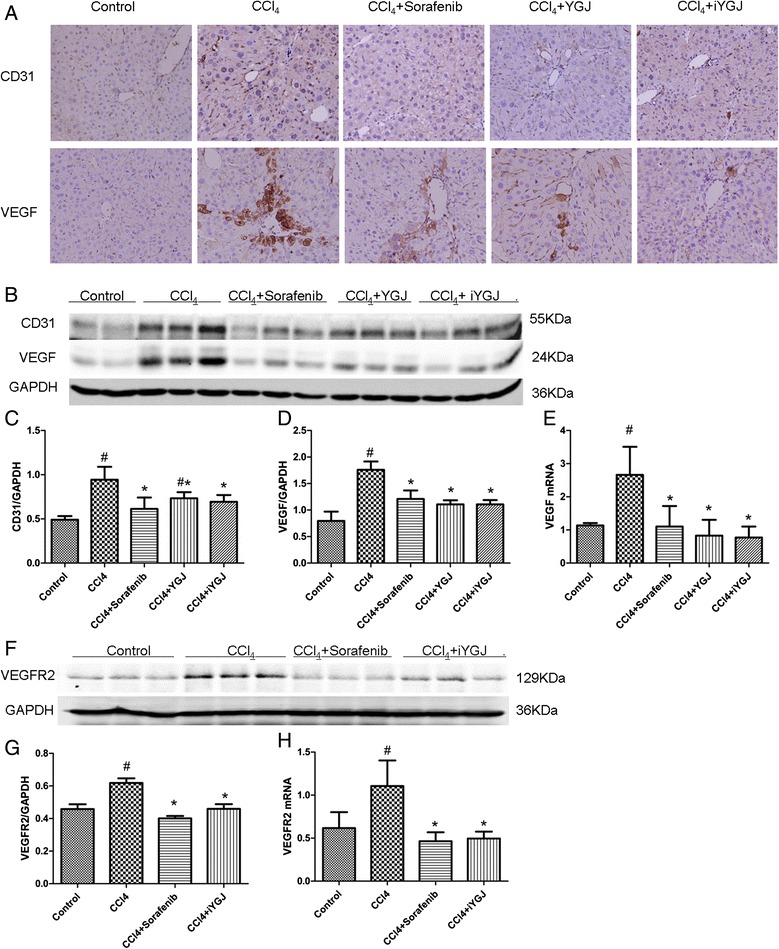
Cirrhosis was induced with carbon tetrachloride (CCl4) (ip) in C57BL/6 mice for 6 weeks. From week 4 to week 6, cirrhotic mice were randomly divided into four groups: sorafenib-treated, YGJ-treated and iYGJ-treated mice and placebo. Serum biochemistries, hydroxyproline (Hyp) content and histopathological changes of hepatic tissues were measured as were α-smooth muscle actin (α-SMA), collagen I, CD31, vascular endothelial growth factor (VEGF), VEGF receptor (VEGFR) 2 and hypoxia-inducible factor (HIF)-1α.
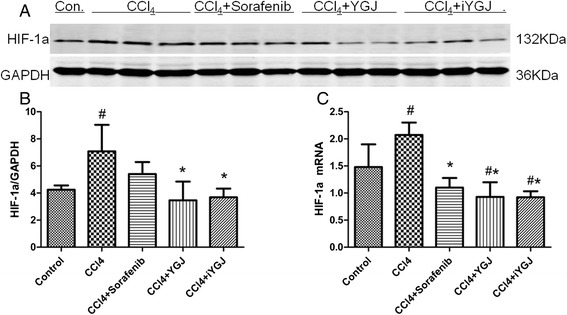
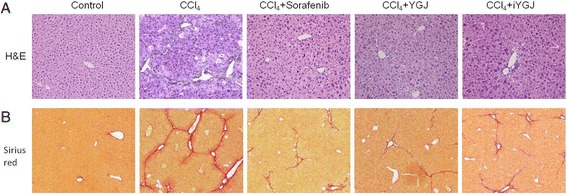
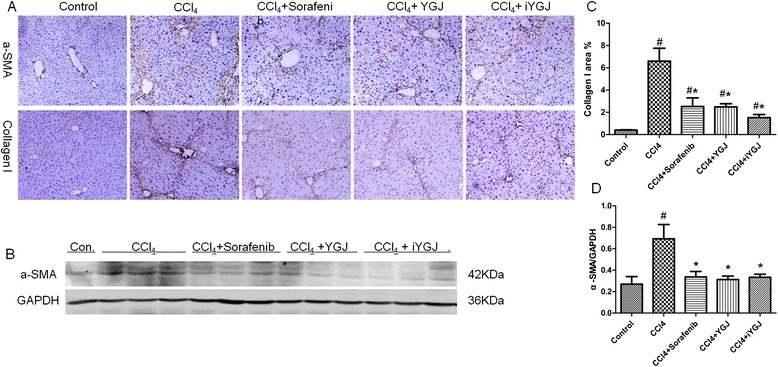
Both YGJ and iYGJ improved serum biochemistries. Changes of histopathology showed that YGJ and iYGJ reduced hepatic tissue necroinflammatory and collagen fiber deposition in cirrhosis mice. Compared to the CCl4 treated animals, Hyp, α-SMA, collagen I, CD31, VEGF, VEGFR, and HIF-1α expression decreased in YGJ and iYGJ groups.
YGJ and iYGJ inhibited liver angiogenesis in cirrhotic mice treated with CCl4 by inhibiting the HIF-1α/VEGF signaling pathway, suggesting that anti-angiogenic effects of YGJ and iYGJ are associated with improving the hepatic hypoxic microenvironment.
肝硬化与血管生成及肝血管结构破坏有关。中药方剂一贯煎(YGJ)广泛用于治疗肝脏疾病。我们研究了YGJ或其成分(iYGJ)是否具有抗血管生成作用,并探讨了这一过程的潜在机制。
采用四氯化碳(CCl4)腹腔注射诱导C57BL/6小鼠肝硬化6周。从第4周开始至第6周,将肝硬化小鼠随机分为四组:索拉非尼治疗组、YGJ治疗组、iYGJ治疗组和安慰剂组。检测血清生化指标、肝组织羟脯氨酸(Hyp)含量及组织病理学变化,以及α平滑肌肌动蛋白(α-SMA)、I型胶原、CD31、血管内皮生长因子(VEGF)、VEGF受体(VEGFR)2和缺氧诱导因子(HIF)-1α。
YGJ和iYGJ均改善了血清生化指标。组织病理学变化显示,YGJ和iYGJ减少了肝硬化小鼠肝组织的坏死性炎症和胶原纤维沉积。与CCl4处理的动物相比,YGJ和iYGJ组中Hyp、α-SMA、I型胶原、CD31、VEGF、VEGFR和HIF-**1α表达均降低。
YGJ和iYGJ通过抑制HIF-1α/VEGF信号通路抑制CCl4处理的肝硬化小鼠肝脏血管生成,提示YGJ和iYGJ的抗血管生成作用与改善肝脏缺氧微环境有关。