• 文献检索
  • 文档翻译
  • 深度研究
  • 学术资讯
  • Suppr Zotero 插件Zotero 插件
  • 邀请有礼
  • 套餐&价格
  • 历史记录
应用&插件
Suppr Zotero 插件Zotero 插件浏览器插件Mac 客户端Windows 客户端微信小程序
定价
高级版会员购买积分包购买API积分包
服务
文献检索文档翻译深度研究API 文档MCP 服务
关于我们
关于 Suppr公司介绍联系我们用户协议隐私条款
关注我们

Suppr 超能文献

核心技术专利:CN118964589B侵权必究
粤ICP备2023148730 号-1Suppr @ 2026

文献检索

告别复杂PubMed语法,用中文像聊天一样搜索,搜遍4000万医学文献。AI智能推荐,让科研检索更轻松。

立即免费搜索

文件翻译

保留排版,准确专业,支持PDF/Word/PPT等文件格式,支持 12+语言互译。

免费翻译文档

深度研究

AI帮你快速写综述,25分钟生成高质量综述,智能提取关键信息,辅助科研写作。

立即免费体验

中国西部的狂犬病病例有两个不同的起源。

Rabies Cases in the West of China Have Two Distinct Origins.

作者信息

Tao Xiao-Yan, Guo Zhen-Yang, Li Hao, Jiao Wen-Tao, Shen Xin-Xin, Zhu Wu-Yang, Rayner Simon, Tang Qing

机构信息

State Key Laboratory for Infectious Disease Prevention and Control, National Institute for Viral Disease Control and Prevention, Chinese Center for Disease Control and Prevention, Beijing, China; Collaborative Innovation Center for Diagnosis and Treatment of Infectious Diseases, Hangzhou, Zhejiang, China.

State Key Laboratory for Infectious Disease Prevention and Control, National Institute for Viral Disease Control and Prevention, Chinese Center for Disease Control and Prevention, Beijing, China.

出版信息

PLoS Negl Trop Dis. 2015 Oct 20;9(10):e0004140. doi: 10.1371/journal.pntd.0004140. eCollection 2015.

DOI:10.1371/journal.pntd.0004140
PMID:26484668
原文链接:https://pmc.ncbi.nlm.nih.gov/articles/PMC4618851/
Abstract

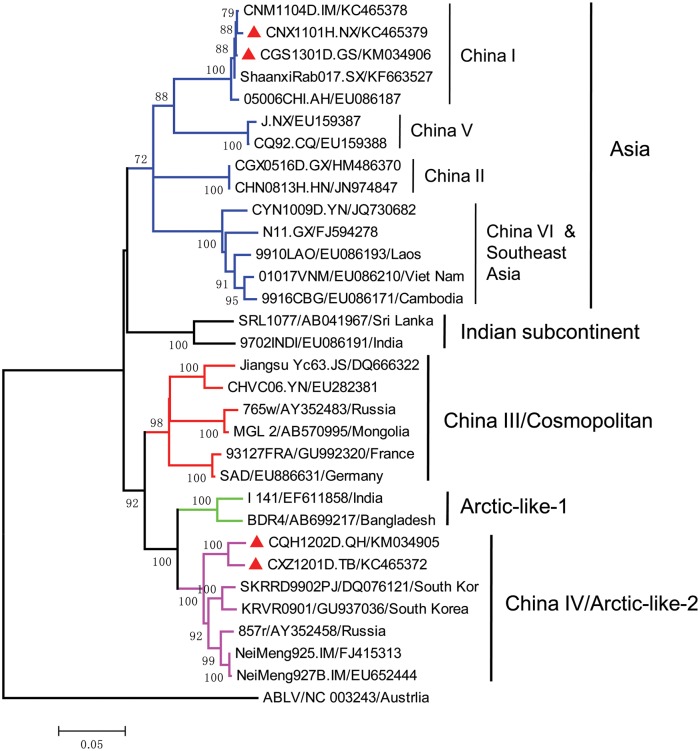
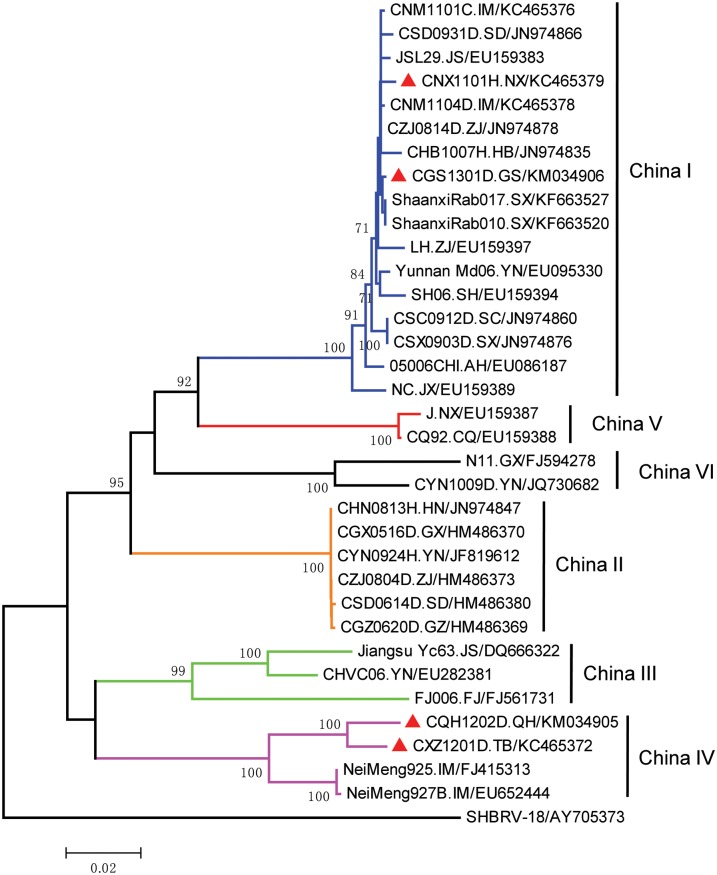
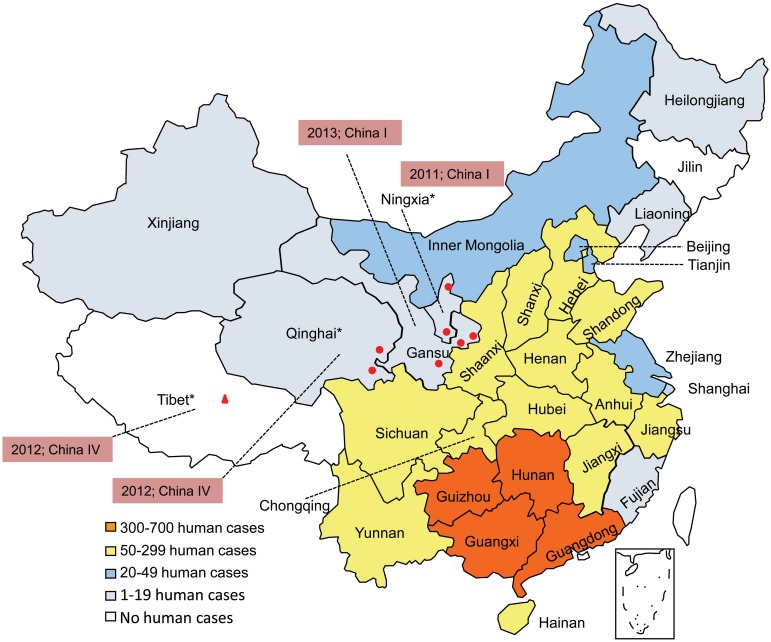
In China, rabies remains an ongoing threat to public health. Although control efforts have been effective in reducing the number of annual cases, the virus continues to spread into new areas. Tibet, Qinghai, Gansu and Ningxia in western China have, until recently, reported only a handful of events. However, since 2011, there have been increasing numbers of cases recorded in these areas. In this study, we report the collection and analysis of samples collected from these regions. We find that cases originate from two different sources. Strains collected from Gansu and Ningxia are closely related to the primary lineage associated with the current epizootic, whereas those from Tibet and Qinghai are related to the Arctic-like-2 lineage that is most commonly associated with wildlife cases in China. Thus, it appears that while the epizootic is beginning to encroach into Gansu and Ningxia, Tibet and Qinghai a significant number of rabies cases originate from wildlife.

摘要

在中国,狂犬病仍然是对公众健康的持续威胁。尽管防控措施在减少年度病例数量方面取得了成效,但病毒仍在继续蔓延至新的地区。中国西部的西藏、青海、甘肃和宁夏,直到最近仅报告了少数几起病例。然而,自2011年以来,这些地区记录的病例数量不断增加。在本研究中,我们报告了从这些地区收集和分析的样本情况。我们发现病例源自两个不同的来源。从甘肃和宁夏收集的毒株与当前 epizootic 相关的主要谱系密切相关,而来自西藏和青海的毒株则与在中国最常与野生动物病例相关的北极样-2谱系有关。因此,虽然 epizootic 开始侵入甘肃和宁夏,但西藏和青海的大量狂犬病病例源自野生动物。
https://cdn.ncbi.nlm.nih.gov/pmc/blobs/34db/4618851/da680620fdc8/pntd.0004140.g003.jpg
https://cdn.ncbi.nlm.nih.gov/pmc/blobs/34db/4618851/190e86ed0a49/pntd.0004140.g001.jpg
https://cdn.ncbi.nlm.nih.gov/pmc/blobs/34db/4618851/5dddf6b1e456/pntd.0004140.g002.jpg
https://cdn.ncbi.nlm.nih.gov/pmc/blobs/34db/4618851/da680620fdc8/pntd.0004140.g003.jpg
https://cdn.ncbi.nlm.nih.gov/pmc/blobs/34db/4618851/190e86ed0a49/pntd.0004140.g001.jpg
https://cdn.ncbi.nlm.nih.gov/pmc/blobs/34db/4618851/5dddf6b1e456/pntd.0004140.g002.jpg
https://cdn.ncbi.nlm.nih.gov/pmc/blobs/34db/4618851/da680620fdc8/pntd.0004140.g003.jpg

相似文献

1
Rabies Cases in the West of China Have Two Distinct Origins.中国西部的狂犬病病例有两个不同的起源。
PLoS Negl Trop Dis. 2015 Oct 20;9(10):e0004140. doi: 10.1371/journal.pntd.0004140. eCollection 2015.
2
The reemergence of human rabies and emergence of an Indian subcontinent lineage in Tibet, China.中国西藏地区出现人狂犬病重现和印度次大陆谱系的出现。
PLoS Negl Trop Dis. 2019 Jan 14;13(1):e0007036. doi: 10.1371/journal.pntd.0007036. eCollection 2019 Jan.
3
Molecular characterization of viral G gene in emerging and re-emerging areas of rabies in China, 2007 to 2011.2007 年至 2011 年中国新兴和再现狂犬病地区病毒 G 基因的分子特征。
Virol Sin. 2012 Jun;27(3):194-203. doi: 10.1007/s12250-012-3248-7. Epub 2012 Jun 9.
4
Evolutionary dynamics of rabies viruses highlights the importance of China rabies transmission in Asia.狂犬病病毒的进化动态突显了中国在亚洲狂犬病传播中的重要性。
Virology. 2011 Feb 20;410(2):403-9. doi: 10.1016/j.virol.2010.12.011. Epub 2010 Dec 30.
5
Molecular phylodynamic analysis indicates lineage displacement occurred in Chinese rabies epidemics between 1949 to 2010.分子系统发育分析表明,1949 年至 2010 年间,中国的狂犬病疫情发生了谱系替代。
PLoS Negl Trop Dis. 2013 Jul 11;7(7):e2294. doi: 10.1371/journal.pntd.0002294. Print 2013.
6
Molecular epidemiology of rabies virus isolates in Uganda.乌干达狂犬病病毒分离株的分子流行病学。
Virus Res. 2010 Jan;147(1):135-8. doi: 10.1016/j.virusres.2009.10.003. Epub 2009 Oct 26.
7
Molecular characterization of rabies virus isolated from dogs in Tunisia: evidence of two phylogenetic variants.从突尼斯犬分离的狂犬病病毒的分子特征:两种系统发育变异的证据。
Virus Res. 2011 Jun;158(1-2):246-50. doi: 10.1016/j.virusres.2010.10.015. Epub 2010 Oct 21.
8
Genetic evidence for domestic raccoon dog rabies caused by Arctic-like rabies virus in Inner Mongolia, China.中国内蒙古由北极样狂犬病病毒引起的家养浣熊狂犬病的遗传证据。
Epidemiol Infect. 2011 Apr;139(4):629-35. doi: 10.1017/S0950268810001263. Epub 2010 Jun 14.
9
Molecular epidemiology of rabies virus in Romania provides evidence for a high degree of heterogeneity and virus diversity.罗马尼亚的狂犬病病毒分子流行病学提供了高度异质性和病毒多样性的证据。
Virus Res. 2010 Jun;150(1-2):28-33. doi: 10.1016/j.virusres.2010.02.008. Epub 2010 Feb 21.
10
Molecular epidemiology of rabies virus in Vietnam (2006-2009).越南狂犬病病毒的分子流行病学(2006-2009 年)。
Jpn J Infect Dis. 2011;64(5):391-6.

引用本文的文献

1
A Comprehensive Analysis and Forecast of Rabies Epidemic and Elimination Challenges - China, 2005-2023.2005 - 2023年中国狂犬病流行及消除挑战的综合分析与预测
China CDC Wkly. 2025 Jul 18;7(29):967-972. doi: 10.46234/ccdcw2025.163.
2
Genetic characteristics and geographic distribution of rabies virus in China.中国狂犬病病毒的遗传特征与地理分布
Arch Virol. 2023 Dec 29;169(1):14. doi: 10.1007/s00705-023-05947-8.
3
A Descriptive Analysis of Human Rabies in Mainland China, 2005-2020.中国大陆 2005-2020 年狂犬病描述性分析。

本文引用的文献

1
Human rabies surveillance and control in China, 2005-2012.2005 - 2012年中国人类狂犬病监测与防控
BMC Infect Dis. 2014 Apr 18;14:212. doi: 10.1186/1471-2334-14-212.
2
Molecular phylodynamic analysis indicates lineage displacement occurred in Chinese rabies epidemics between 1949 to 2010.分子系统发育分析表明,1949 年至 2010 年间,中国的狂犬病疫情发生了谱系替代。
PLoS Negl Trop Dis. 2013 Jul 11;7(7):e2294. doi: 10.1371/journal.pntd.0002294. Print 2013.
3
National borders effectively halt the spread of rabies: the current rabies epidemic in China is dislocated from cases in neighboring countries.
Int J Environ Res Public Health. 2022 Dec 26;20(1):380. doi: 10.3390/ijerph20010380.
4
Knowledge, attitudes and practices regarding to rabies and its prevention and control among bite victims by suspected rabid animals in China.中国疑似狂犬病动物咬伤受害者对狂犬病及其预防控制的知识、态度和行为
One Health. 2021 May 8;13:100264. doi: 10.1016/j.onehlt.2021.100264. eCollection 2021 Dec.
5
Neglected challenges in the control of animal rabies in China.中国动物狂犬病防控中被忽视的挑战。
One Health. 2021 Jan 5;12:100212. doi: 10.1016/j.onehlt.2021.100212. eCollection 2021 Jun.
6
Molecular evolutionary analysis reveals Arctic-like rabies viruses evolved and dispersed independently in North and South Asia.分子进化分析揭示了类似北极的狂犬病病毒在北亚和南亚独立进化和传播。
J Vet Sci. 2021 Jan;22(1):e5. doi: 10.4142/jvs.2021.22.e5.
7
Animal Rabies Surveillance, China, 2004-2018.中国 2004-2018 年动物狂犬病监测。
Emerg Infect Dis. 2020 Dec;26(12):2825-2834. doi: 10.3201/eid2612.200303.
8
Human rabies in China: evidence-based suggestions for improved case detection and data gathering.中国的狂犬病:基于证据的建议,以改善病例检测和数据收集。
Infect Dis Poverty. 2020 Jun 1;9(1):60. doi: 10.1186/s40249-020-00672-9.
9
The reemergence of human rabies and emergence of an Indian subcontinent lineage in Tibet, China.中国西藏地区出现人狂犬病重现和印度次大陆谱系的出现。
PLoS Negl Trop Dis. 2019 Jan 14;13(1):e0007036. doi: 10.1371/journal.pntd.0007036. eCollection 2019 Jan.
10
Rabies Outbreaks and Vaccination in Domestic Camels and Cattle in Northwest China.中国西北地区的家养骆驼和牛中的狂犬病爆发和疫苗接种。
PLoS Negl Trop Dis. 2016 Sep 1;10(9):e0004890. doi: 10.1371/journal.pntd.0004890. eCollection 2016 Sep.
国界有效地阻止了狂犬病的传播:中国目前的狂犬病疫情与邻国的病例脱节。
PLoS Negl Trop Dis. 2013;7(1):e2039. doi: 10.1371/journal.pntd.0002039. Epub 2013 Jan 31.
4
Arenavirus variations due to host-specific adaptation.沙粒病毒由于宿主特异性适应而发生变异。
Viruses. 2013 Jan 17;5(1):241-78. doi: 10.3390/v5010241.
5
Molecular characterization of viral G gene in emerging and re-emerging areas of rabies in China, 2007 to 2011.2007 年至 2011 年中国新兴和再现狂犬病地区病毒 G 基因的分子特征。
Virol Sin. 2012 Jun;27(3):194-203. doi: 10.1007/s12250-012-3248-7. Epub 2012 Jun 9.
6
The spatial and temporal dynamics of rabies in China.中国狂犬病的时空动态。
PLoS Negl Trop Dis. 2012;6(5):e1640. doi: 10.1371/journal.pntd.0001640. Epub 2012 May 1.
7
Analysis on factors related to rabies epidemic in China from 2007-2011.2007-2011 年中国狂犬病流行相关因素分析。
Virol Sin. 2012 Apr;27(2):132-43. doi: 10.1007/s12250-012-3244-y. Epub 2012 Apr 11.
8
Genetic evidence for domestic raccoon dog rabies caused by Arctic-like rabies virus in Inner Mongolia, China.中国内蒙古由北极样狂犬病病毒引起的家养浣熊狂犬病的遗传证据。
Epidemiol Infect. 2011 Apr;139(4):629-35. doi: 10.1017/S0950268810001263. Epub 2010 Jun 14.
9
Epidemiological investigations of human rabies in China.中国的狂犬病流行病学调查。
BMC Infect Dis. 2009 Dec 21;9:210. doi: 10.1186/1471-2334-9-210.
10
Molecular epidemiology of rabies in Southern People's Republic of China.中华人民共和国南方地区狂犬病的分子流行病学
Emerg Infect Dis. 2009 Aug;15(8):1192-8. doi: 10.3201/eid1508.081551.