Benda Nathalie M M, Seeger Joost P H, Stevens Guus G C F, Hijmans-Kersten Bregina T P, van Dijk Arie P J, Bellersen Louise, Lamfers Evert J P, Hopman Maria T E, Thijssen Dick H J
Radboud university medical center, Radboud Institute for Health Sciences, Department of Physiology, Nijmegen, the Netherlands.
Radboud university medical center, Radboud Institute for Health Sciences, Department of Physiology, Nijmegen, the Netherlands; Liverpool John Moores University, Research Institute for Sport and Exercise Sciences, Liverpool, United Kingdom.
PLoS One. 2015 Oct 30;10(10):e0141256. doi: 10.1371/journal.pone.0141256. eCollection 2015.
Physical fitness is an important prognostic factor in heart failure (HF). To improve fitness, different types of exercise have been explored, with recent focus on high-intensity interval training (HIT). We comprehensively compared effects of HIT versus continuous training (CT) in HF patients NYHA II-III on physical fitness, cardiovascular function and structure, and quality of life, and hypothesize that HIT leads to superior improvements compared to CT.
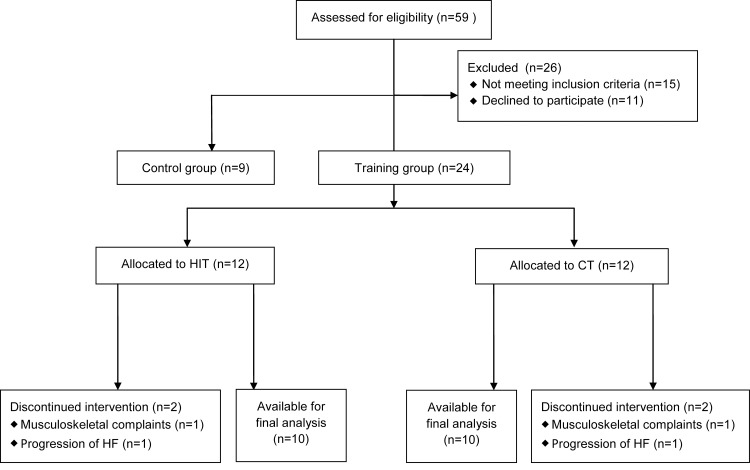
Twenty HF patients (male:female 19:1, 64±8 yrs, ejection fraction 38±6%) were allocated to 12-weeks of HIT (10*1-minute at 90% maximal workload-alternated by 2.5 minutes at 30% maximal workload) or CT (30 minutes at 60-75% of maximal workload). Before and after intervention, we examined physical fitness (incremental cycling test), cardiac function and structure (echocardiography), vascular function and structure (ultrasound) and quality of life (SF-36, Minnesota living with HF questionnaire (MLHFQ)).
Training improved maximal workload, peak oxygen uptake (VO2peak) related to the predicted VO2peak, oxygen uptake at the anaerobic threshold, and maximal oxygen pulse (all P<0.05), whilst no differences were present between HIT and CT (N.S.). We found no major changes in resting cardiovascular function and structure. SF-36 physical function score improved after training (P<0.05), whilst SF-36 total score and MLHFQ did not change after training (N.S.).
Training induced significant improvements in parameters of physical fitness, although no evidence for superiority of HIT over CT was demonstrated. No major effect of training was found on cardiovascular structure and function or quality of life in HF patients NYHA II-III.
Nederlands Trial Register NTR3671.
体能是心力衰竭(HF)的一个重要预后因素。为了提高体能,人们探索了不同类型的运动,近期重点关注高强度间歇训练(HIT)。我们全面比较了HIT与持续训练(CT)对纽约心脏协会(NYHA)心功能II - III级HF患者体能、心血管功能与结构以及生活质量的影响,并假设HIT相较于CT能带来更显著的改善。
20例HF患者(男:女 = 19:1,64±8岁,射血分数38±6%)被分配至12周的HIT组(90%最大负荷下进行10次1分钟训练,期间穿插30%最大负荷下2.5分钟训练)或CT组(60 - 75%最大负荷下进行30分钟训练)。干预前后,我们检测了体能(递增式自行车测试)、心功能与结构(超声心动图)、血管功能与结构(超声)以及生活质量(SF - 36量表、明尼苏达心力衰竭生活问卷(MLHFQ))。
训练提高了最大负荷、与预测最大摄氧量(VO₂peak)相关的峰值摄氧量(VO₂peak)、无氧阈摄氧量以及最大氧脉搏(均P<0.05),但HIT组与CT组之间无差异(无统计学意义)。我们发现静息心血管功能与结构无重大变化。训练后SF - 36身体功能评分改善(P<0.05),而训练后SF - 36总分及MLHFQ未改变(无统计学意义)。
训练使体能参数有显著改善,尽管未证明HIT优于CT。未发现训练对NYHA心功能II - III级HF患者的心血管结构与功能或生活质量有重大影响。
荷兰试验注册编号NTR3671。