Santos Nuno, Almeida Virgílio, Gortázar Christian, Correia-Neves Margarida
Life and Health Sciences Research Institute (ICVS), School of Health Sciences, University of Minho, Braga, Portugal.
ICVS/3B's, PT Government Associate Laboratory, Braga, Portugal.
Vet Res. 2015 Oct 30;46:129. doi: 10.1186/s13567-015-0270-4.
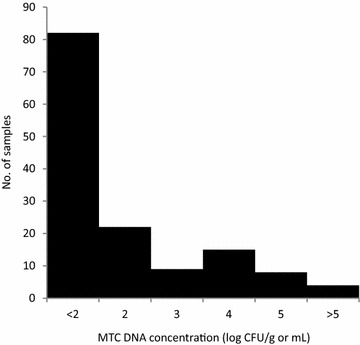
Wild boar (Sus scrofa) and red deer (Cervus elaphus) are the main maintenance hosts for bovine tuberculosis (bTB) in continental Europe. Understanding Mycobacterium tuberculosis complex (MTC) excretion routes is crucial to define strategies to control bTB in free-ranging populations, nevertheless available information is scarce. Aiming at filling this gap, four different MTC excretion routes (oronasal, bronchial-alveolar, fecal and urinary) were investigated by molecular methods in naturally infected hunter-harvested wild boar and red deer. In addition MTC concentrations were estimated by the Most Probable Number method. MTC DNA was amplified in all types of excretion routes. MTC DNA was amplified in at least one excretion route from 83.0% (CI95 70.8-90.8) of wild ungulates with bTB-like lesions. Oronasal or bronchial-alveolar shedding were detected with higher frequency than fecal shedding (p < 0.001). The majority of shedders yielded MTC concentrations <10(3) CFU/g or mL. However, from those ungulates from which oronasal, bronchial-alveolar and fecal samples were available, 28.2% of wild boar (CI95 16.6-43.8) and 35.7% of red deer (CI95 16.3-61.2) yielded MTC concentrations >10(3) CFU/g or mL (referred here as super-shedders). Red deer have a significantly higher risk of being super-shedders compared to wild boar (OR = 11.8, CI95 2.3-60.2). The existence of super-shedders among the naturally infected population of wild boar and red deer is thus reported here for the first time and MTC DNA concentrations greater than the minimum infective doses were estimated in excretion samples from both species.
野猪(Sus scrofa)和马鹿(Cervus elaphus)是欧洲大陆牛结核病(bTB)的主要维持宿主。了解结核分枝杆菌复合群(MTC)的排泄途径对于确定控制散养动物群体中牛结核病的策略至关重要,然而现有信息匮乏。为填补这一空白,通过分子方法对自然感染的、猎人捕获的野猪和马鹿的四种不同MTC排泄途径(口鼻、支气管肺泡、粪便和尿液)进行了研究。此外,采用最可能数法估计了MTC浓度。在所有类型的排泄途径中均扩增出了MTC DNA。在至少一种排泄途径中,83.0%(95%置信区间70.8 - 90.8)患有类牛结核病变的野生有蹄类动物扩增出了MTC DNA。口鼻或支气管肺泡排菌的检出频率高于粪便排菌(p < 0.001)。大多数排菌者的MTC浓度<10³ CFU/g或mL。然而,在那些可获得口鼻、支气管肺泡和粪便样本的有蹄类动物中,28.2%(95%置信区间16.6 - 43.8)的野猪和35.7%(95%置信区间16.3 - 61.2)的马鹿MTC浓度>10³ CFU/g或mL(此处称为超级排菌者)。与野猪相比,马鹿成为超级排菌者的风险显著更高(比值比=11.8,95%置信区间2.3 - 60.2)。本文首次报道了自然感染的野猪和马鹿群体中存在超级排菌者,并在两个物种的排泄样本中估计出了高于最小感染剂量的MTC DNA浓度。