Liu Bian, Taioli Emanuela
Department of Population Health Science and Policy, Icahn School of Medicine at Mount Sinai, and Institute for Translational Epidemiology, New York, New York, United States of America.
PLoS One. 2015 Nov 6;10(11):e0142382. doi: 10.1371/journal.pone.0142382. eCollection 2015.
Recent studies reported seasonal differences in gene expression in white blood cells, adipose tissue, and inflammatory biomarkers of the immune system. There is no data on the seasonal variations of these biomarkers in the US general population of both children and adults. Then aim of this study is to explore the seasonal trends in complete blood count (CBC), and C-reactive protein (CRP) in a large non-institutionalized US population.
Seven cross-sectional data collected in the National Health and Nutrition Examination Survey (NHANES) during 1999-2012 were aggregated; participants reporting recent use of prescribed steroids, chemotherapy, immunomodulators and antibiotics were excluded. Linear regression models were used to compare levels of CBC and CRP between winter-spring (November-April) and summer-fall (May-October), adjusting for demographics, personal behavioral factors, and chronic disease conditions.
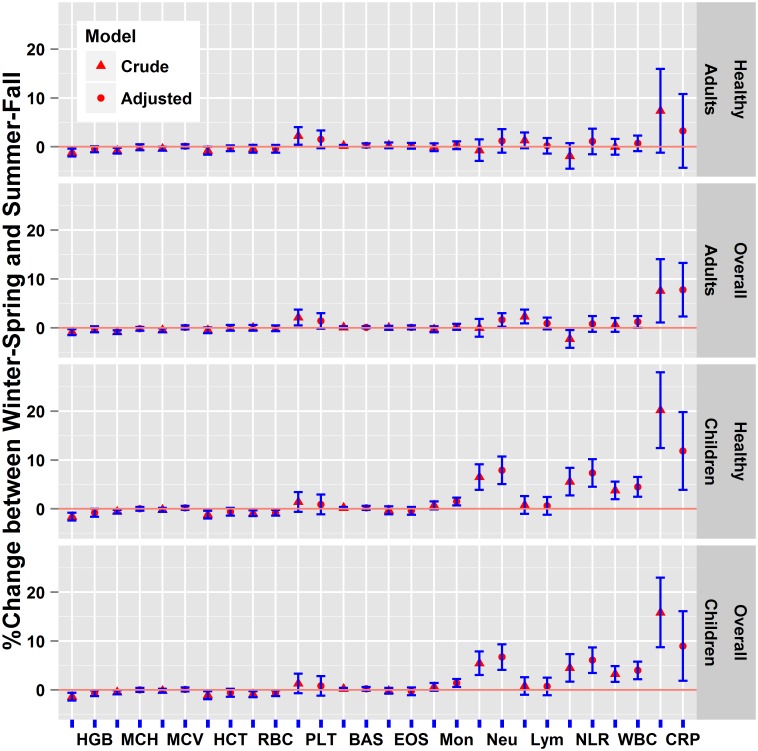
A total of 27,478 children and 36,644 adults (≥18 years) were included in the study. Levels of neutrophils, white blood cell count (WBC), and CRP were higher in winter-spring than summer-fall (p≤0.05). Red blood cell components were lower in winter-spring than in summer-fall, while the opposite was seen for platelets.
This large population-based study found notable seasonal variations in blood cell composition and inflammatory biomarkers, with a more pro-inflammatory immune system seen in winter-spring than summer-fall. The red blood cell patterns could have implications for the observed cardio-vascular seasonality.
近期研究报道了白细胞、脂肪组织和免疫系统炎症生物标志物的基因表达存在季节性差异。在美国儿童和成人的普通人群中,尚无关于这些生物标志物季节性变化的数据。本研究的目的是探讨美国大量非机构化人群中全血细胞计数(CBC)和C反应蛋白(CRP)的季节性趋势。
汇总了1999年至2012年期间在国家健康与营养检查调查(NHANES)中收集的七项横断面数据;排除了报告近期使用过处方类固醇、化疗、免疫调节剂和抗生素的参与者。使用线性回归模型比较冬春季节(11月至4月)和夏秋季节(5月至10月)之间的CBC和CRP水平,并对人口统计学、个人行为因素和慢性病状况进行了调整。
本研究共纳入27478名儿童和36644名成年人(≥18岁)。冬春季节的中性粒细胞、白细胞计数(WBC)和CRP水平高于夏秋季节(p≤0.05)。冬春季节的红细胞成分低于夏秋季节,而血小板则相反。
这项基于大量人群的研究发现血细胞组成和炎症生物标志物存在显著的季节性变化,冬春季节的免疫系统比夏秋季节更具促炎作用。红细胞模式可能对观察到的心血管季节性有影响。