Huang Jinbo, Yu Yinghua, Wei Changyuan, Qin Qinghong, Mo Qinguo, Yang Weiping
The Department of Breast Surgery, Affiliated Tumor Hospital of Guangxi Medical University, Nanning, Guangxi, People's Republic of China.
The Department of Ultrasound Diagnosis, Affiliated Tumor Hospital of Guangxi Medical University, Nanning, Guangxi, People's Republic of China.
PLoS One. 2015 Nov 6;10(11):e0142271. doi: 10.1371/journal.pone.0142271. eCollection 2015.
Despite the common use of conventional electrocautery in modified radical mastectomy for breast cancer, the harmonic scalpel is recently emerging as a dominant surgical instrument for dissection and haemostasis, which is thought to reduce the morbidity, such as seroma and blood loss. But the results of published trials are inconsistent. So we made the meta-analysis to assess the intraoperative and postoperative endpoints among women undergoing modified radical mastectomy with harmonic scalpel or electrocautery.
A comprehensive literature search of case-control studies from PubMed, MEDLINE, EMBASE and Cochrane Library databases involving modified radical mastectomy with harmonic scalpel or electrocautery was performed. We carried out a meta-analysis of primary endpoints including postoperative drainage, seroma development, intraoperative blood loss and secondly endpoints including operative time and wound complications. We used odds ratios (ORs) with 95% confidence intervals (CIs) to evaluate the effect size for categorical outcomes and standardised mean differences (SMDs) for continuous outcomes.
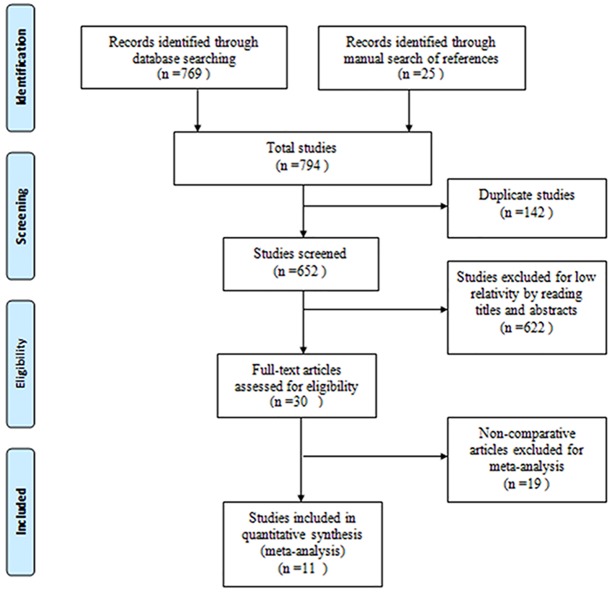
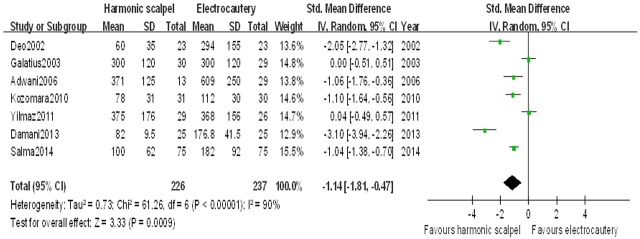
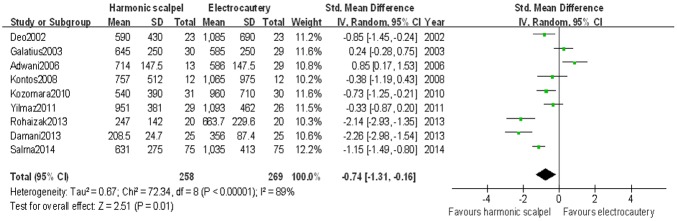
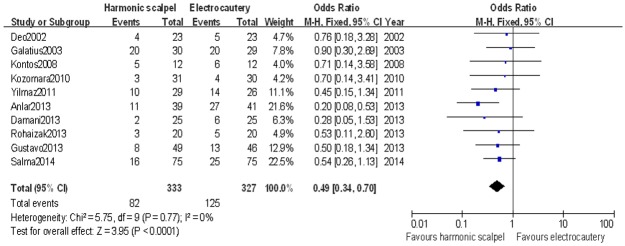
A total of 11 studies with 702 patients were included for this meta-analysis. There was significant difference in total postoperative drainage (SMD: -0.74 [95%CI: -1.31, -0.16]; P< 0.01), seroma development[OR: 0.49 (0.34, 0.70); P < 0.01], intraoperative blood loss(SMD: -1.14 [95%CI: -1.81,-0.47]; P < 0.01) and wound complications [OR: 0.38 (0.24, 0.59); P < 0.01] between harmonic scalpel dissection and standard electrocautery in modified radical mastectomy for breast cancer. No difference was found as for operative time between harmonic scalpel dissection and standard electrocautery (SMD: 0.04 [95%CI: -0.41, 0.50]; P = 0.85).
Compared to standard electrocautery, harmonic scalpel dissection presents significant advantages in decreasing postoperative drainage, seroma development, intraoperative blood loss and wound complications in modified radical mastectomy for breast cancer, without increasing operative time. Harmonic scalpel can be recommended as a preferential surgical instrument in modified radical mastectomy.
尽管传统电灼术在乳腺癌改良根治术中常用,但谐波手术刀最近正成为一种主要的用于解剖和止血的手术器械,据认为它可降低诸如血清肿和失血等发病率。但已发表试验的结果并不一致。因此,我们进行了荟萃分析,以评估接受谐波手术刀或电灼术的乳腺癌改良根治术女性患者的术中和术后终点。
对来自PubMed、MEDLINE、EMBASE和Cochrane图书馆数据库的涉及谐波手术刀或电灼术的乳腺癌改良根治术的病例对照研究进行全面文献检索。我们对主要终点进行了荟萃分析,包括术后引流、血清肿形成、术中失血,次要终点包括手术时间和伤口并发症。我们使用具有95%置信区间(CI)的比值比(OR)来评估分类结局的效应大小,使用标准化均数差(SMD)来评估连续结局的效应大小。
本荟萃分析共纳入11项研究,702例患者。在乳腺癌改良根治术中,谐波手术刀解剖与标准电灼术相比,术后总引流量(SMD:-0.74 [95%CI:-1.31,-0.16];P<0.01)、血清肿形成[OR:0.49(0.34,0.70);P<0.01]、术中失血(SMD:-1.14 [95%CI:-1.81,-0.47];P<0.01)和伤口并发症[OR:0.38(0.24,0.59);P<0.01]有显著差异。谐波手术刀解剖与标准电灼术在手术时间方面未发现差异(SMD:0.04 [95%CI:-0.41,0.50];P = 0.85)。
与标准电灼术相比,谐波手术刀解剖在减少乳腺癌改良根治术的术后引流、血清肿形成、术中失血和伤口并发症方面具有显著优势,且不增加手术时间。谐波手术刀可推荐作为乳腺癌改良根治术中的首选手术器械。