Ghanavati Zeinab, Neisi Niloofar, Bayati Vahid, Makvandi Manoochehr
Cellular and Molecular Research Center, Faculty of Medicine, Ahvaz Jundishapur University of Medical Sciences, Ahvaz, Iran.; Department of Anatomical Sciences, Faculty of Medicine, Ahvaz Jundishapur University of Medical Sciences, Ahvaz, Iran.
Department of Medical Virology, Faculty of Medicine, Ahvaz Jundishapur University of Medical Sciences, Ahvaz, Iran.
Anat Cell Biol. 2015 Dec;48(4):251-7. doi: 10.5115/acb.2015.48.4.251. Epub 2015 Dec 21.
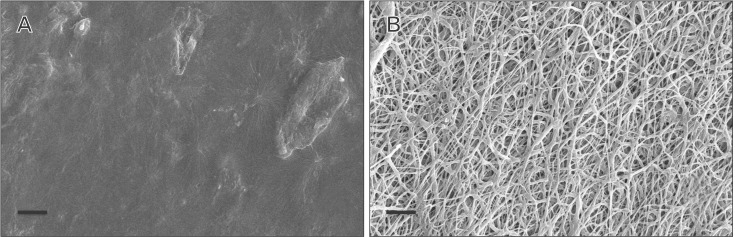
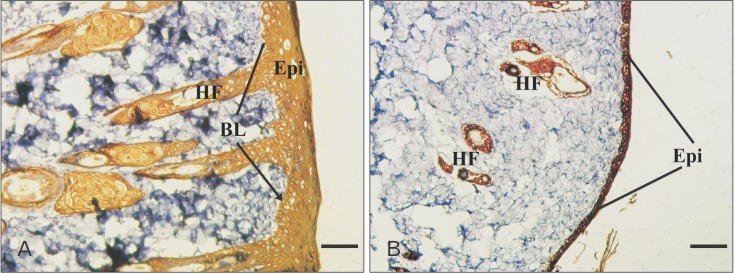
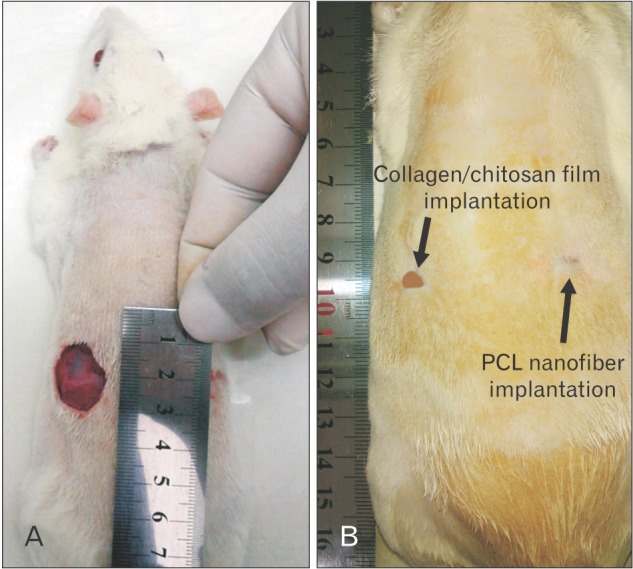
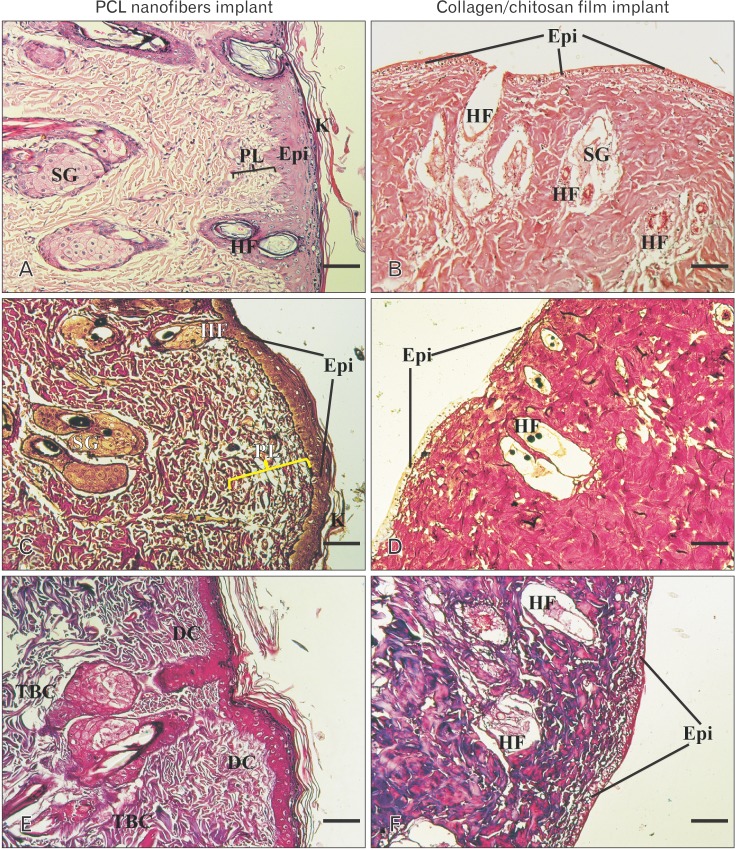
Tissue engineering is a new field of which the main purpose is to regenerate and repair the damaged tissues. Scaffolds serve as three dimensional matrices for neo-organogenesis and their substance can be biologic or synthetic. Natural polymers have good interactions with the cells and synthetic biomaterials are also highly useful in biomedical application because of their biocompatible properties. In addition to scaffold substance, surface properties of biomaterials have an important role in tissue engineering. In this study, we examined whether substrate substance is important for wound healing or its surface topography. Therefore, we fabricated two matrices, electrospun polycaprolactone (PCL) nanofibers and collagen/chitosan film, and implanted them to the same rat models. After 2 weeks, the sizes of healing wounds were measured and their cellular structures were evaluated by histochemistry and mmunohistochemistry. Histological staining showed a good level of cellularization and epidermis-dermis formation in PCL implant while no determinable epithelium was observed after 2 weeks in collagen-chitosan graft. Immunohistochemical study demonstrated the highly expressed pancytokeratin in PCL graft while its expression was weak in underdeveloped epidermis of collagen-chitosan implantation. In conclusion, this study suggested that PCL nanofibers with high surface area had a more ideal property than natural collagen-chitosan film, therefore the structure and topography of a matrix seemed to be more important in wound healing than its material substance.
组织工程是一个新领域,其主要目的是再生和修复受损组织。支架作为新器官形成的三维基质,其材料可以是生物的或合成的。天然聚合物与细胞具有良好的相互作用,合成生物材料因其生物相容性在生物医学应用中也非常有用。除了支架材料,生物材料的表面性质在组织工程中也起着重要作用。在本研究中,我们研究了基质材料对伤口愈合是否重要,还是其表面形貌更重要。因此,我们制备了两种基质,静电纺聚己内酯(PCL)纳米纤维和胶原/壳聚糖膜,并将它们植入相同的大鼠模型中。2周后,测量愈合伤口的大小,并通过组织化学和免疫组织化学评估其细胞结构。组织学染色显示PCL植入物中有良好的细胞化水平和表皮-真皮形成,而胶原-壳聚糖移植物在2周后未观察到可确定的上皮。免疫组织化学研究表明PCL移植物中全细胞角蛋白高度表达,而在胶原-壳聚糖植入物未发育的表皮中其表达较弱。总之,本研究表明具有高表面积的PCL纳米纤维比天然胶原-壳聚糖膜具有更理想的特性,因此基质的结构和形貌在伤口愈合中似乎比其材料更重要。