Tumilowicz Alison, Neufeld Lynnette M, Pelto Gretel H
Global Alliance for Improved Nutrition (GAIN), Geneva, Switzerland.
Division of Nutritional Sciences, Cornell University, Ithaca, New York, USA.
Matern Child Nutr. 2015 Dec;11 Suppl 3(Suppl 3):55-72. doi: 10.1111/mcn.12246.
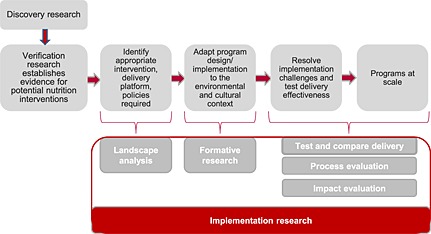
'Implementation research in nutrition' is an emerging area of study aimed at building evidence-based knowledge and sound theory to design and implement programs that will effectively deliver nutrition interventions. This paper describes some of the basic features of ethnography and illustrates its applications in components of the implementation process. We review the central purpose of ethnography, which is to obtain the emic view--the insider's perspective--and how ethnography has historically interfaced with nutrition. We present examples of ethnographic studies in relation to an analytic framework of the implementation process, situating them with respect to landscape analysis, formative research, process evaluation and impact evaluation. These examples, conducted in various parts of the world by different investigators, demonstrate how ethnography provided important, often essential, insights that influenced programming decisions or explained programme outcomes. Key messages Designing, implementing and evaluating interventions requires knowledge about the populations and communities in which interventions are situated, including knowledge from the 'emic' (insider's) perspective. Obtaining emic perspectives and analysing them in relation to cultural, economic and structural features of social organisation in societies is a central purpose of ethnography. Ethnography is an essential aspect of implementation research in nutrition, as it provides important insights for making decisions about appropriate interventions and delivery platforms; determining how best to fit aspects of programme design and implementation into different environmental and cultural contexts; opening the 'black box' in interventions to understand how delivery and utilisation processes affect programme outcomes or impacts; and understanding how programme impacts were achieved, or not.
“营养领域的实施研究”是一个新兴的研究领域,旨在积累基于证据的知识和完善的理论,以设计和实施能够有效提供营养干预措施的项目。本文描述了人种志的一些基本特征,并举例说明了其人种志在实施过程各组成部分中的应用。我们回顾了人种志的核心目的,即获取主位观点——内部人的视角,以及人种志在历史上与营养领域是如何相互关联的。我们给出了与实施过程分析框架相关的人种志研究实例,并将它们置于情境分析、形成性研究、过程评估和影响评估的背景下。这些由不同研究者在世界不同地区开展的实例,展示了人种志如何提供了重要的、往往是必不可少的见解,这些见解影响了项目决策或解释了项目成果。关键信息 设计、实施和评估干预措施需要了解干预措施所处的人群和社区,包括来自“主位”(内部人)视角的知识。获取主位视角并结合社会中社会组织的文化、经济和结构特征对其进行分析,是人种志的核心目的。人种志是营养领域实施研究的一个重要方面,因为它为做出关于适当干预措施和实施平台的决策;确定如何最好地使项目设计和实施的各个方面适应不同的环境和文化背景;打开干预措施的“黑匣子”以了解实施和利用过程如何影响项目成果或影响;以及理解项目影响是如何实现或未实现的,提供了重要的见解。