Beauvais Wendy, Musallam Imadidden, Guitian Javier
Veterinary Epidemiology, Economics and Public Health Group, The Royal Veterinary College, Hawkshead Lane, North Mymms, Hatfield, AL9 7TA, UK.
London Centre for Neglected Tropical Disease Research, London, UK.
Parasit Vectors. 2016 Jan 30;9:55. doi: 10.1186/s13071-016-1327-6.
Brucella melitensis causes production losses in ruminants and febrile disease in humans in Africa, Central Asia, the Middle East and elsewhere. Although traditionally understood to affect primarily sheep and goats, it is also the predominant Brucella species that affects cows in some endemic areas. Despite this, no licensed vaccine is available specifically for use against B. melitensis in cows. The mainstay of most control programs is vaccination of sheep and goats with a live vaccine, Rev-1. The aim of this study was to investigate how critical vaccination of cows might be, in order to control B. melitensis on a mixed sheep-and-cattle farm.
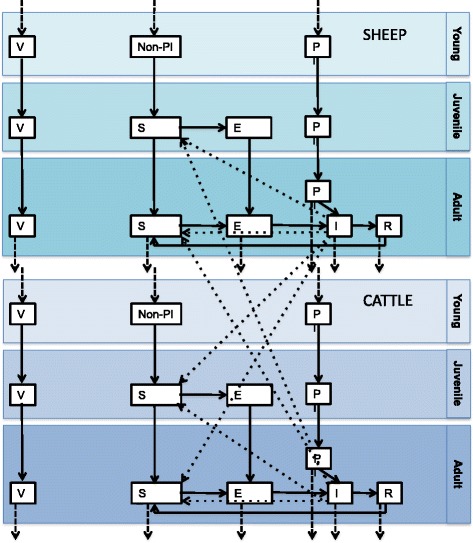
A dynamic, differential-equation, age-structured, seasonal model with births and deaths, was used to investigate whether vaccination of both sheep and cattle had an impact on time to elimination of brucellosis on an individual mixed species farm, when compared to vaccination of sheep only. The model was a Susceptible-Exposed-Infectious-Recovered-Susceptible (SEIRS) model with an additional compartment for Persistently Infected (PI) individuals. Transmission parameters were fit based on a nation-wide probabilistic seroprevalence survey in Jordan.
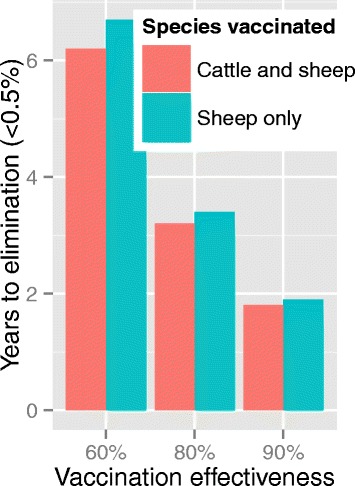
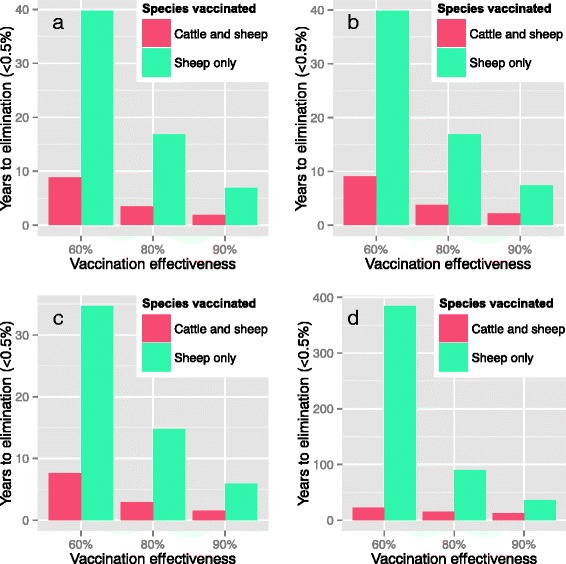
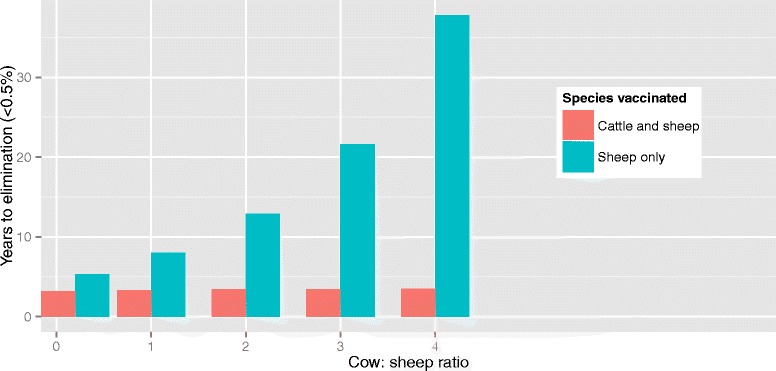
The model predicted that it would take 3.5 years to eliminate brucellosis (to less than 0.5% of adult sheep seropositive as a result of infection) on a mixed-species B. melitensis-endemic farm with the median field-study seroprevalence, following vaccination of both sheep and cattle, assuming a vaccine effectiveness of 80%. Limiting the vaccination to sheep only, increased the time to 16.8 years. Sensitivity analysis showed that the finding that vaccination of cattle was of significant importance, was robust. Vaccine effectiveness had a strong influence on time to elimination.
In the absence of further data, vaccination of cattle should be considered essential in Brucella-endemic settings where mixed small ruminant and cattle flocks predominate. Further evidence that Brucella melitensis predominates in cattle in Jordan, as opposed to Brucella abortus, is needed in order to validate this model. The results may be applicable to other mixed-species settings with similar livestock management practices. These methods may be applied to other pathogens affecting multiple livestock species or with seasonal transmission.
羊布鲁氏菌可导致反刍动物生产损失,并在非洲、中亚、中东及其他地区引发人类发热性疾病。虽然传统上认为它主要影响绵羊和山羊,但在一些地方病流行地区,它也是影响奶牛的主要布鲁氏菌物种。尽管如此,目前尚无专门用于预防奶牛感染羊布鲁氏菌的许可疫苗。大多数防控计划的主要手段是用活疫苗Rev-1对绵羊和山羊进行接种。本研究的目的是调查在绵羊和牛混养的农场中,对奶牛进行疫苗接种对于控制羊布鲁氏菌病有多关键。
使用一个具有出生和死亡的动态、微分方程、年龄结构的季节性模型,来研究与仅对绵羊进行疫苗接种相比,对绵羊和牛都进行疫苗接种是否会对单个混养农场中布鲁氏菌病的消除时间产生影响。该模型是一个易感-暴露-感染-康复-易感(SEIRS)模型,增加了一个用于持续感染(PI)个体的隔室。传播参数是根据约旦全国范围的概率性血清阳性率调查进行拟合的。
该模型预测,在一个羊布鲁氏菌病流行的混养农场中,若疫苗有效性为80%,在对绵羊和牛都进行疫苗接种后,按照现场研究血清阳性率中位数计算,需要3.5年才能消除布鲁氏菌病(使因感染而血清呈阳性的成年绵羊比例降至0.5%以下)。若仅对绵羊进行疫苗接种,则消除时间会增加到16.8年。敏感性分析表明,牛疫苗接种具有重要意义这一发现是可靠的。疫苗有效性对消除时间有很大影响。
在缺乏进一步数据的情况下,在以小型反刍动物和牛群混养为主的布鲁氏菌病流行地区,应考虑对牛进行疫苗接种至关重要。需要进一步证据证明在约旦羊布鲁氏菌在牛群中占主导地位,而非流产布鲁氏菌,以验证该模型。这些结果可能适用于其他具有类似畜牧管理方式的混养环境。这些方法可应用于影响多种家畜物种或具有季节性传播的其他病原体。