Woerner Michael, Sendtner Ernst, Springorum Robert, Craiovan Benjamin, Worlicek Michael, Renkawitz Tobias, Grifka Joachim, Weber Markus
a Department of Orthopedic Surgery , Regensburg University Medical Center , Asklepios Klinikum , Bad Abbach , Germany.
Acta Orthop. 2016 Jun;87(3):225-30. doi: 10.3109/17453674.2015.1137182. Epub 2016 Feb 5.
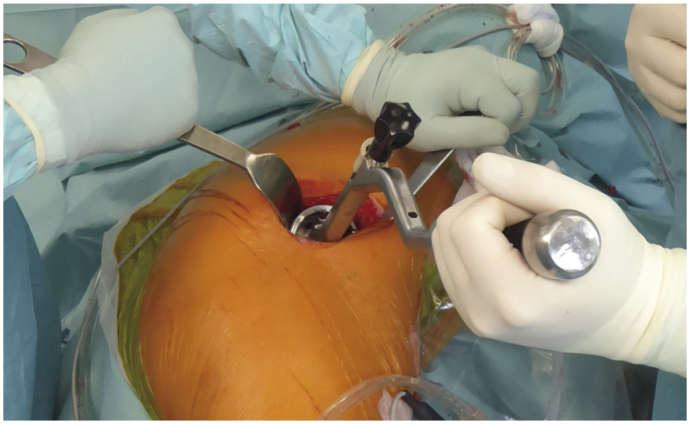
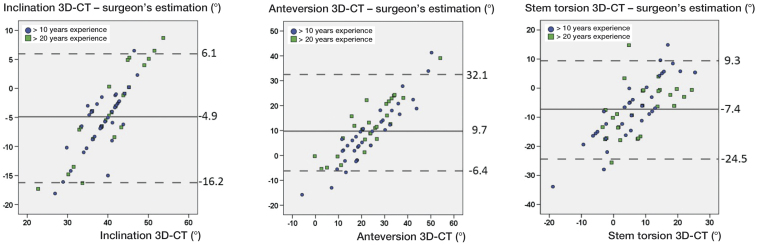
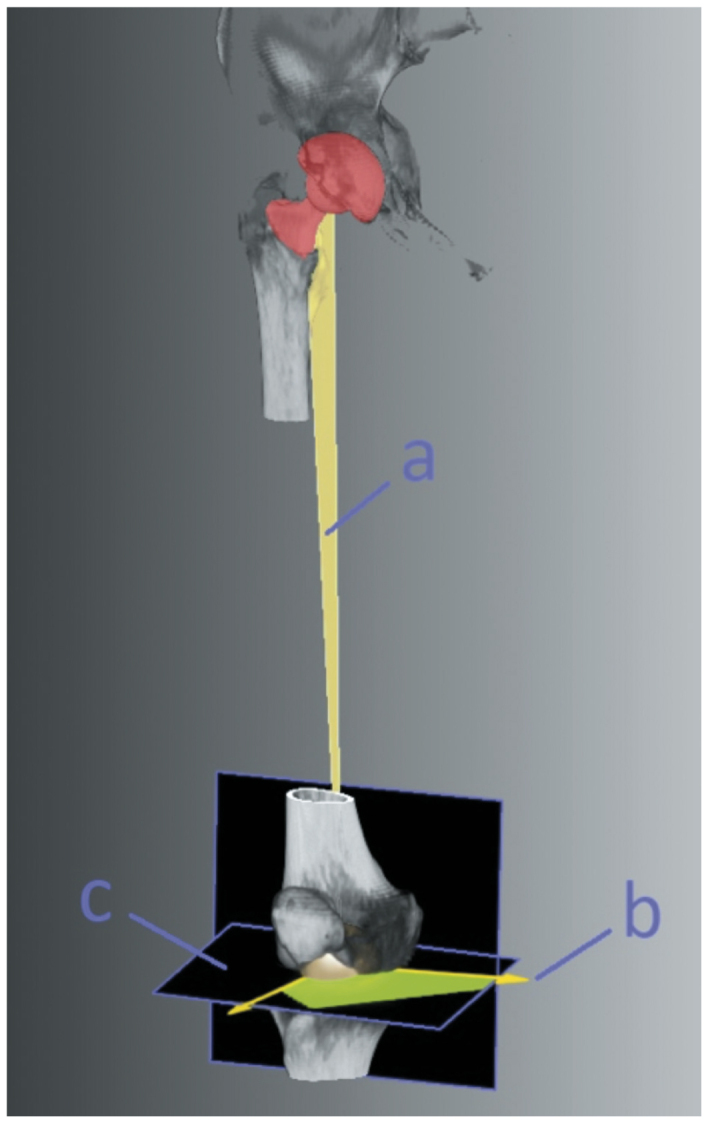
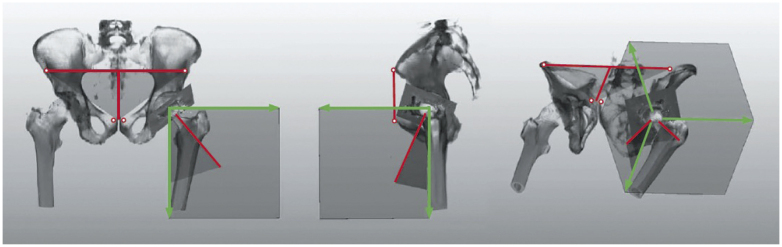
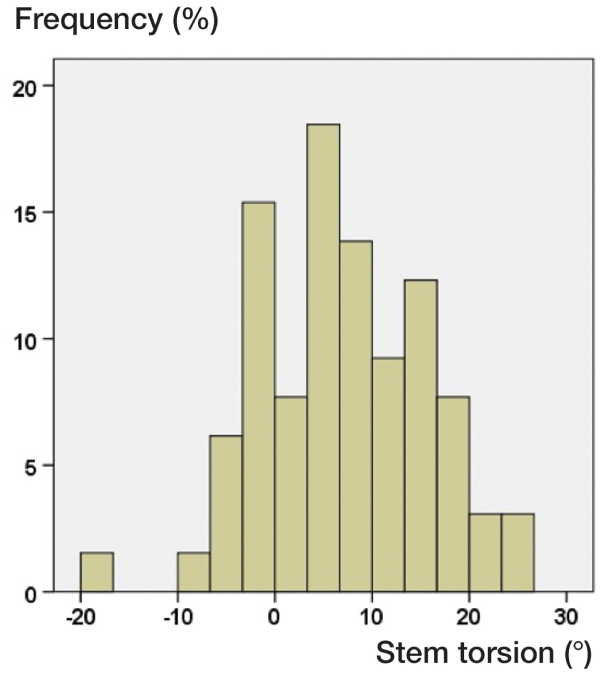
Background and purpose - In hip arthroplasty, acetabular inclination and anteversion-and also femoral stem torsion-are generally assessed by eye intraoperatively. We assessed whether visual estimation of cup and stem position is reliable. Patients and methods - In the course of a subgroup analysis of a prospective clinical trial, 65 patients underwent cementless hip arthroplasty using a minimally invasive anterolateral approach in lateral decubitus position. Altogether, 4 experienced surgeons assessed cup position intraoperatively according to the operative definition by Murray in the anterior pelvic plane and stem torsion in relation to the femoral condylar plane. Inclination, anteversion, and stem torsion were measured blind postoperatively on 3D-CT and compared to intraoperative results. Results - The mean difference between the 3D-CT results and intraoperative estimations by eye was -4.9° (-18 to 8.7) for inclination, 9.7° (-16 to 41) for anteversion, and -7.3° (-34 to 15) for stem torsion. We found an overestimation of > 5° for cup inclination in 32 hips, an overestimation of > 5° for stem torsion in 40 hips, and an underestimation < 5° for cup anteversion in 42 hips. The level of professional experience and patient characteristics had no clinically relevant effect on the accuracy of estimation by eye. Altogether, 46 stems were located outside the native norm of 10-20° as defined by Tönnis, measured on 3D-CT. Interpretation - Even an experienced surgeon's intraoperative estimation of cup and stem position by eye is not reliable compared to 3D-CT in minimally invasive THA. The use of mechanical insertion jigs, intraoperative fluoroscopy, or imageless navigation is recommended for correct implant insertion.
背景与目的——在髋关节置换术中,髋臼倾斜度和前倾角以及股骨干扭转通常在术中凭肉眼评估。我们评估了通过视觉估计髋臼杯和股骨柄位置是否可靠。
患者与方法——在一项前瞻性临床试验的亚组分析过程中,65例患者采用微创前外侧入路在侧卧位下行非骨水泥型髋关节置换术。共有4名经验丰富的外科医生在术中根据Murray在前骨盆平面的手术定义评估髋臼杯位置,并根据股骨髁平面评估股骨干扭转。术后在三维CT上盲测倾斜度、前倾角和股骨干扭转,并与术中结果进行比较。
结果——三维CT结果与术中肉眼估计之间的平均差异为:倾斜度为-4.9°(-18至8.7),前倾角为9.7°(-16至41),股骨干扭转度为-7.3°(-34至15)。我们发现32个股骨髋臼杯倾斜度高估>5°,40个股骨干扭转度高估>5°,42个股骨髋臼杯前倾角低估<5°。专业经验水平和患者特征对肉眼估计的准确性没有临床相关影响。在三维CT上测量,共有46个股骨柄位于Tönnis定义的10 - 20°正常范围之外。
解读——在微创全髋关节置换术中,与三维CT相比,即使是经验丰富的外科医生通过肉眼对髋臼杯和股骨柄位置进行术中估计也不可靠。建议使用机械插入夹具、术中透视或无影像导航来正确植入假体。