Kim Aekyong
School of Pharmacy, Catholic University of Daegu, Gyeongbuk, Korea.
Toxicol Res. 2015 Dec;31(4):323-30. doi: 10.5487/TR.2015.31.4.323.
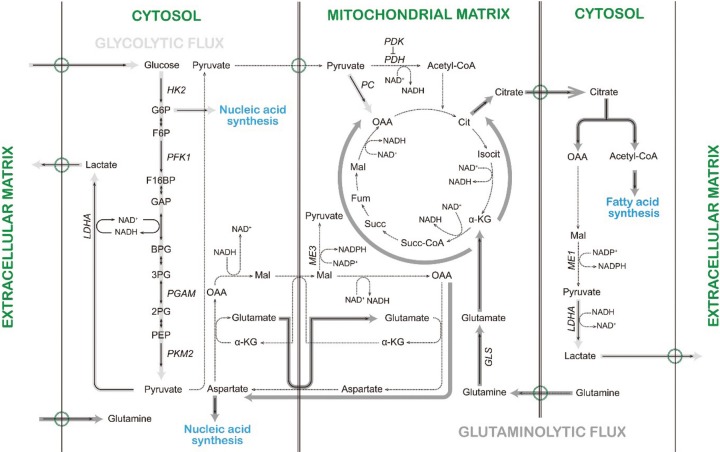
Cancer is a disease characterized by uncontrolled growth. Metabolic demands to sustain rapid proliferation must be compelling since aerobic glycolysis is the first as well as the most commonly shared characteristic of cancer. During the last decade, the significance of metabolic reprogramming of cancer has been at the center of attention. Nonetheless, despite all the knowledge gained on cancer biology, the field is not able to reach agreement on the issue of mitochondria: Are damaged mitochondria the cause for aerobic glycolysis in cancer? Warburg proposed the damaged mitochondria theory over 80 years ago; the field has been testing the theory equally long. In this review, we will discuss alterations in metabolic fluxes of cancer cells, and provide an opinion on the damaged mitochondria theory.
癌症是一种以不受控制的生长为特征的疾病。由于有氧糖酵解是癌症的首要也是最常见的共同特征,维持快速增殖的代谢需求必定十分迫切。在过去十年中,癌症代谢重编程的重要性一直是关注的焦点。然而,尽管在癌症生物学方面已经取得了诸多认识,但该领域在关于线粒体的问题上仍未能达成共识:受损的线粒体是癌症中发生有氧糖酵解的原因吗?80多年前,瓦尔堡提出了受损线粒体理论;该领域对这一理论也进行了同样长时间的验证。在这篇综述中,我们将讨论癌细胞代谢通量的变化,并对受损线粒体理论发表看法。