Stephen Dimity Maree, Barnett Adrian Gerard
Institute of Health and Biomedical Innovation, School of Public Health and Social Work, Queensland University of Technology, Kelvin Grove, Queensland, Australia.
BMJ Open. 2016 Feb 25;6(2):e010204. doi: 10.1136/bmjopen-2015-010204.
Foodborne illnesses in Australia, including salmonellosis, are estimated to cost over $A1.25 billion annually. The weather has been identified as being influential on salmonellosis incidence, as cases increase during summer, however time series modelling of salmonellosis is challenging because outbreaks cause strong autocorrelation. This study assesses whether switching models is an improved method of estimating weather-salmonellosis associations.
We analysed weather and salmonellosis in South-East Queensland between 2004 and 2013 using 2 common regression models and a switching model, each with 21-day lags for temperature and precipitation.
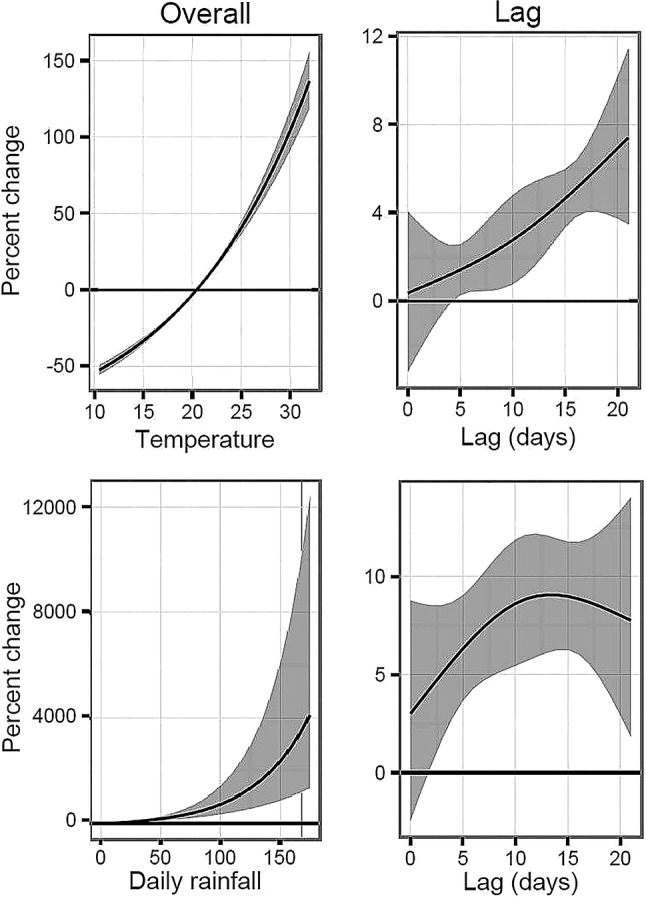
The switching model best fit the data, as judged by its substantial improvement in deviance information criterion over the regression models, less autocorrelated residuals and control of seasonality. The switching model estimated a 5 °C increase in mean temperature and 10 mm precipitation were associated with increases in salmonellosis cases of 45.4% (95% CrI 40.4%, 50.5%) and 24.1% (95% CrI 17.0%, 31.6%), respectively.
Switching models improve on traditional time series models in quantifying weather-salmonellosis associations. A better understanding of how temperature and precipitation influence salmonellosis may identify where interventions can be made to lower the health and economic costs of salmonellosis.
据估计,澳大利亚食源性疾病(包括沙门氏菌病)每年造成的损失超过12.5亿澳元。天气已被确定对沙门氏菌病发病率有影响,因为夏季病例会增加,然而沙门氏菌病的时间序列建模具有挑战性,因为疫情会导致强烈的自相关性。本研究评估切换模型是否是估计天气与沙门氏菌病关联的一种改进方法。
我们使用2种常见回归模型和一种切换模型,分析了2004年至2013年昆士兰州东南部的天气和沙门氏菌病情况,每种模型对温度和降水都采用21天的滞后。
通过偏差信息准则相对于回归模型的显著改进、自相关残差较少以及季节性控制,判断切换模型最适合数据。切换模型估计平均温度升高5°C和降水量增加10毫米分别与沙门氏菌病病例增加45.4%(95%可信区间40.4%,50.5%)和24.1%(95%可信区间17.0%,31.6%)相关。
在量化天气与沙门氏菌病关联方面,切换模型优于传统时间序列模型。更好地了解温度和降水如何影响沙门氏菌病,可能会确定在哪些方面可以采取干预措施,以降低沙门氏菌病的健康和经济成本。