Papakonstantinou Emilia, Kechribari Ioanna, Sotirakoglou Κyriaki, Tarantilis Petros, Gourdomichali Theodora, Michas George, Kravvariti Vassiliki, Voumvourakis Konstantinos, Zampelas Antonis
Department of Food Science and Human Nutrition, Agricultural University of Athens, IeraOdos 75, Athens, 11855, Greece.
Department of Crop Science, Agricultural University of Athens, Athens, Greece.
Nutr J. 2016 Mar 15;15:26. doi: 10.1186/s12937-016-0146-0.
It has been suggested that coffee may affect the gut-brain axis with conflicting outcomes. Moreover, there is insufficient evidence to determine whether the type or temperature of coffee consumed will have a different impact on the gut-brain axis. The purpose of this study was to investigate the effects of acute coffee consumption on the following: 1. self-reported GI symptoms and salivary gastrin, 2. stress indices [salivary cortisol and alpha-amylase (sAA)] and psychometric measures, and 3. blood pressure (BP), in healthy, daily coffee consuming individuals in non-stressful conditions.
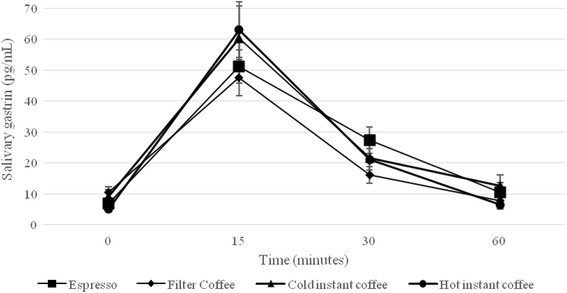
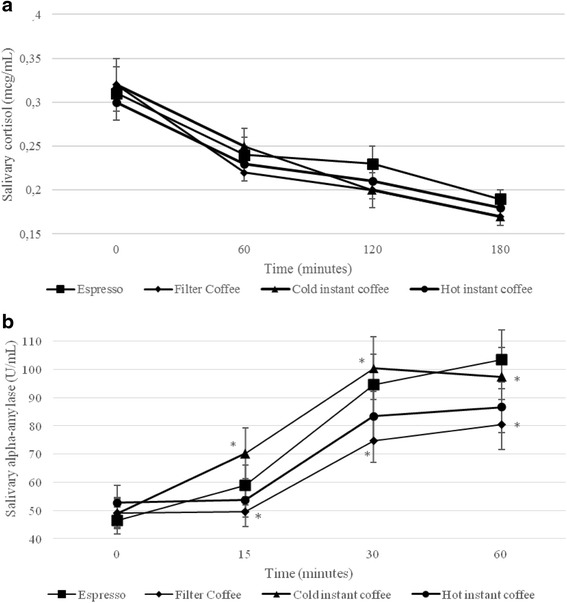
This was a randomized, double blind, crossover clinical trial, in which 40 healthy individuals (20 men, 20 women), 20-55 years of age, randomly consumed four 200 ml coffee beverages containing 160 mg caffeine (hot and cold instant coffee, cold espresso, hot filtered coffee), 1 week apart. Salivary samples and psychometric questionnaires were collected at baseline and post-coffee consumption at 15,30, and 60 min for salivary gastrin and sAA measurements and at 60,120, and 180 min for cortisol measurements. BP was measured at beginning and end of each intervention. ClinicalTrials.gov ID: NCT02253628 RESULTS: Coffee consumption significantly increased sAA activity (P = 0.041), with significant differences only between cold instant and filter coffee at 15 and 30 min post-consumption (P < 0.05). Coffee temporarily increased salivary gastrin, without differences between coffee types. Coffee did not affect salivary cortisol or self-reported anxiety levels. Coffee consumption significantly increased BP, within the healthy physiological levels, in a gender specific manner at the end of the experimental periods, without differences between coffee types.
Acute coffee consumption in non-stressful conditions activated sAA and BP but not salivary cortisol, indicating activation of the sympathetic nervous system. Post-coffee sAA increase without a concomitant cortisol increase may also indicate that coffee may have some anti-stress properties.
有人认为咖啡可能会以相互矛盾的结果影响肠-脑轴。此外,没有足够的证据来确定饮用咖啡的类型或温度是否会对肠-脑轴产生不同的影响。本研究的目的是调查在无压力条件下,日常饮用咖啡的健康个体急性摄入咖啡对以下方面的影响:1. 自我报告的胃肠道症状和唾液胃泌素;2. 应激指标[唾液皮质醇和α-淀粉酶(sAA)]和心理测量指标;3. 血压(BP)。
这是一项随机、双盲、交叉临床试验,40名年龄在20至55岁之间的健康个体(20名男性,20名女性)随机饮用四种200毫升含160毫克咖啡因的咖啡饮料(热速溶咖啡、冷速溶咖啡、冷浓缩咖啡、热过滤咖啡),每次间隔1周。在基线以及饮用咖啡后15、30和60分钟收集唾液样本和心理测量问卷,用于测量唾液胃泌素和sAA,在60、120和180分钟收集用于测量皮质醇。在每次干预开始和结束时测量血压。ClinicalTrials.gov标识符:NCT02253628 结果:饮用咖啡显著增加了sAA活性(P = 0.041),仅在饮用后15和30分钟时,冷速溶咖啡和过滤咖啡之间存在显著差异(P < 0.05)。咖啡使唾液胃泌素暂时升高,不同类型咖啡之间无差异。咖啡不影响唾液皮质醇或自我报告的焦虑水平。在实验期结束时,饮用咖啡以性别特异性方式显著升高血压,但在健康生理范围内,不同类型咖啡之间无差异。
在无压力条件下急性摄入咖啡会激活sAA和BP,但不会激活唾液皮质醇,表明交感神经系统被激活。饮用咖啡后sAA升高而皮质醇没有随之升高,这也可能表明咖啡可能具有一些抗应激特性。