Cassidy Sophie, Chau Josephine Y, Catt Michael, Bauman Adrian, Trenell Michael I
Faculty of Medical Sciences, Institute of Cellular Medicine, Newcastle University, Newcastle upon Tyne, UK.
Prevention Research Collaboration, Sydney School of Public Health, Charles Perkins Centre D17, University of Sydney, New South Wales, Australia.
BMJ Open. 2016 Mar 15;6(3):e010038. doi: 10.1136/bmjopen-2015-010038.
Simultaneously define diet, physical activity, television (TV) viewing, and sleep duration across cardiometabolic disease groups, and investigate clustering of non-diet lifestyle behaviours.
Cross-sectional observational study.
22 UK Biobank assessment centres across the UK.
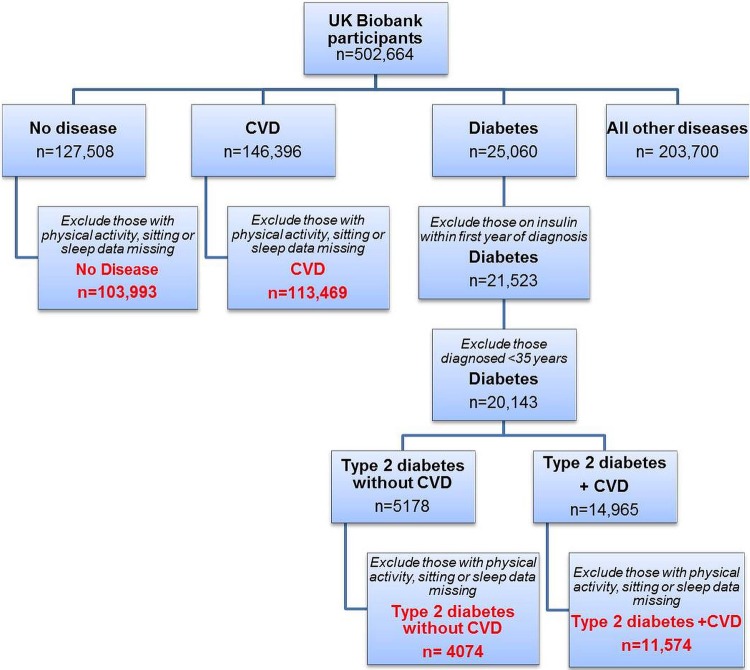
502,664 adults aged 37-63 years old, 54% women. 4 groups were defined based on disease status; 'No disease' (n=103,993), 'cardiovascular disease' (CVD n=113,469), 'Type 2 diabetes without CVD' (n=4074) and 'Type 2 diabetes + CVD' (n=11,574).
Diet, physical activity, TV viewing and sleep duration.
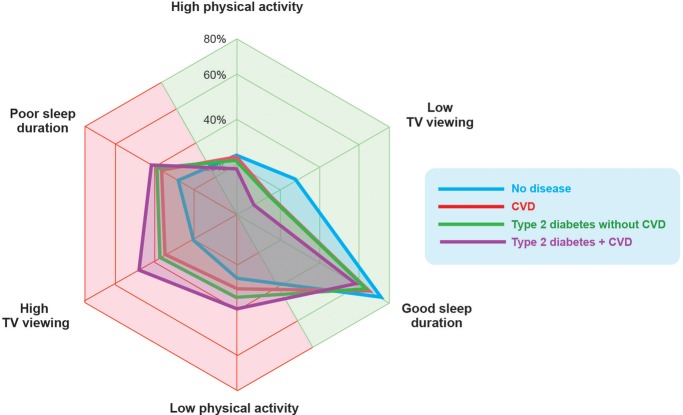
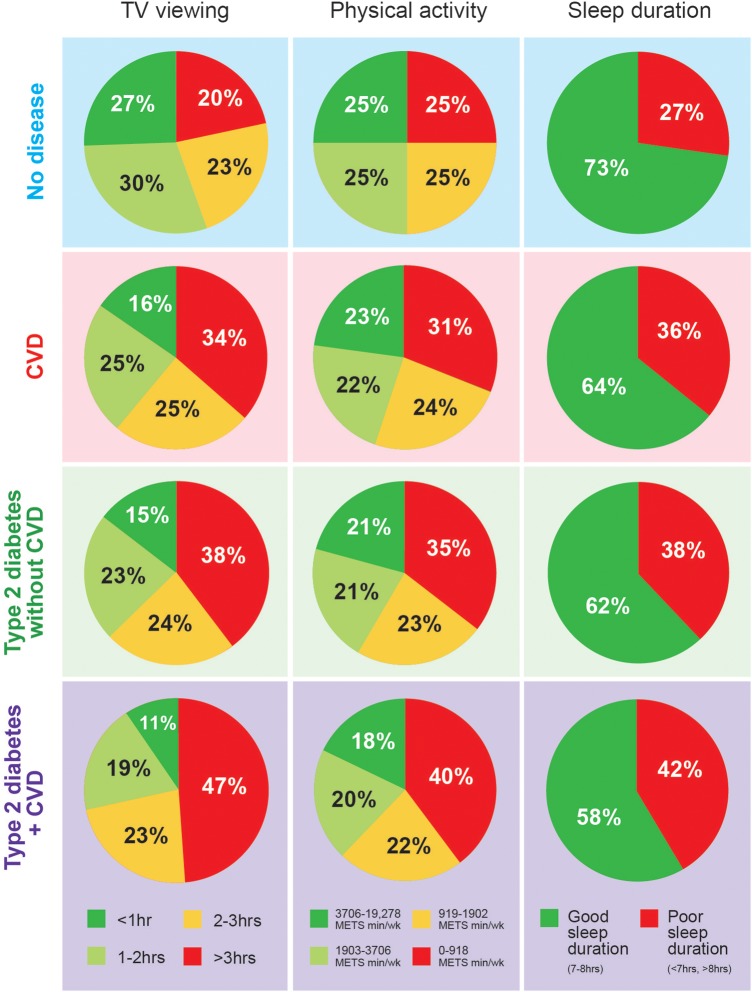
People with 'CVD' report low levels of physical activity (<918 MET min/week, OR (95% CI) 1.23 (1.20 to 1.25)), high levels of TV viewing (>3 h/day; 1.42 (1.39 to 1.45)), and poor sleep duration (<7, >8 h/night; 1.37 (1.34 to 1.39)) relative to people without disease. People with 'Type 2 diabetes + CVD' were more likely to report low physical activity (1.71 (1.64 to 1.78)), high levels of TV viewing (1.92 (1.85 to 1.99)) and poor sleep duration (1.52 (1.46 to 1.58)) relative to people without disease. Non-diet behaviours were clustered, with people with 'CVD' or 'Type 2 diabetes + CVD' more likely to report simultaneous low physical activity, high TV viewing and poor sleep duration than those without disease (2.15 (2.03 to 2.28) and 3.29 (3.02 to 3.58), respectively). By contrast, 3 in 4 adults with 'Type 2 diabetes', and 2 in 4 adults with 'CVD' have changed their diet in the past 5 years, compared with only 1 in 4 in the 'No disease' group. Models were adjusted for gender, age, body mass index, Townsend Deprivation Index, ethnicity, alcohol intake, smoking and meeting fruit/vegetable guidelines.
Low physical activity, high TV and poor sleep duration are prominent unaddressed high-risk characteristics of both CVD and type 2 diabetes, and are likely to be clustered together.
同时界定不同心血管代谢疾病组的饮食、体育活动、看电视(TV)时间和睡眠时间,并调查非饮食生活方式行为的聚集情况。
横断面观察性研究。
英国各地的22个英国生物银行评估中心。
502664名年龄在37 - 63岁的成年人,女性占54%。根据疾病状态分为4组;“无疾病”(n = 103993)、“心血管疾病”(CVD,n = 113469)、“无心血管疾病的2型糖尿病”(n = 4074)和“2型糖尿病 + 心血管疾病”(n = 11574)。
饮食、体育活动、看电视时间和睡眠时间。
与无疾病的人相比,患有“心血管疾病”的人报告体育活动水平较低(<918代谢当量分钟/周,比值比(95%可信区间)1.23(1.20至1.25))、看电视时间较长(>3小时/天;1.42(1.39至1.45))以及睡眠时间较差(<7、>8小时/晚;1.37(1.34至1.39))。与无疾病的人相比,患有“2型糖尿病 + 心血管疾病”的人更有可能报告体育活动水平较低(1.71(1.64至1.78))、看电视时间较长(1.92(1.85至1.99))以及睡眠时间较差(1.52(1.46至1.58))。非饮食行为存在聚集现象,患有“心血管疾病”或“2型糖尿病 + 心血管疾病”的人比无疾病的人更有可能同时报告体育活动水平低、看电视时间长和睡眠时间差(分别为2.15(2.03至2.28)和3.29(3.02至3.58))。相比之下,在过去5年中,四分之三患有“2型糖尿病”的成年人以及四分之二患有“心血管疾病”的成年人改变了他们的饮食,而在“无疾病”组中只有四分之一的人这样做。模型对性别、年龄、体重指数、汤森德贫困指数、种族、酒精摄入量、吸烟情况以及是否符合水果/蔬菜指南进行了调整。
体育活动水平低、看电视时间长和睡眠时间差是心血管疾病和糖尿病突出的未得到解决的高危特征,并且可能聚集在一起。