Colman Daniel R, Jay Zackary J, Inskeep William P, Jennings Ryan deM, Maas Kendra R, Rusch Douglas B, Takacs-Vesbach Cristina D
Department of Biology, University of New Mexico Albuquerque, NM, USA.
Thermal Biology Institute and Department of Land Resources and Environmental Sciences, Montana State University Bozeman, MT, USA.
Front Microbiol. 2016 Mar 15;7:304. doi: 10.3389/fmicb.2016.00304. eCollection 2016.
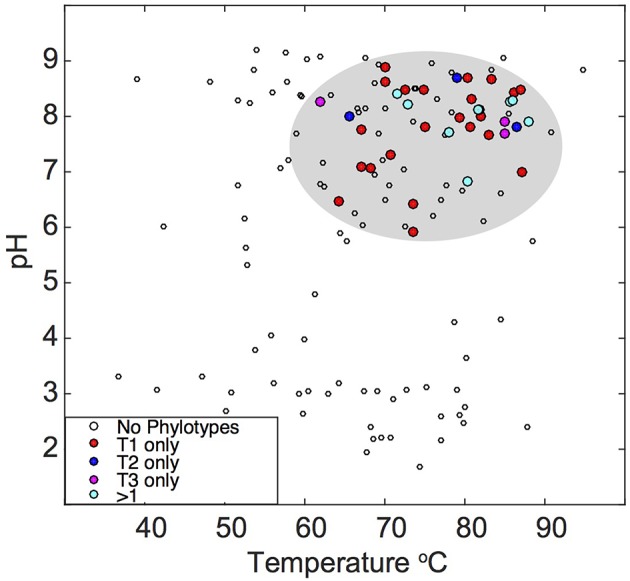
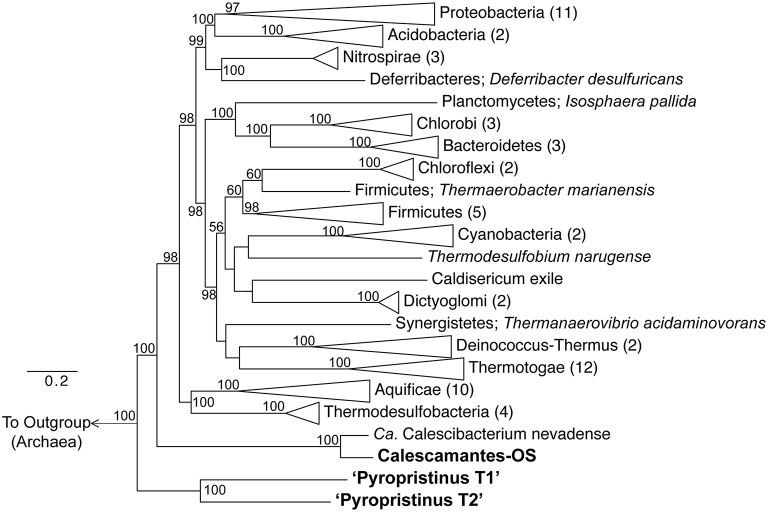
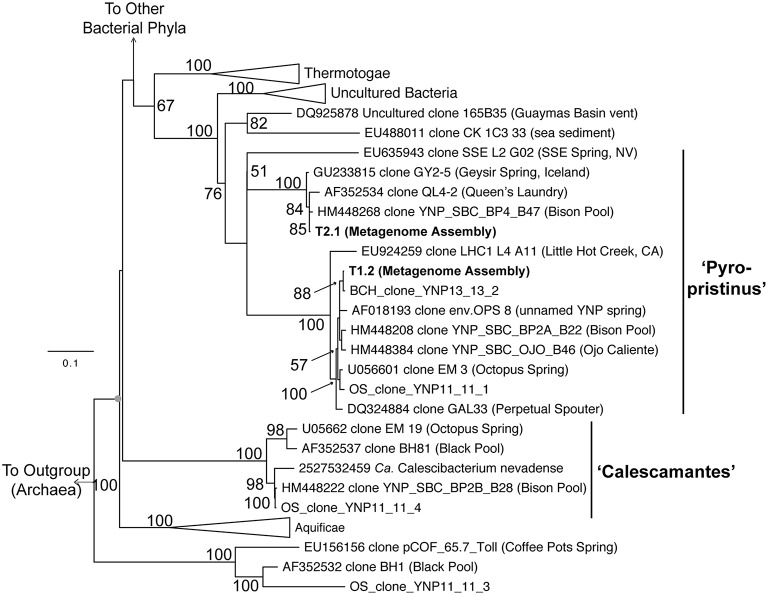
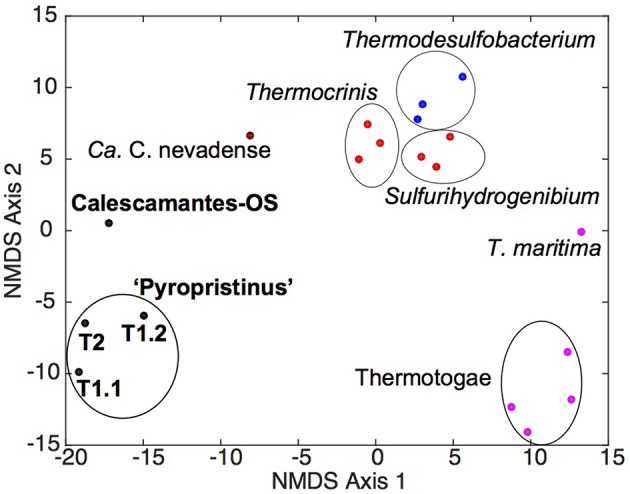
Thermal spring ecosystems are a valuable resource for the discovery of novel hyperthermophilic Bacteria and Archaea, and harbor deeply-branching lineages that provide insight regarding the nature of early microbial life. We characterized bacterial populations in two circumneutral (pH ~8) Yellowstone National Park thermal (T ~80°C) spring filamentous "streamer" communities using random metagenomic DNA sequence to investigate the metabolic potential of these novel populations. Four de novo assemblies representing three abundant, deeply-branching bacterial phylotypes were recovered. Analysis of conserved phylogenetic marker genes indicated that two of the phylotypes represent separate groups of an uncharacterized phylum (for which we propose the candidate phylum name "Pyropristinus"). The third new phylotype falls within the proposed Calescamantes phylum. Metabolic reconstructions of the "Pyropristinus" and Calescamantes populations showed that these organisms appear to be chemoorganoheterotrophs and have the genomic potential for aerobic respiration and oxidative phosphorylation via archaeal-like V-type, and bacterial F-type ATPases, respectively. A survey of similar phylotypes (>97% nt identity) within 16S rRNA gene datasets suggest that the newly described organisms are restricted to terrestrial thermal springs ranging from 70 to 90°C and pH values of ~7-9. The characterization of these lineages is important for understanding the diversity of deeply-branching bacterial phyla, and their functional role in high-temperature circumneutral "streamer" communities.
热泉生态系统是发现新型嗜热细菌和古菌的宝贵资源,其中蕴藏着进化分支很深的谱系,有助于深入了解早期微生物生命的本质。我们利用随机宏基因组DNA序列对黄石国家公园两个中性(pH值约为8)、热泉(温度约80°C)丝状“飘带”群落中的细菌种群进行了特征分析,以研究这些新种群的代谢潜力。我们获得了代表三种丰富的、进化分支很深的细菌系统发育型的四个从头组装基因组。对保守的系统发育标记基因的分析表明,其中两个系统发育型代表了一个未分类门的不同类群(我们为此提议将候选门命名为“Pyropristinus”)。第三个新的系统发育型属于提议的Calescamantes门。对“Pyropristinus”和Calescamantes种群的代谢重建表明,这些生物似乎是化学有机异养生物,分别具有通过类似古菌的V型和细菌F型ATP酶进行有氧呼吸和氧化磷酸化的基因组潜力。对16S rRNA基因数据集中相似系统发育型(核苷酸同一性>97%)的调查表明,新描述的生物仅限于温度在70至90°C、pH值约为7至9的陆地热泉。这些谱系的特征分析对于理解进化分支很深的细菌门的多样性及其在高温中性“飘带”群落中的功能作用具有重要意义。