Khan Nargis, Vidyarthi Aurobind, Javed Shifa, Agrewala Javed N
Council of Scientific and Industrial Research - Institute of Microbial Technology Chandigarh, India.
Department of Cytology and Gynecologic Pathology, Postgraduate Institute of Medical Education and Research Chandigarh, India.
Front Microbiol. 2016 Mar 14;7:328. doi: 10.3389/fmicb.2016.00328. eCollection 2016.
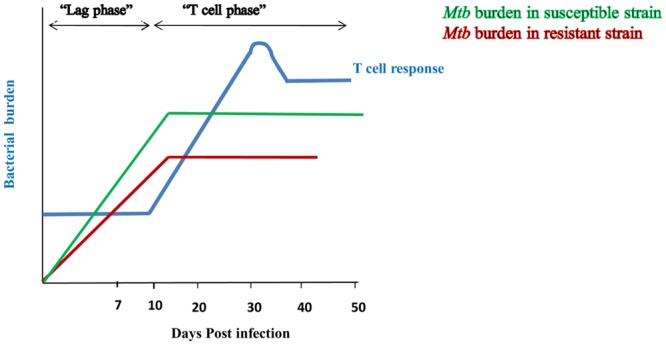
T cells play a cardinal role in imparting protection against Mycobacterium tuberculosis (Mtb). However, ample time is required before T-cells are able to evoke efficient effector responses in the lung, where the mycobacterium inflicts disease. This delay in T cells priming, which is termed as lag phase, provides sufficient time for Mtb to replicate and establish itself within the host. In contrast, innate immunity efficiently curb the growth of Mtb during initial phase of infection through several mechanisms. Pathogen recognition by innate cells rapidly triggers a cascade of events, such as apoptosis, autophagy, inflammasome formation and nitric oxide production to kill intracellular pathogens. Furthermore, bactericidal mechanisms such as autophagy and apoptosis, augment the antigen processing and presentation, thereby contributing substantially to the induction of adaptive immunity. This manuscript highlights the role of innate immune mechanisms in restricting the survival of Mtb during lag phase. Finally, this article provides new insight for designing immuno-therapies by targeting innate immune mechanisms to achieve optimum immune response to cure TB.
T细胞在提供针对结核分枝杆菌(Mtb)的保护方面起着关键作用。然而,在T细胞能够在肺部引发有效的效应反应之前,需要充足的时间,而肺部正是分枝杆菌引发疾病的部位。T细胞启动的这种延迟,即所谓的滞后阶段,为Mtb在宿主体内复制并立足提供了充足的时间。相比之下,固有免疫在感染初期通过多种机制有效地抑制Mtb的生长。固有细胞对病原体的识别迅速触发一系列事件,如细胞凋亡、自噬、炎性小体形成和一氧化氮产生,以杀死细胞内病原体。此外,诸如自噬和细胞凋亡等杀菌机制增强了抗原加工和呈递,从而对适应性免疫的诱导做出了重大贡献。本手稿强调了固有免疫机制在滞后阶段限制Mtb存活中的作用。最后,本文通过靶向固有免疫机制以实现治愈结核病的最佳免疫反应,为设计免疫疗法提供了新的见解。