Fan Yuchen, Moon James J
Department of Pharmaceutical Sciences, University of Michigan, Ann Arbor, MI, USA.
Biointerfaces Institute, University of Michigan, Ann Arbor, MI, USA.
Wiley Interdiscip Rev Nanomed Nanobiotechnol. 2017 Jan;9(1). doi: 10.1002/wnan.1403. Epub 2016 Apr 1.
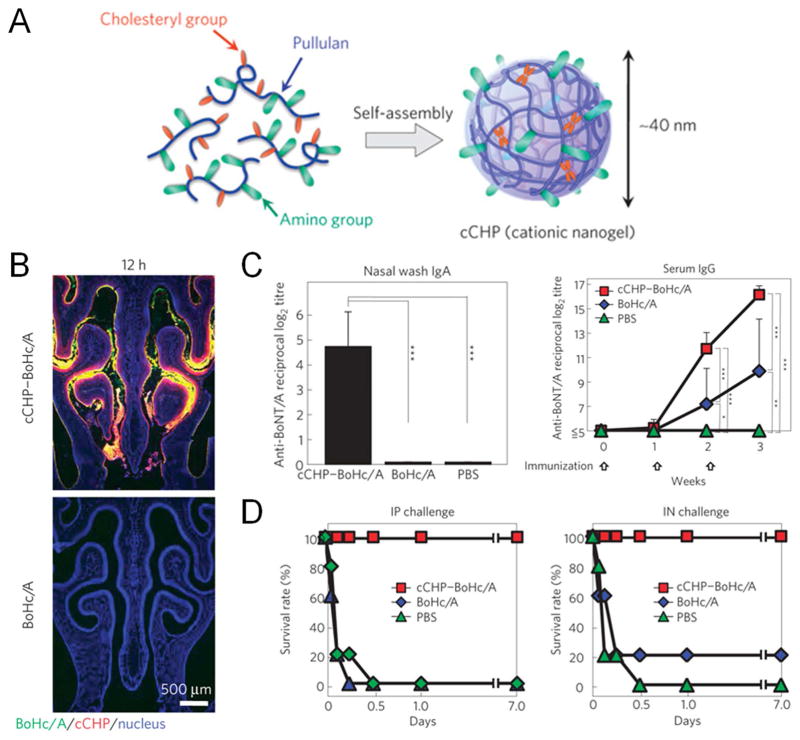
Bioterrorism agents that can be easily transmitted with high mortality rates and cause debilitating diseases pose major threats to national security and public health. The recent Ebola virus outbreak in West Africa and ongoing Zika virus outbreak in Brazil, now spreading throughout Latin America, are case examples of emerging infectious pathogens that have incited widespread fear and economic and social disruption on a global scale. Prophylactic vaccines would provide effective countermeasures against infectious pathogens and biological warfare agents. However, traditional approaches relying on attenuated or inactivated vaccines have been hampered by their unacceptable levels of reactogenicity and safety issues, whereas subunit antigen-based vaccines suffer from suboptimal immunogenicity and efficacy. In contrast, particulate vaccine delivery systems offer key advantages, including efficient and stable delivery of subunit antigens, co-delivery of adjuvant molecules to bolster immune responses, low reactogenicity due to the use of biocompatible biomaterials, and robust efficiency to elicit humoral and cellular immunity in systemic and mucosal tissues. Thus, vaccine nanoparticles and microparticles are promising platforms for clinical development of biodefense vaccines. In this review, we summarize the current status of research efforts to develop particulate vaccine delivery systems against bioterrorism agents and emerging infectious pathogens. WIREs Nanomed Nanobiotechnol 2017, 9:e1403. doi: 10.1002/wnan.1403 For further resources related to this article, please visit the WIREs website.
易于传播、死亡率高且会引发使人衰弱疾病的生物恐怖主义制剂,对国家安全和公众健康构成重大威胁。近期在西非爆发的埃博拉病毒以及目前在巴西爆发且正在蔓延至整个拉丁美洲的寨卡病毒疫情,就是新兴传染病原体的实例,这些病原体在全球范围内引发了广泛恐慌以及经济和社会混乱。预防性疫苗将为抵御传染病原体和生物战制剂提供有效对策。然而,依赖减毒或灭活疫苗的传统方法受到其不可接受的反应原性水平和安全问题的阻碍,而基于亚单位抗原的疫苗则存在免疫原性和效力欠佳的问题。相比之下,颗粒疫苗递送系统具有关键优势,包括高效稳定地递送亚单位抗原、共同递送佐剂分子以增强免疫反应、由于使用生物相容性生物材料而具有低反应原性,以及在全身和粘膜组织中引发体液免疫和细胞免疫的强大效力。因此,疫苗纳米颗粒和微粒是生物防御疫苗临床开发的有前景的平台。在本综述中,我们总结了针对生物恐怖主义制剂和新兴传染病原体开发颗粒疫苗递送系统的研究工作现状。WIREs Nanomed Nanobiotechnol 2017, 9:e1403. doi: 10.1002/wnan.1403 有关本文的更多资源,请访问WIREs网站。