Zhang Zhongwen, Zhang Xiaoqian, Dong Jianjun, Gao Weiyi, Liu Fupeng, Zhao Junyu, Wu Xiaoyun, Guan Xiaoling, Liu Ju, Liao Lin
Department of Medicine Shandong Provincial Qianfoshan Hospital Shandong University Jinan China; Division of Endocrinology Department of Medicine Shandong Provincial Qianfoshan Hospital Shandong University Jinan China.
Division of Endocrinology Department of Medicine Shandong Provincial Qianfoshan Hospital Shandong University Jinan China.
J Diabetes Investig. 2016 Mar;7(2):212-8. doi: 10.1111/jdi.12397. Epub 2015 Aug 21.
AIMS/INTRODUCTION: Chemokine ligand 5 (CCL5) is a member of the CC-chemokine family expressed in various organs. It contributes to the migration of monocytes/macrophages into injured vascular walls by binding with its receptor chemokine receptor 5 (CCR5). Many studies have accessed the association between CCL5/CCR5 gene promoter polymorphisms and diabetic microvascular complications (DMI). However, the results are conflicting and inconclusive. The aim of the present study was to evaluate the association more precisely.
Trials were retrieved through PubMed, Embase, Medline, China National Knowledge Infrastructure, Web of Science and Cochrane database without restrictions on language. The pooled odds ratio (OR) and 95% confidence interval (CI) were used to describe the strength of association with DMI.
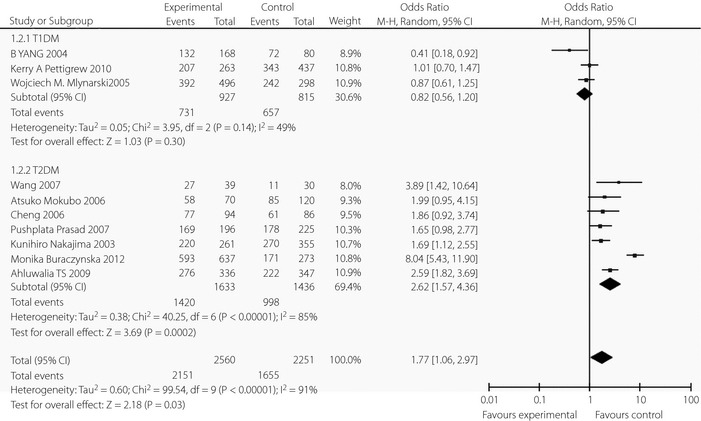
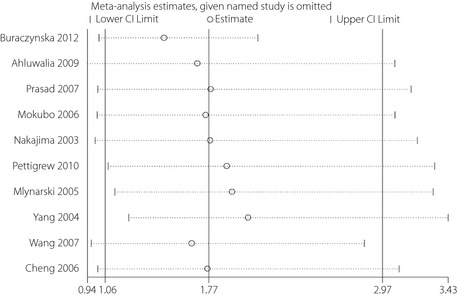
Data were obtained from 11 case-control studies that included 2,737 DMI patients and 2,435 diabetic control subjects. In the overall analysis, the CCL5-403 G/A and CCL5-28 C/G gene polymorphisms were not significantly associated with the risk of DMI. However, CCR5-59029 G/A was an independent risk factor of DMI in a dominant model (OR 1.77, 95% CI 1.06-2.97). Subgroup analysis showed that the risk of the CCR5 59029A-positive genotype was significant in Asians (OR 2.08, 95% CI 1.68-2.57). In addition, the CCR5 59029A-positive genotype was associated with increased risk of albuminuria.
There were no associations of CCL5 gene promoter polymorphism with the risk of DMI. However, the 59029A polymorphism in CCR5 might affect individual susceptibility for DMI.
目的/引言:趋化因子配体5(CCL5)是CC趋化因子家族的成员,在多种器官中表达。它通过与其受体趋化因子受体5(CCR5)结合,促使单核细胞/巨噬细胞迁移至受损血管壁。许多研究探讨了CCL5/CCR5基因启动子多态性与糖尿病微血管并发症(DMI)之间的关联。然而,结果相互矛盾且尚无定论。本研究旨在更精确地评估这种关联。
通过PubMed、Embase、Medline、中国知网、科学网和Cochrane数据库检索试验,不受语言限制。采用合并比值比(OR)和95%置信区间(CI)描述与DMI的关联强度。
数据来自11项病例对照研究,包括2737例DMI患者和2435例糖尿病对照受试者。在总体分析中,CCL5 - 403 G/A和CCL5 - 28 C/G基因多态性与DMI风险无显著关联。然而,在显性模型中,CCR5 - 59029 G/A是DMI的独立危险因素(OR 1.77,95% CI 1.06 - 2.97)。亚组分析显示,CCR5 59029A阳性基因型在亚洲人中的风险显著(OR 2.08,95% CI 1.68 - 2.57)。此外,CCR5 59029A阳性基因型与蛋白尿风险增加相关。
CCL5基因启动子多态性与DMI风险无关联。然而,CCR5中的59029A多态性可能影响个体对DMI的易感性。