Systems Biology Program, Centre for Genomic Regulation (CRG), The Barcelona Institute of Science and Technology, Dr Aiguader 88, Barcelona 08003, Spain.
Universitat Pompeu Fabra (UPF), Barcelona, Spain.
Nat Commun. 2016 May 23;7:11582. doi: 10.1038/ncomms11582.
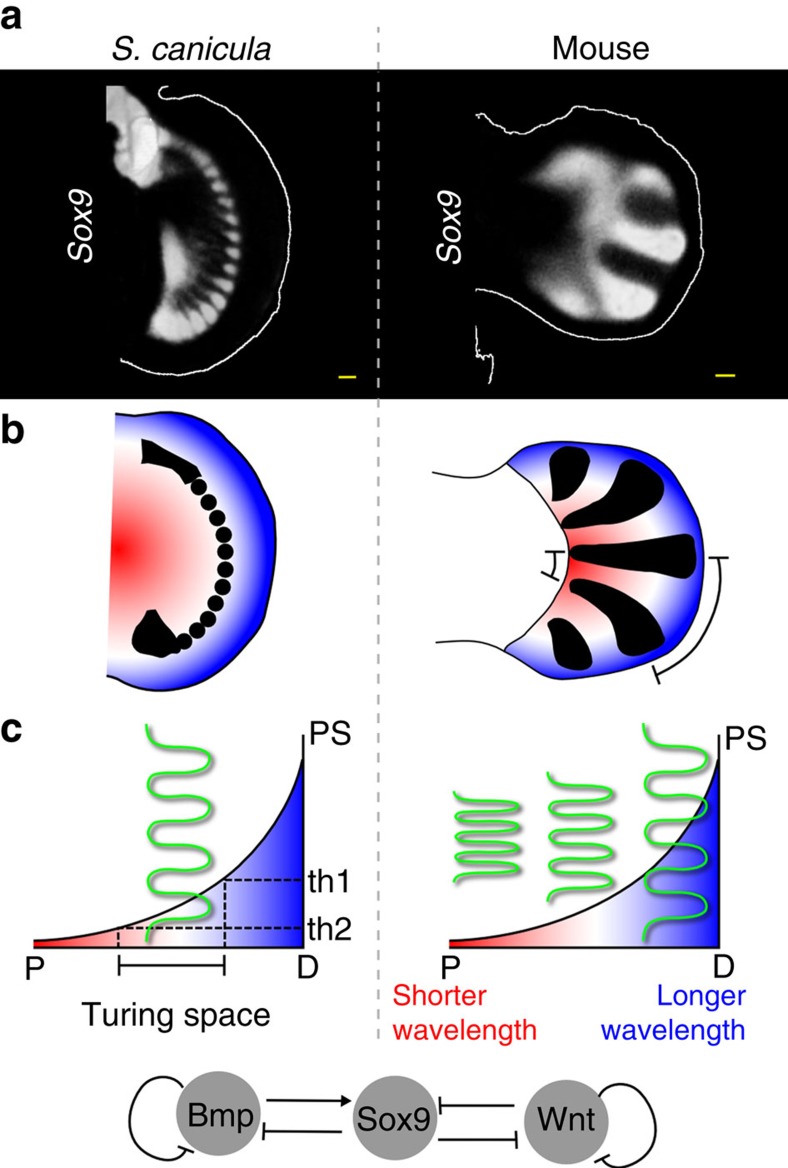
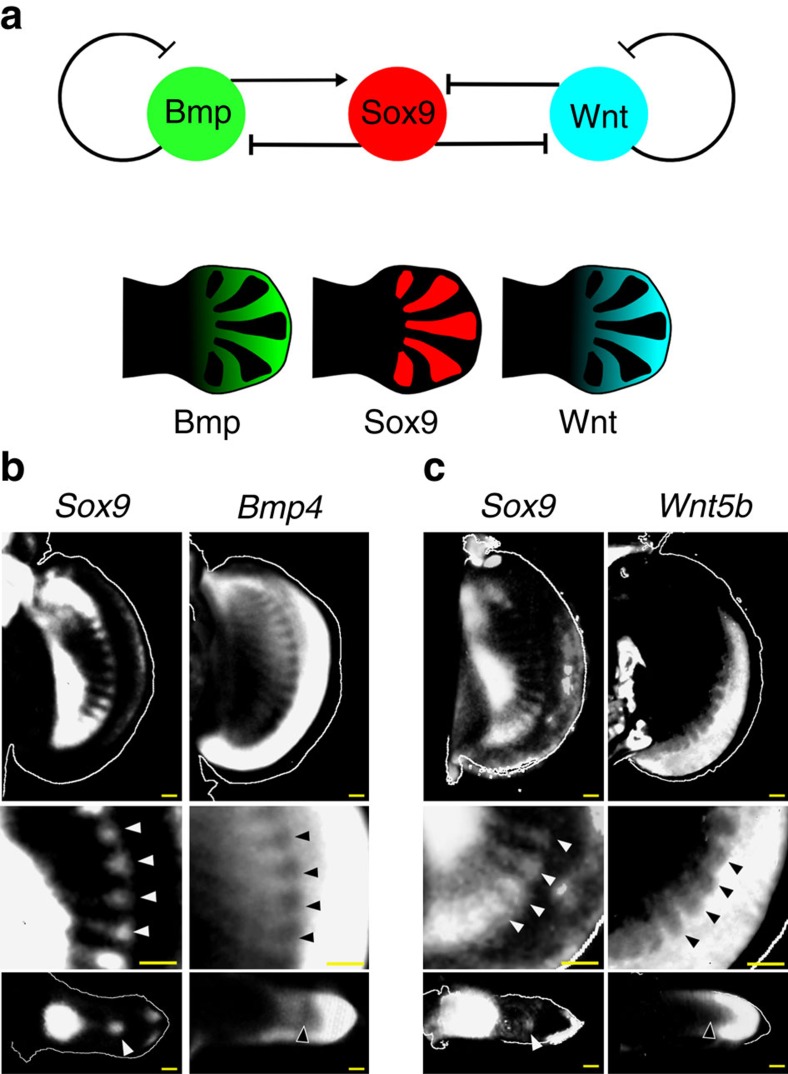
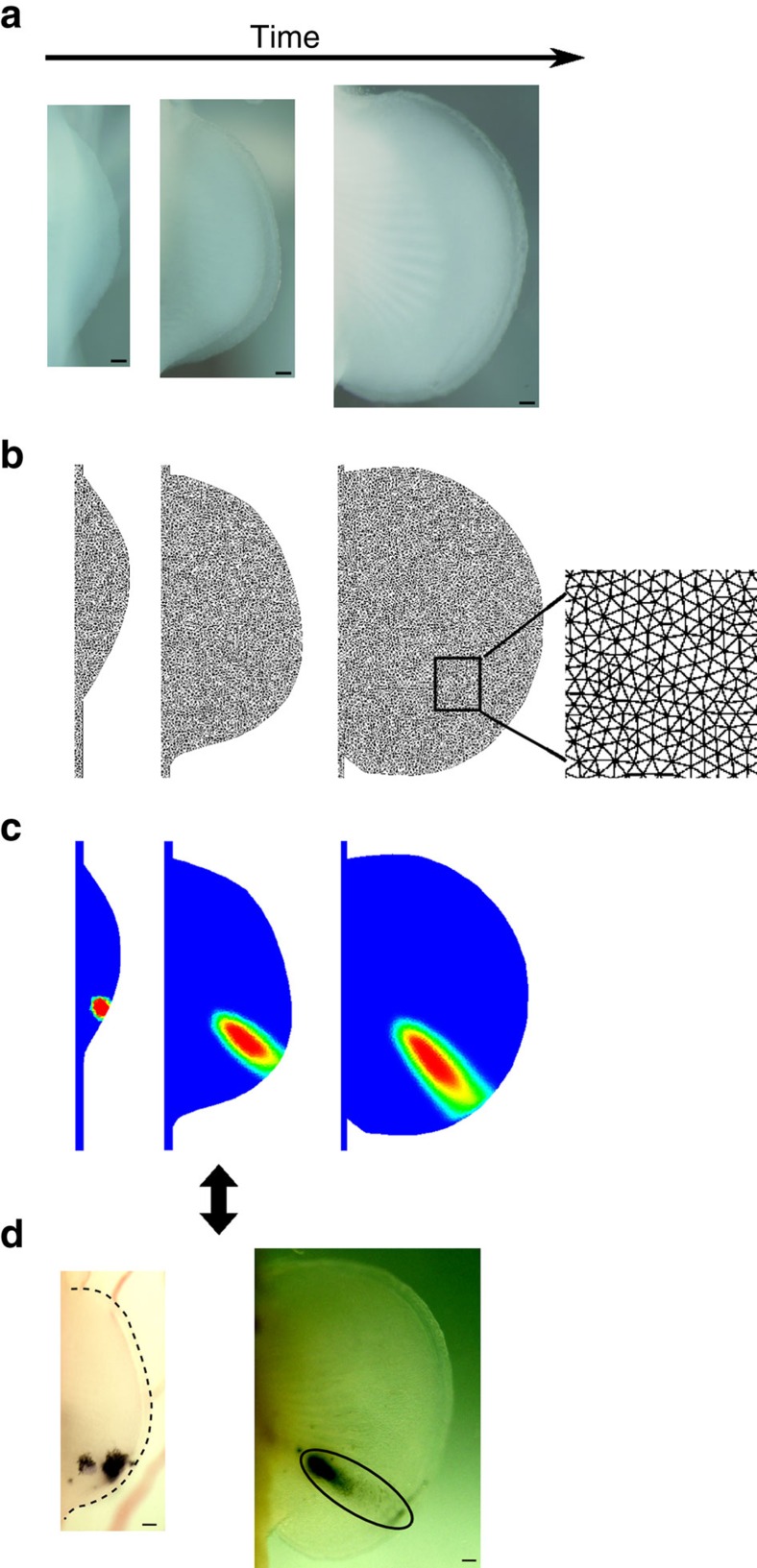
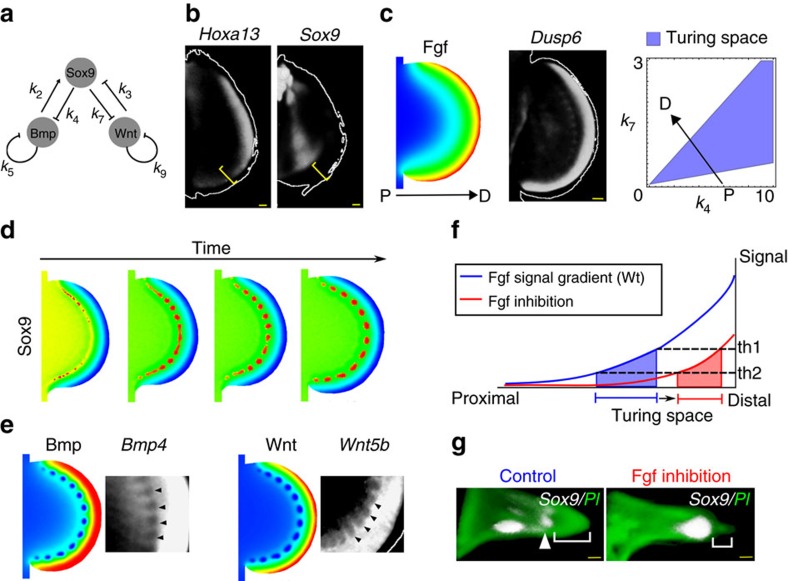
A Turing mechanism implemented by BMP, SOX9 and WNT has been proposed to control mouse digit patterning. However, its generality and contribution to the morphological diversity of fins and limbs has not been explored. Here we provide evidence that the skeletal patterning of the catshark Scyliorhinus canicula pectoral fin is likely driven by a deeply conserved Bmp-Sox9-Wnt Turing network. In catshark fins, the distal nodular elements arise from a periodic spot pattern of Sox9 expression, in contrast to the stripe pattern in mouse digit patterning. However, our computer model shows that the Bmp-Sox9-Wnt network with altered spatial modulation can explain the Sox9 expression in catshark fins. Finally, experimental perturbation of Bmp or Wnt signalling in catshark embryos produces skeletal alterations which match in silico predictions. Together, our results suggest that the broad morphological diversity of the distal fin and limb elements arose from the spatial re-organization of a deeply conserved Turing mechanism.
已经提出了一种由 BMP、SOX9 和 WNT 实现的图灵机制来控制小鼠数字模式。然而,它的普遍性及其对鳍和肢形态多样性的贡献尚未得到探索。在这里,我们提供的证据表明,猫鲨 Scyliorhinus canicula 胸鳍的骨骼模式可能是由一个深度保守的 Bmp-Sox9-Wnt 图灵网络驱动的。在猫鲨的鳍中,远端结节元素来自 Sox9 表达的周期性斑点模式,与小鼠数字模式中的条纹模式形成对比。然而,我们的计算机模型表明,改变空间调制的 Bmp-Sox9-Wnt 网络可以解释猫鲨鳍中的 Sox9 表达。最后,在猫鲨胚胎中对 Bmp 或 Wnt 信号的实验干扰会产生与计算机预测相匹配的骨骼改变。总之,我们的结果表明,远端鳍和肢元素的广泛形态多样性是由一个深度保守的图灵机制的空间重新组织引起的。