Gao Yifei, Dai Xujing, Chen Limei, Lee Arier C, Tong Mancy, Wise Michelle, Chen Qi
1. The Hospital of Obstetrics & Gynaecology, Fudan University, China.
2. Section of Epidemiology and Biostatistics, School of Population Health, The University of Auckland, New Zealand.
J Cancer. 2016 Jun 6;7(9):1169-73. doi: 10.7150/jca.15037. eCollection 2016.
Obesity is a well-known risk factor for developing endometrial cancer. However, the incidence and survival rate of endometrial cancer are associated with ethnicity and geographical area. In addition, whether menopausal status is associated with developing endometrial cancer in obese women and whether obesity is associated with subtypes of endometrial cancer have not been fully investigated. Here, we investigated the effect of BMI on developing endometrial cancer in Chinese women taking into account menopausal status and cancer subtypes.
Data on 1,127 women with endometrial cancer including body mass index (BMI), age at diagnosis, parity, menopausal status and cancer subtype were collected from the largest obstetrics & gynaecology hospital in China and analysed.
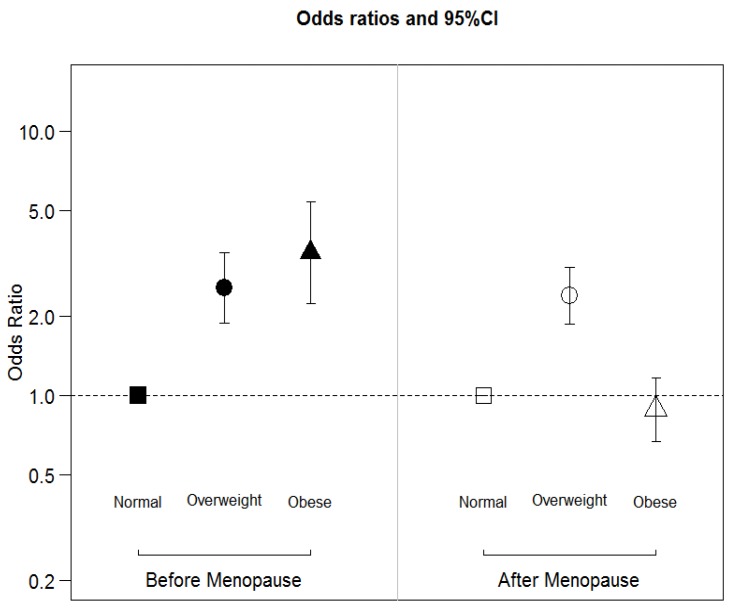
After adjusting for age and parity, the odds for developing endometrial cancer in overweight or obese perimenopausal women was significantly higher than that in women with normal weight (OR=2.6 with 95%CI:1.9-3.5, and OR=3.5 with 95%CI: 2.2-5.4, respectively). The odds of developing endometrial cancer in overweight postmenopausal women were significantly higher than that in women who were normal weight (OR=2.4 with 95%CI: 1.8-3.1), however this was not the case for obese postmenopausal women. We further found that BMI, menopausal status, age and parity were not associated with subtypes of endometrial cancer.
Our data demonstrate that obesity is positively associated with the incidence of developing endometrial cancer in Chinese women, with more significant effects in perimenopausal women.
肥胖是公认的子宫内膜癌发病风险因素。然而,子宫内膜癌的发病率和生存率与种族和地理区域有关。此外,肥胖女性的绝经状态与子宫内膜癌发病是否相关,以及肥胖与子宫内膜癌亚型是否相关,尚未得到充分研究。在此,我们在考虑绝经状态和癌症亚型的情况下,研究了体重指数(BMI)对中国女性子宫内膜癌发病的影响。
收集了来自中国最大的妇产科医院的1127例子宫内膜癌女性的数据,包括体重指数(BMI)、诊断时年龄、产次、绝经状态和癌症亚型,并进行分析。
在调整年龄和产次后,超重或肥胖的围绝经期女性患子宫内膜癌的几率显著高于体重正常的女性(OR分别为2.6,95%CI:1.9 - 3.5;OR为3.5,95%CI:2.2 - 5.4)。超重的绝经后女性患子宫内膜癌的几率显著高于体重正常的女性(OR = 2.4,95%CI:1.8 - 3.1),然而肥胖的绝经后女性并非如此。我们进一步发现,BMI、绝经状态、年龄和产次与子宫内膜癌亚型无关。
我们的数据表明,肥胖与中国女性子宫内膜癌的发病率呈正相关,在围绝经期女性中影响更为显著。