Kawashima Motoko, Uchino Miki, Yokoi Norihiko, Uchino Yuichi, Dogru Murat, Komuro Aoi, Sonomura Yukiko, Kato Hiroaki, Kinoshita Shigeru, Tsubota Kazuo
Department of Ophthalmology, Keio University School of Medicine, Shinjuku-ku, Tokyo, Japan.
Department of Ophthalmology, Keio University School of Medicine, Shinjuku-ku, Tokyo, Japan; Ryogoku Eye Clinic, Sumida-ku, Tokyo, Japan.
Clin Ophthalmol. 2016 Jun 1;10:1015-21. doi: 10.2147/OPTH.S99620. eCollection 2016.
To investigate the association of dry eye disease with sleep quality.
In 2011, a cross-sectional survey was conducted among all the employees, mainly young and middle-aged Japanese office workers, who used visual display technology, at a company in Osaka, Japan (N=672; age range =26-64 years). The participants were classified according to the Japanese dry eye diagnosis criteria by dry eye examination results including the Schirmer test, fluorescein and lissamine green staining, tear film break-up time, and symptom questionnaire into three groups as follows: definite dry eye disease, probable dry eye disease, and no dry eye disease. To determine sleep quality, Japanese version of the Pittsburgh Sleep Quality Index (global score) was implemented. The global score (range =0-21) was calculated by summing seven sleep variable scores (scale, 0-3); scores ≥5.5 indicated poor sleep.
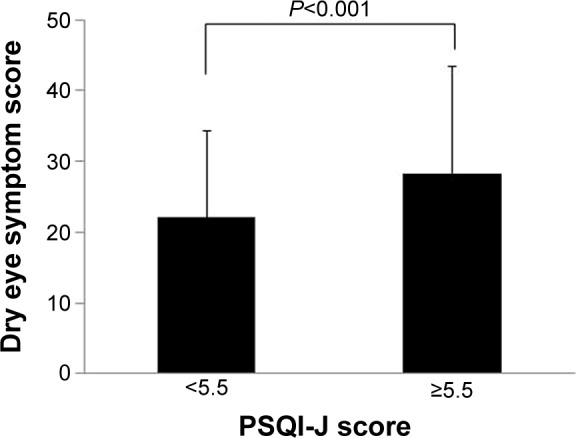
The total mean global score was 5.1±2.3 (completed N=383); 45% of the dry eye disease participants reported having poor sleep quality, while 34% of the no dry eye disease participants did so, with a significant difference found in the global score (P=0.002). Furthermore, a statistically significant association was observed between the global score and dry eye disease (P=0.005).
Poor sleep quality is associated with dry eye disease, especially with dry eye symptoms.
研究干眼症与睡眠质量之间的关联。
2011年,在日本大阪一家公司对所有使用视觉显示技术的员工(主要是日本中青年上班族)进行了横断面调查(N = 672;年龄范围=26 - 64岁)。根据干眼症检查结果,包括泪液分泌试验、荧光素和丽丝胺绿染色、泪膜破裂时间以及症状问卷,按照日本干眼症诊断标准将参与者分为以下三组:确诊干眼症、疑似干眼症和无干眼症。为确定睡眠质量,采用了匹兹堡睡眠质量指数日语版(全球评分)。全球评分(范围=0 - 21)通过将七个睡眠变量评分(量表,0 - 3)相加得出;评分≥5.5表明睡眠质量差。
总平均全球评分为5.1±2.3(完成调查N = 383);45%的干眼症参与者报告睡眠质量差,而无干眼症参与者中这一比例为34%,全球评分存在显著差异(P = 0.002)。此外,全球评分与干眼症之间存在统计学上的显著关联(P = 0.005)。
睡眠质量差与干眼症相关,尤其是与干眼症状相关。