Yassine Omar, Zaher Amir, Li Er Qiang, Alfadhel Ahmed, Perez Jose E, Kavaldzhiev Mincho, Contreras Maria F, Thoroddsen Sigurdur T, Khashab Niveen M, Kosel Jurgen
Computer, Electrical and Mathematical Sciences &Engineering Division, King Abdullah University of Science and Technology (KAUST), Thuwal 23955-6900, Kingdom of Saudi Arabia.
School of Engineering, University of British Columbia, 3333 University Way, Kelowna, BC, V1V 1V7, Canada.
Sci Rep. 2016 Jun 23;6:28539. doi: 10.1038/srep28539.
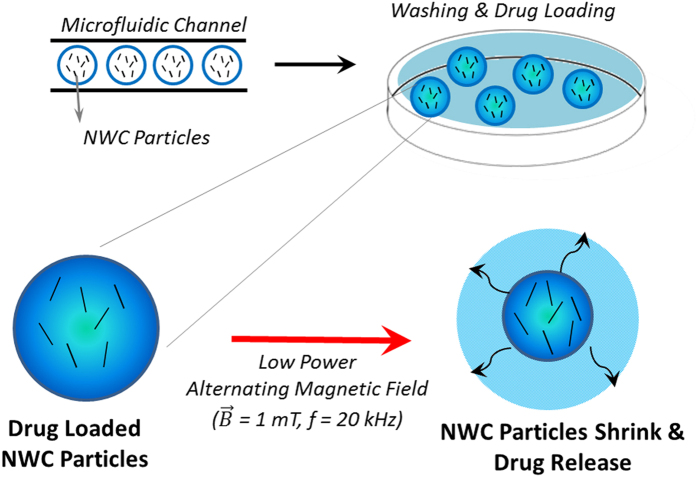
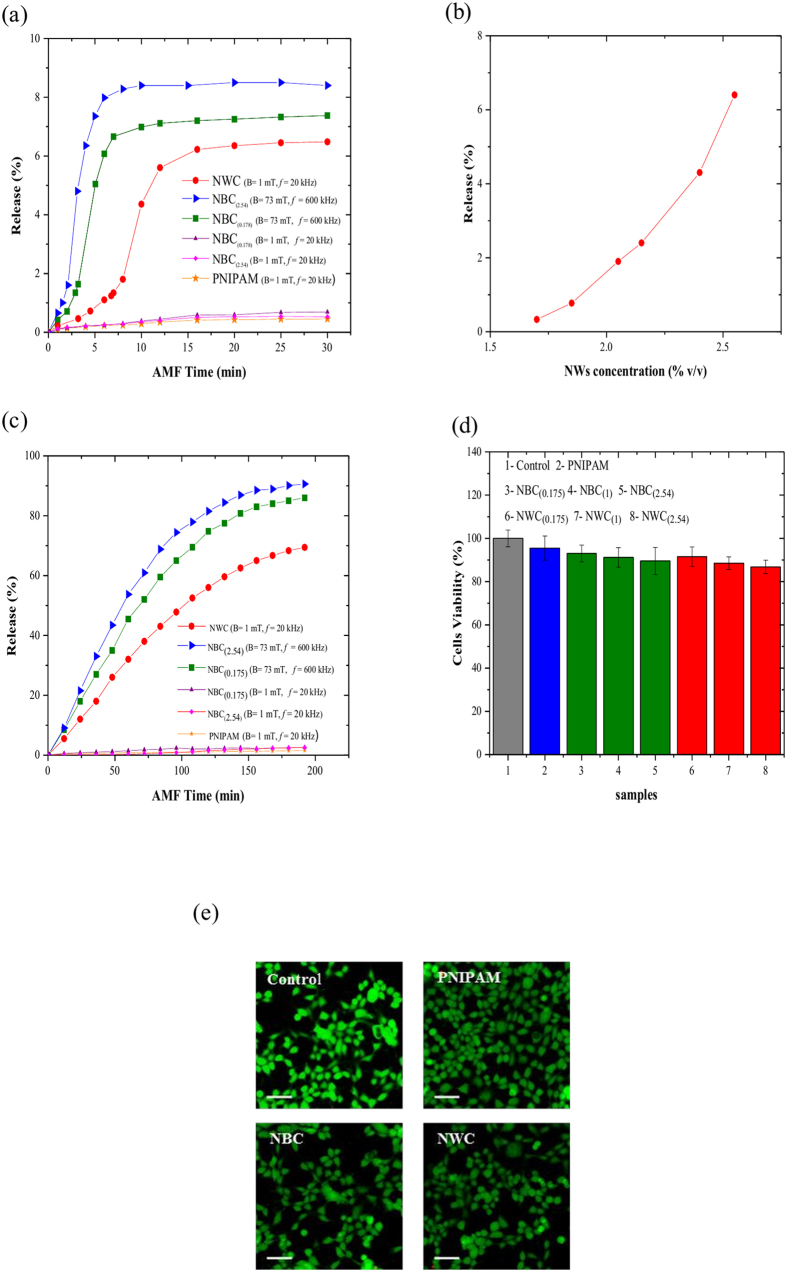
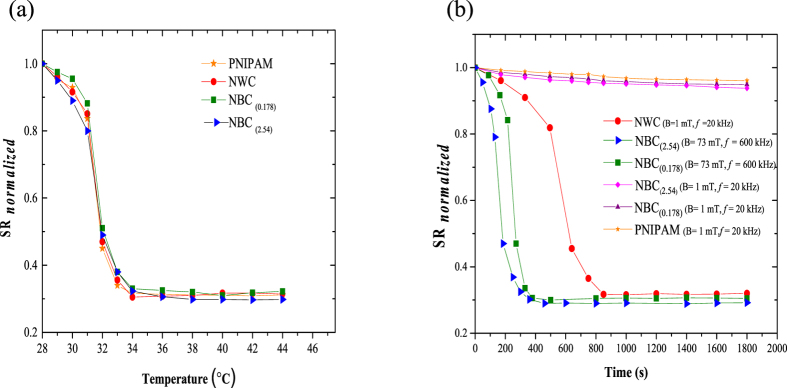
Highly efficient magnetic release from nanocomposite microparticles is shown, which are made of Poly (N-isopropylacrylamide) hydrogel with embedded iron nanowires. A simple microfluidic technique was adopted to fabricate the microparticles with a high control of the nanowire concentration and in a relatively short time compared to chemical synthesis methods. The thermoresponsive microparticles were used for the remotely triggered release of Rhodamine (B). With a magnetic field of only 1 mT and 20 kHz a drug release of 6.5% and 70% was achieved in the continuous and pulsatile modes, respectively. Those release values are similar to the ones commonly obtained using superparamagnetic beads but accomplished with a magnetic field of five orders of magnitude lower power. The high efficiency is a result of the high remanent magnetization of the nanowires, which produce a large torque when exposed to a magnetic field. This causes the nanowires to vibrate, resulting in friction losses and heating. For comparison, microparticles with superparamagnetic beads were also fabricated and tested; while those worked at 73 mT and 600 kHz, no release was observed at the low field conditions. Cytotoxicity assays showed similar and high cell viability for microparticles with nanowires and beads.
展示了由嵌入铁纳米线的聚(N-异丙基丙烯酰胺)水凝胶制成的纳米复合微粒的高效磁释放。采用了一种简单的微流控技术来制备微粒,与化学合成方法相比,该技术能高度控制纳米线浓度且所需时间相对较短。这些热响应性微粒用于远程触发罗丹明(B)的释放。仅在1 mT和20 kHz的磁场下,连续模式和脉动模式下的药物释放率分别达到了6.5%和70%。这些释放值与使用超顺磁性微珠通常获得的值相似,但实现这些值所需的磁场功率低了五个数量级。高效率是纳米线高剩磁的结果,纳米线在暴露于磁场时会产生大扭矩。这会导致纳米线振动,从而产生摩擦损耗并发热。作为比较,还制备并测试了带有超顺磁性微珠的微粒;虽然这些微粒在73 mT和600 kHz下工作,但在低场条件下未观察到释放。细胞毒性试验表明,带有纳米线的微粒和带有微珠的微粒具有相似且较高的细胞活力。