Österberg Julia, Wingstrand Anne, Nygaard Jensen Annette, Kerouanton Annaelle, Cibin Veronica, Barco Lisa, Denis Martine, Aabo Sören, Bengtsson Björn
National Veterinary Institute (SVA), Uppsala, Sweden.
National Food Institute, Technical University of Denmark (DTU), Copenhagen, Denmark.
PLoS One. 2016 Jun 30;11(6):e0157049. doi: 10.1371/journal.pone.0157049. eCollection 2016.
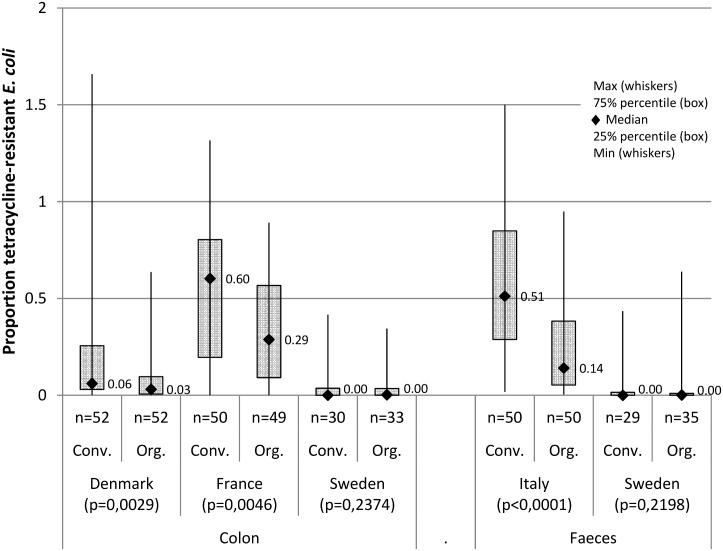
Organic pig production differs in many ways from conventional production of pigs, e.g., in antibiotic use, herd structure, feeding regimes, access to outdoor areas and space allowance per pig. This study investigated if these differences result in a lower occurrence of antibiotic resistance in organic slaughter pigs in Denmark, France, Italy and Sweden. Samples were taken from the colon content and/or faeces and minimum inhibitory concentrations (MIC) of ten antibiotics were determined in isolates of Escherichia coli. In addition, the proportion of tetracycline (TET) resistant E. coli in colon content and/or faeces from individual pigs was determined. In all four countries the percentage resistance to ampicillin, streptomycin, sulphonamides or trimethoprim was significantly lower in E. coli from organic pigs. In France and Italy, the percentage of isolates resistant to chloramphenicol, ciprofloxacin, nalidixic acid or gentamicin was also significantly lower in the E. coli from organic pigs. Resistance to cefotaxime, was not found in any country. The percentage of E. coli isolates resistant to TET as well as the proportion of TET-resistant E. coli was significantly lower in organic than in conventional pigs, except in Sweden where TET-resistance was equally low in both production types. There were also differences between countries within production type in the percentage resistance to individual antibiotics as well as the proportion of TET-resistant E. coli with lower median proportions in Sweden and Denmark compared to France and Italy. The study shows that in each of the four countries resistance in intestinal E. coli was less common in organic than in conventional pigs, but that there were also large differences in resistance between countries within each production type, indicating that both country- and production-specific factors influence the occurrence of resistance.
有机猪生产在许多方面不同于传统的猪生产,例如在抗生素使用、猪群结构、饲养方式、户外活动机会以及每头猪的空间占有量等方面。本研究调查了这些差异是否导致丹麦、法国、意大利和瑞典的有机屠宰猪中抗生素耐药性的发生率较低。从结肠内容物和/或粪便中取样,并测定大肠杆菌分离株对十种抗生素的最低抑菌浓度(MIC)。此外,还测定了个体猪结肠内容物和/或粪便中四环素(TET)耐药大肠杆菌的比例。在所有四个国家,有机猪的大肠杆菌对氨苄青霉素、链霉素、磺胺类药物或甲氧苄啶的耐药百分比均显著较低。在法国和意大利,有机猪的大肠杆菌对氯霉素、环丙沙星、萘啶酸或庆大霉素的耐药分离株百分比也显著较低。在任何国家都未发现对头孢噻肟的耐药性。除瑞典外,有机猪中对TET耐药的大肠杆菌分离株百分比以及TET耐药大肠杆菌的比例均显著低于传统猪,在瑞典两种生产类型中TET耐药性同样较低。在不同生产类型的国家之间,对个别抗生素的耐药百分比以及TET耐药大肠杆菌的比例也存在差异,与法国和意大利相比,瑞典和丹麦的中位数比例较低。该研究表明,在这四个国家中,每个国家有机猪肠道大肠杆菌中的耐药性都比传统猪中少见,但在每种生产类型的国家之间耐药性也存在很大差异,这表明国家和生产特定因素都会影响耐药性的发生。