Langenbach Caspar, Campe Ruth, Beyer Sebastian F, Mueller André N, Conrath Uwe
Department of Plant Physiology, RWTH Aachen University Aachen, Germany.
BASF Plant Science Company GmbH Limburgerhof, Germany.
Front Plant Sci. 2016 Jun 7;7:797. doi: 10.3389/fpls.2016.00797. eCollection 2016.
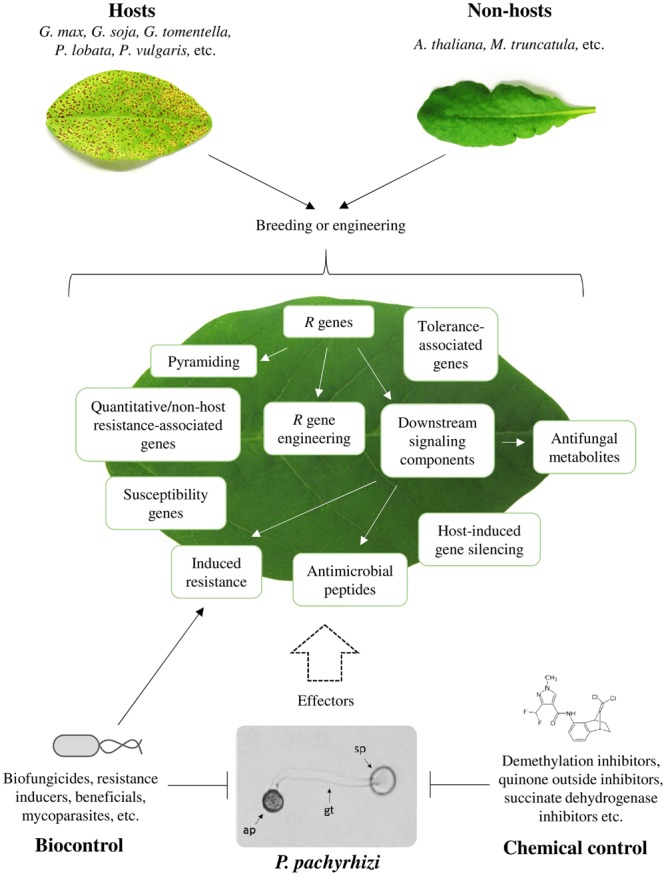
Phakopsora pachyrhizi is a biotrophic fungus provoking SBR disease. SBR poses a major threat to global soybean production. Though several R genes provided soybean immunity to certain P. pachyrhizi races, the pathogen swiftly overcame this resistance. Therefore, fungicides are the only current means to control SBR. However, insensitivity to fungicides is soaring in P. pachyrhizi and, therefore, alternative measures are needed for SBR control. In this article, we discuss the different approaches for fighting SBR and their potential, disadvantages, and advantages over other measures. These encompass conventional breeding for SBR resistance, transgenic approaches, exploitation of transcription factors, secondary metabolites, and antimicrobial peptides, RNAi/HIGS, and biocontrol strategies. It seems that an integrating approach exploiting different measures is likely to provide the best possible means for the effective control of SBR.
大豆锈病菌是一种引发大豆锈病的活体营养型真菌。大豆锈病对全球大豆生产构成重大威胁。尽管有几个抗性基因赋予了大豆对某些大豆锈病菌生理小种的免疫力,但该病原菌迅速克服了这种抗性。因此,目前杀菌剂是防治大豆锈病的唯一手段。然而,大豆锈病菌对杀菌剂的不敏感性正在飙升,因此需要采取替代措施来防治大豆锈病。在本文中,我们讨论了对抗大豆锈病的不同方法及其潜力、缺点以及与其他措施相比的优点。这些方法包括抗大豆锈病的常规育种、转基因方法、转录因子、次生代谢产物和抗菌肽的利用、RNA干扰/寄主诱导的基因沉默以及生物防治策略。利用不同措施的综合方法似乎可能为有效防治大豆锈病提供最佳手段。