McKay Carly D, Merrett Charlotte K, Emery Carolyn A
Department for Health, University of Bath, Bath BA2 7AY, UK.
Sport Injury Prevention Research Centre, University of Calgary, Calgary, AB T2N 1N4, Canada.
Int J Environ Res Public Health. 2016 Jul 7;13(7):657. doi: 10.3390/ijerph13070657.
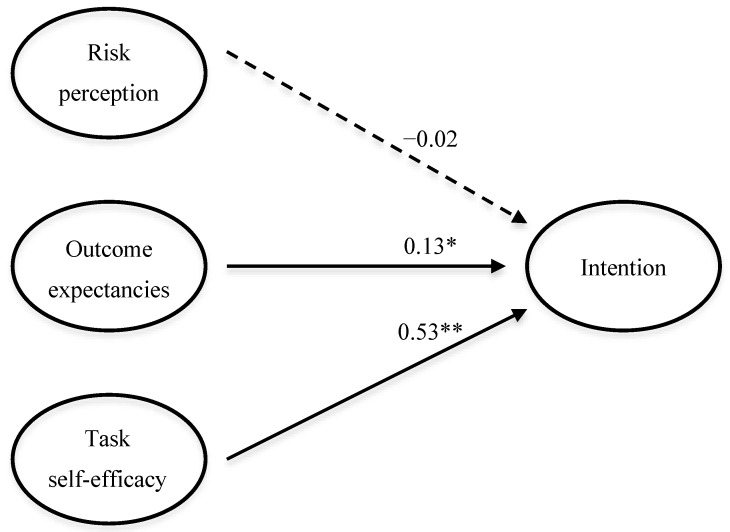
The Fédération Internationale de Football (FIFA) 11+ warm-up program is efficacious at preventing lower limb injury in youth soccer; however, there has been poor adoption of the program in the community. The purpose of this study was to determine the utility of the Health Action Process Approach (HAPA) behavior change model in predicting intention to use the FIFA 11+ in a sample of 12 youth soccer teams (coaches n = 10; 12-16 year old female players n = 200). A bespoke cross-sectional questionnaire measured pre-season risk perceptions, outcome expectancies, task self-efficacy, facilitators, barriers, and FIFA 11+ implementation intention. Most coaches (90.0%) and players (80.0%) expected the program to reduce injury risk but reported limited intention to use it. Player data demonstrated an acceptable fit to the hypothesized model (standardized root mean square residual (SRMR) = 0.08; root mean square of error of approximation (RMSEA) = 0.06 (0.047-0.080); comparative fit index (CFI) = 0.93; Tucker Lewis index (TLI) = 0.91) Task self-efficacy (β = 0.53, p ≤ 0.01) and outcome expectancies (β = 0.13 p ≤ 0.05) were positively associated with intention, but risk perceptions were not (β = -0.02). The findings suggest that the HAPA model is appropriate for use in this context, and highlight the need to target task self-efficacy and outcome expectancies in FIFA 11+ implementation strategies.
国际足球联合会(FIFA)11+热身计划在预防青少年足球运动员下肢损伤方面是有效的;然而,该计划在社区中的采用情况不佳。本研究的目的是确定健康行动过程方法(HAPA)行为改变模型在预测12支青少年足球队(教练n = 10;12 - 16岁女性球员n = 200)样本中使用FIFA 11+的意图方面的效用。一份定制的横断面问卷测量了季前风险认知、结果期望、任务自我效能、促进因素、障碍以及FIFA 11+实施意图。大多数教练(90.0%)和球员(80.0%)期望该计划能降低受伤风险,但表示使用该计划的意图有限。球员数据显示与假设模型拟合度可接受(标准化残差平方根(SRMR)= 0.08;近似误差均方根(RMSEA)= 0.06(0.047 - 0.080);比较拟合指数(CFI)= 0.93;塔克·刘易斯指数(TLI)= 0.91)。任务自我效能(β = 0.53,p≤0.01)和结果期望(β = 0.13,p≤0.05)与意图呈正相关,但风险认知并非如此(β = -0.02)。研究结果表明,HAPA模型适用于此背景,并强调在FIFA 11+实施策略中需要针对任务自我效能和结果期望。