Jaleta Kassahun T, Hill Sharon Rose, Birgersson Göran, Tekie Habte, Ignell Rickard
Unit of Chemical Ecology, Department of Plant Protection Biology, Swedish University of Agricultural Sciences, P. O. Box 102, 23053, Alnarp, Sweden.
Department of Zoological Sciences, College of Natural Science, Addis Ababa University, P. O. Box 1176, Addis Ababa, Ethiopia.
Malar J. 2016 Jul 21;15(1):354. doi: 10.1186/s12936-016-1386-3.
Anopheles arabiensis is a dominant vector of malaria in sub-Saharan Africa, which feeds indoors and outdoors on human and other vertebrate hosts, making it a difficult species to control with existing control methods. Novel methods that reduce human-vector interactions are, therefore, required to improve the impact of vector control programmes. Investigating the mechanisms underlying the host discrimination process in An. arabiensis could provide valuable knowledge leading to the development of novel control technologies. In this study, a host census and blood meal analysis were conducted to determine the host selection behaviour of An. arabiensis. Since mosquitoes select and discriminate among hosts primarily using olfaction, the volatile headspace of the preferred non-human host and non-host species, were collected. Using combined gas chromatography and electroantennographic detection analysis followed by combined gas chromatography and mass spectrometry, the bioactive compounds in the headspace collections were identified. The efficiency of the identified non-host compounds to repel host-seeking malaria mosquitoes was tested under field conditions.
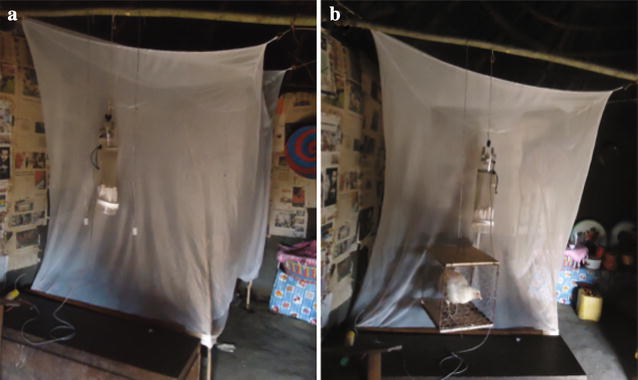
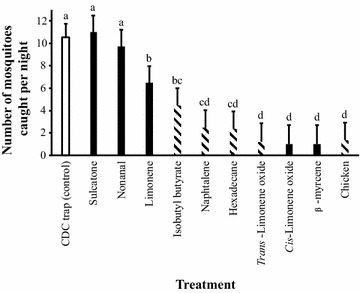
The host census and blood meal analyses demonstrated that An. arabiensis strongly prefers human blood when host seeking indoors, while it randomly feeds on cattle, goats and sheep when found outdoors. However, An. arabiensis avoids chickens despite their relatively high abundance, indicating that chickens are a non-host species for this vector. Eleven bioactive compounds were found in the headspace of the non-host species. Six of these were species-specific, out of which four were identified using combined gas chromatography and mass spectrometry. When tested in the field, the chicken-specific compounds, isobutyl butyrate, naphthalene, hexadecane and trans-limonene oxide, and the generic host compounds, limonene, cis-limonene oxide and β-myrcene, significantly reduced trap catches within the house compared to a negative control. A significant reduction in trap catch was also observed when suspending a caged chicken next to the trap.
Non-host volatiles repel host-seeking An. arabiensis and thus play a significant role in host discrimination. As such, this study demonstrates that non-host volatiles can provide protection to humans at risk of mosquito-vectored diseases in combination with established control programmes.
阿拉伯按蚊是撒哈拉以南非洲地区疟疾的主要传播媒介,它在室内和室外叮咬人类及其他脊椎动物宿主,这使得用现有的控制方法来控制该物种变得困难。因此,需要新的方法来减少人与媒介的相互作用,以提高病媒控制项目的效果。研究阿拉伯按蚊宿主识别过程的潜在机制,可为开发新的控制技术提供有价值的知识。在本研究中,进行了宿主普查和血餐分析,以确定阿拉伯按蚊的宿主选择行为。由于蚊子主要通过嗅觉在宿主之间进行选择和区分,因此收集了偏好的非人类宿主和非宿主物种的挥发性顶空。采用气相色谱与电触角检测联用分析,随后结合气相色谱与质谱联用,鉴定了顶空收集物中的生物活性化合物。在野外条件下测试了所鉴定的非宿主化合物对寻找宿主的疟疾蚊子的驱避效率。
宿主普查和血餐分析表明,阿拉伯按蚊在室内寻找宿主时强烈偏好人类血液,而在室外时则随机叮咬牛、山羊和绵羊。然而,尽管鸡的数量相对较多,但阿拉伯按蚊会避开鸡,这表明鸡是该媒介的非宿主物种。在非宿主物种的顶空中发现了11种生物活性化合物。其中6种是物种特异性的,其中4种通过气相色谱与质谱联用进行了鉴定。在野外测试时,与阴性对照相比,鸡特异性化合物丁酸异丁酯、萘、十六烷和反式氧化柠檬烯,以及通用宿主化合物柠檬烯、顺式氧化柠檬烯和β-月桂烯,显著减少了屋内诱捕器的捕获量。在诱捕器旁边悬挂一只关在笼子里的鸡时,也观察到诱捕量显著减少。
非宿主挥发物可驱避寻找宿主的阿拉伯按蚊,因此在宿主识别中起重要作用。因此,本研究表明,非宿主挥发物可与既定的控制项目相结合,为有蚊媒疾病风险的人类提供保护。