Woestenberg Petra J, Tjhie Jeroen H T, de Melker Hester E, van der Klis Fiona R M, van Bergen Jan E A M, van der Sande Marianne A B, van Benthem Birgit H B
Center for Infectious Disease Control, National Institute for Public Health and the Environment (RIVM), Bilthoven, The Netherlands.
Department of Medical Microbiology, Laboratory for Pathology and Medical Microbiology (PAMM), Veldhoven, The Netherlands.
BMC Infect Dis. 2016 Aug 2;16:364. doi: 10.1186/s12879-016-1707-8.
Genital herpes results in considerable morbidity, including risk of neonatal herpes, and is increasingly being caused by Herpes Simplex Virus (HSV) type 1. Possibly children are less often HSV-1 infected, leaving them susceptible until sexual debut. We assessed changes in the Dutch HSV-1 and HSV-2 seroprevalence over time and determinants associated with HSV seropositivity.
We used data from two population-based seroepidemiological studies conducted in 1995-6 and 2006-7 with a similar study design. Serum samples of 6 months to 44-year-old participants were tested for type-specific HSV antibodies using HerpesSelect® with a cut-off level of >1.10 for seropositivity. Age and sex-specific HSV-1 and HSV-2 seroprevalence was weighted for the Dutch population. Logistic regression was performed to investigate determinants associated with HSV seropositivity.
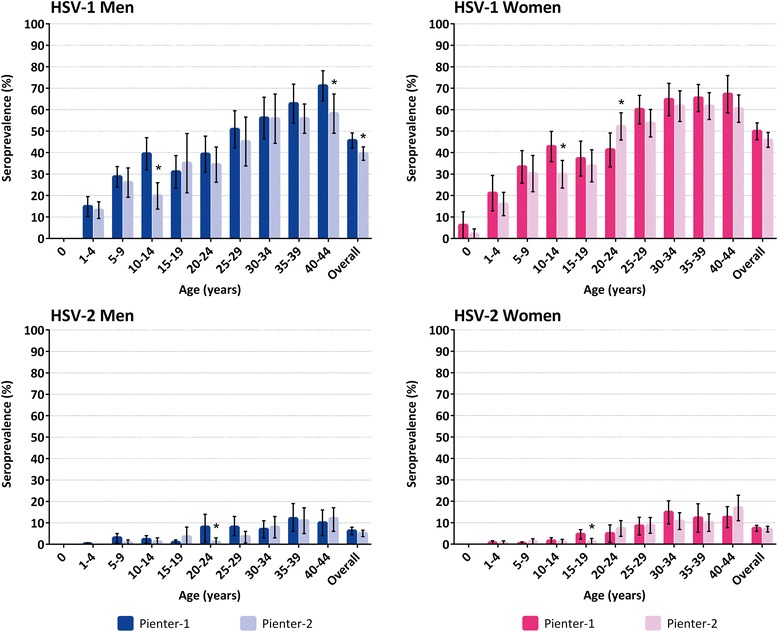
Overall, weighted HSV-1 seroprevalence was significantly lower in 2006-7 [42.7 % 95 % confidence interval (CI) 39.9-45.4] than in 1995-6 (47.7 % 95 % CI 44.8-50.7), especially among 10- to 14-year-olds. Overall, weighted HSV-2 seroprevalence remained stable: 6.8 % in 1995-6 and 6.0 % in 2006-7. Adults who ever had sexual intercourse were more often seropositive for HSV-1 [adjusted Odds Ratio (aOR) 1.69 95 % CI 1.33-2.16] and HSV-2 (aOR 2.35 95 % CI 1.23-4.52). Age at sexual debut was the only sexual risk determinant associated with HSV-1 seropositivity.
Because of the lower HSV-1 seroprevalence in 2006-7 compared to 1995-6, more adults are susceptible to genital HSV-1, including women of reproductive age. Given the higher risk of neonatal herpes when HSV is acquired during pregnancy, prevention and control measures during pregnancy also targeting HSV-1, are important.
生殖器疱疹会导致相当高的发病率,包括新生儿疱疹的风险,并且越来越多地由1型单纯疱疹病毒(HSV)引起。儿童感染HSV-1的情况可能较少,这使得他们在首次性行为之前都易受感染。我们评估了荷兰HSV-1和HSV-2血清阳性率随时间的变化以及与HSV血清阳性相关的决定因素。
我们使用了1995 - 1996年和2006 - 2007年进行的两项基于人群的血清流行病学研究的数据,研究设计相似。使用HerpesSelect®对6个月至44岁参与者的血清样本进行特定类型的HSV抗体检测,血清阳性的临界值设定为>1.10。对荷兰人群按年龄和性别加权计算HSV-1和HSV-2的血清阳性率。进行逻辑回归分析以研究与HSV血清阳性相关的决定因素。
总体而言,2006 - 2007年加权后的HSV-1血清阳性率[42.7%,95%置信区间(CI)39.9 - 45.4]显著低于1995 - 1996年(47.7%,95%CI 44.8 - 50.7),特别是在10至14岁的人群中。总体而言,加权后的HSV-2血清阳性率保持稳定:1995 - 1996年为6.8%,2006 - 2007年为6.0%。曾经有过性行为的成年人HSV-1血清阳性的可能性更高[调整后的优势比(aOR)1.69,95%CI 1.33 - 2.16],HSV-2血清阳性的可能性也更高(aOR 2.35,95%CI 1.23 - 4.52)。首次性行为的年龄是与HSV-1血清阳性相关的唯一性风险决定因素。
由于2006 - 2007年HSV-1血清阳性率低于1995 - 1996年,更多成年人易感染生殖器HSV-1,包括育龄妇女。鉴于孕期感染HSV时新生儿疱疹的风险更高,针对HSV-1的孕期预防和控制措施也很重要。