Hill Jonathan C, Kang Sujin, Benedetto Elena, Myers Helen, Blackburn Steven, Smith Stephanie, Dunn Kate M, Hay Elaine, Rees Jonathan, Beard David, Glyn-Jones Sion, Barker Karen, Ellis Benjamin, Fitzpatrick Ray, Price Andrew
Arthritis Research UK Primary Care Centre, Keele University, Keele, Staffordshire, UK.
Nuffield Department of Orthopaedics, Rheumatology & Musculoskeletal Sciences, Botnar Research Centre, University of Oxford, Oxford, Oxfordshire, UK.
BMJ Open. 2016 Aug 5;6(8):e012331. doi: 10.1136/bmjopen-2016-012331.
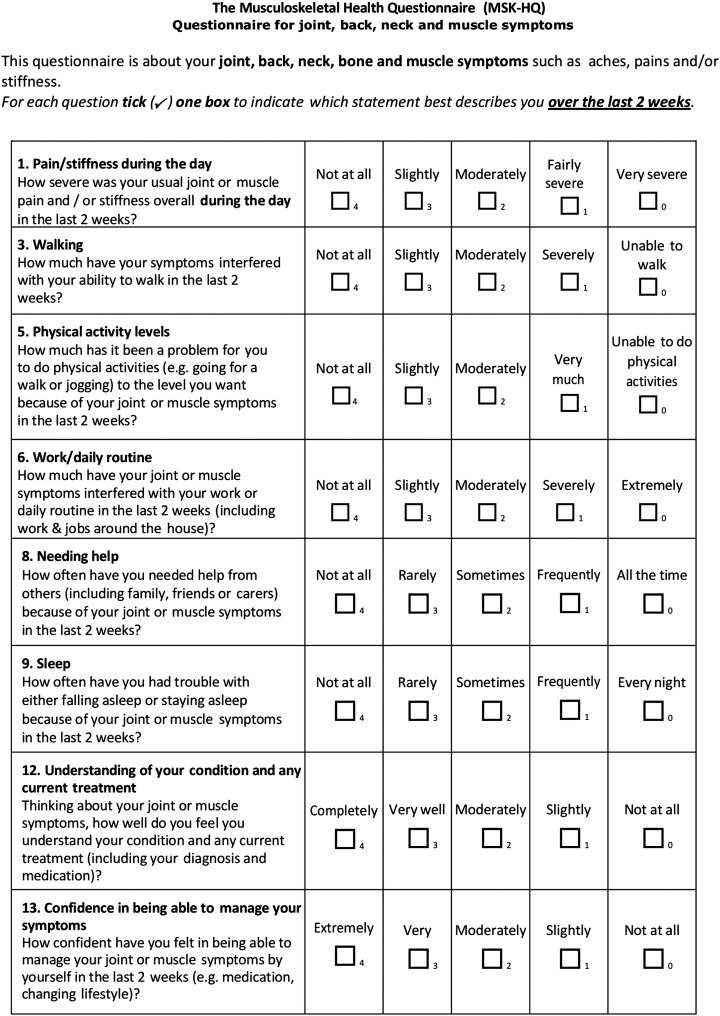
Current musculoskeletal outcome tools are fragmented across different healthcare settings and conditions. Our objectives were to develop and validate a single musculoskeletal outcome measure for use throughout the pathway and patients with different musculoskeletal conditions: the Arthritis Research UK Musculoskeletal Health Questionnaire (MSK-HQ).
A consensus workshop with stakeholders from across the musculoskeletal community, workshops and individual interviews with a broad mix of musculoskeletal patients identified and prioritised outcomes for MSK-HQ inclusion. Initial psychometric validation was conducted in four cohorts from community physiotherapy, and secondary care orthopaedic hip, knee and shoulder clinics.
Stakeholders (n=29) included primary care, physiotherapy, orthopaedic and rheumatology patients (n=8); general practitioners, physiotherapists, orthopaedists, rheumatologists and pain specialists (n=7), patient and professional national body representatives (n=10), and researchers (n=4). The four validation cohorts included 570 participants (n=210 physiotherapy, n=150 hip, n=150 knee, n=60 shoulder patients).
Outcomes included the MSK-HQ's acceptability, feasibility, comprehension, readability and responder burden. The validation cohort outcomes were the MSK-HQ's completion rate, test-retest reliability and convergent validity with reference standards (EQ-5D-5L, Oxford Hip, Knee, Shoulder Scores, and the Keele MSK-PROM).
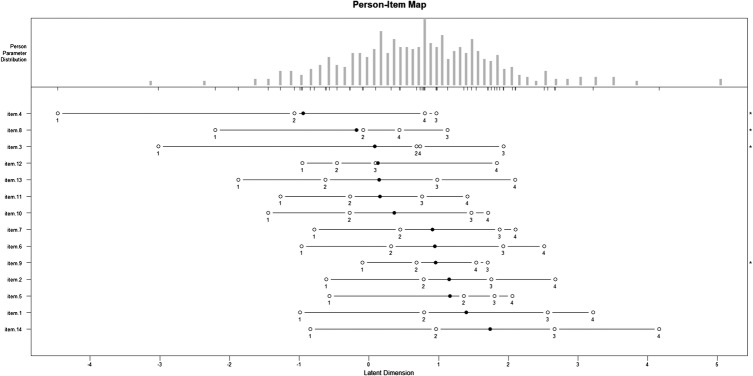
Musculoskeletal domains prioritised were pain severity, physical function, work interference, social interference, sleep, fatigue, emotional health, physical activity, independence, understanding, confidence to self-manage and overall impact. Patients reported MSK-HQ items to be 'highly relevant' and 'easy to understand'. Completion rates were high (94.2%), with scores normally distributed, and no floor/ceiling effects. Test-retest reliability was excellent, and convergent validity was strong (correlations 0.81-0.88).
A new musculoskeletal outcome measure has been developed through a coproduction process with patients to capture prioritised outcomes for use throughout the pathway and with different musculoskeletal conditions. Four validation cohorts found that the MSK-HQ had high completion rates, excellent test-retest reliability and strong convergent validity with reference standards. Further validation studies are ongoing, including a cohort with rheumatoid/inflammatory arthritis.
当前的肌肉骨骼疾病结局评估工具在不同的医疗环境和病情中较为分散。我们的目标是开发并验证一种适用于整个治疗路径以及患有不同肌肉骨骼疾病患者的单一肌肉骨骼疾病结局评估指标:英国关节炎研究肌肉骨骼健康问卷(MSK - HQ)。
与肌肉骨骼领域的利益相关者举办了一次共识研讨会,针对广泛的肌肉骨骼疾病患者群体举办了研讨会并进行了个体访谈,以确定并优先考虑纳入MSK - HQ的结局指标。最初的心理测量学验证在社区物理治疗、二级护理骨科髋、膝和肩部诊所的四个队列中进行。
利益相关者(n = 29)包括初级保健、物理治疗、骨科和风湿病患者(n = 8);全科医生、物理治疗师、骨科医生、风湿病学家和疼痛专家(n = 7),患者和专业全国性机构代表(n = 10)以及研究人员(n = 4)。四个验证队列包括570名参与者(n = 210名物理治疗患者,n = 150名髋部患者,n = 150名膝部患者,n = 60名肩部患者)。
结局指标包括MSK - HQ的可接受性、可行性、理解性、可读性和应答者负担。验证队列的结局指标是MSK - HQ的完成率、重测信度以及与参考标准(EQ - 5D - 5L、牛津髋、膝、肩部评分以及基尔MSK - PROM)的收敛效度。
优先考虑的肌肉骨骼领域包括疼痛严重程度、身体功能、工作干扰、社交干扰、睡眠、疲劳、情绪健康、身体活动、独立性、理解、自我管理信心和总体影响。患者报告MSK - HQ项目“高度相关”且“易于理解”。完成率很高(94.2%),分数呈正态分布,且无地板效应/天花板效应。重测信度极佳,收敛效度很强(相关性为0.81 - 0.88)。
通过与患者共同生产的过程开发了一种新的肌肉骨骼疾病结局评估指标,以获取适用于整个治疗路径以及不同肌肉骨骼疾病的优先结局指标。四个验证队列发现MSK - HQ具有高完成率、出色的重测信度以及与参考标准的强收敛效度。正在进行进一步的验证研究,包括一个类风湿性/炎性关节炎队列。