Cabelin Vincent Louie Domingo, Alejandro Grecebio Jonathan Duran
The Graduate School, University of Santo Tomas, España, Manila 1015, Philippines, College of Arts and Sciences, Notre Dame of Dadiangas University, General Santos City 9500, Philippines.
The Graduate School and Research Center for the Natural and Applied Sciences, University of Santo Tomas, España, Manila 1015, Philippines.
Pharmacogn Mag. 2016 May;12(Suppl 3):S384-8. doi: 10.4103/0973-1296.185780.
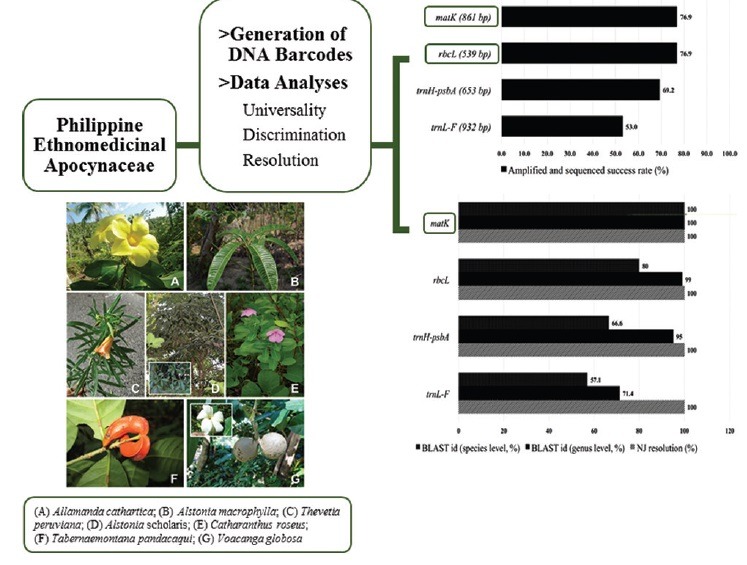
The Philippines is home to some ethnomedicinal Apocynaceae that has been used to cure common ailments. They are perceived to be safe, but misidentification can lead to substitution and adulteration. Morphological characters are primarily utilized to identify these species but a new method utilizing molecular characters called DNA barcoding has emerged. In this study, the efficiency of matK, rbcL, trnH-psbA, and trnL-F to molecularly authenticate selected Apocynaceae species were tested.
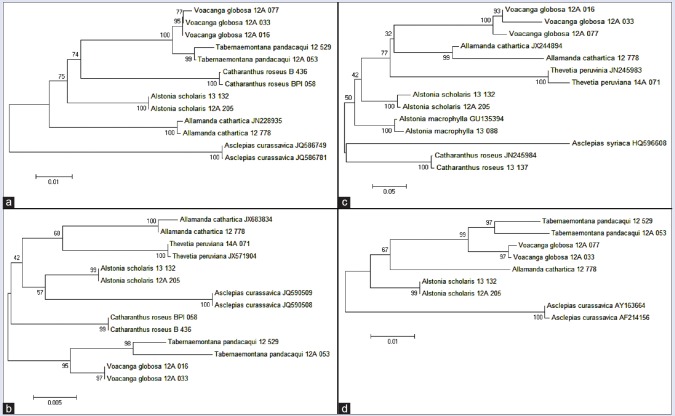
Genomic DNA from silica-dried leaf samples were isolated and used as a template for generating DNA barcodes. Pair-wise sequence divergence using Kimura-2-Parameter was used to analyze inter-specific and intraspecific variations among the barcodes, whereas basic local alignment search tool (BLAST) and neighbor-joining (NJ) analyses were employed to examine discrimination success.
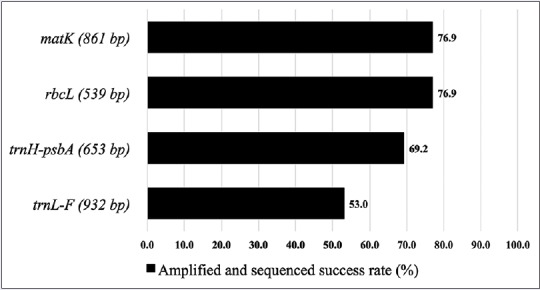
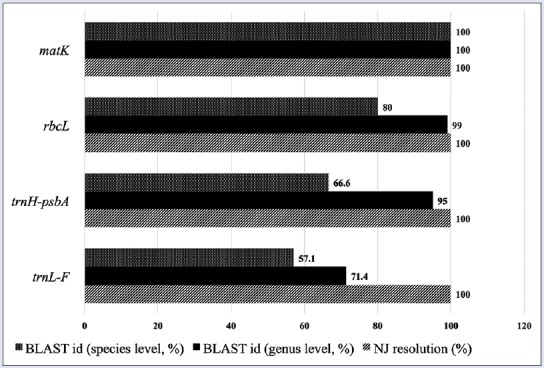
The results show that matK is the best barcode for Apocynaceae as it has the highest amplification and sequencing success together with rbcL while having high inter-specific and low intra-specific divergence relative to the other candidate barcodes. Furthermore, matK provided the highest discrimination both in BLAST and NJ analyses.
This study proposes the use of matK as the principal barcode for Apocynaceae.
Both matK and rbcL have higher universality compared to trnH-psbA and trnL-F matK has relatively high inter-specific divergence and very minimal intra-specific divergencematK is the best barcode to molecularly authenticate Apocynaceae with either trnH-psbA or trnL-F as supplements. Abbreviations used: K2P: Kimura-2-parameter, BLAST: Basic local alignment search tool, NJ: Neighbor-joining.
菲律宾有一些用于民族医学的夹竹桃科植物,被用于治疗常见疾病。人们认为它们是安全的,但错误识别可能导致替代和掺假。形态特征主要用于识别这些物种,但一种利用称为DNA条形码的分子特征的新方法已经出现。在本研究中,测试了matK、rbcL、trnH-psbA和trnL-F对选定夹竹桃科物种进行分子鉴定的效率。
从硅胶干燥的叶片样本中分离基因组DNA,并用作生成DNA条形码的模板。使用Kimura-2-参数进行成对序列差异分析,以分析条形码之间的种间和种内变异,而使用基本局部比对搜索工具(BLAST)和邻接法(NJ)分析来检验鉴别成功率。
结果表明,matK是夹竹桃科植物的最佳条形码,因为它与rbcL一起具有最高的扩增和测序成功率,并且相对于其他候选条形码具有高种间差异和低种内差异。此外,matK在BLAST和NJ分析中都提供了最高的鉴别率。
本研究建议使用matK作为夹竹桃科植物的主要条形码。
与trnH-psbA和trnL-F相比,matK和rbcL具有更高的通用性。matK具有相对较高的种间差异和非常小的种内差异。matK是对夹竹桃科植物进行分子鉴定的最佳条形码,可将trnH-psbA或trnL-F作为补充。使用的缩写:K2P:Kimura-2-参数,BLAST:基本局部比对搜索工具,NJ:邻接法。