Barrozo Roberto M, Hansen Lori M, Lam Anna M, Skoog Emma C, Martin Miriam E, Cai Lucy P, Lin Yong, Latoscha Andreas, Suerbaum Sebastian, Canfield Don R, Solnick Jay V
Center for Comparative Medicine, University of California, Davis School of Medicine, Davis, California.
Institute of Medical Microbiology and Hospital Epidemiology, Hannover Medical School, Hannover, Germany.
Gastroenterology. 2016 Dec;151(6):1164-1175.e3. doi: 10.1053/j.gastro.2016.08.014. Epub 2016 Aug 26.
BACKGROUND & AIMS: Peptic ulcer disease and gastric cancer are caused most often by Helicobacter pylori strains that harbor the cag pathogenicity island, which encodes a type IV secretion system (T4SS) that injects the CagA oncoprotein into host cells. cagY is an essential gene in the T4SS and has an unusual DNA repeat structure that predicts in-frame insertions and deletions. These cagY recombination events typically lead to a reduction in T4SS function in mouse and primate models. We examined the role of the immune response in cagY-dependent modulation of T4SS function.
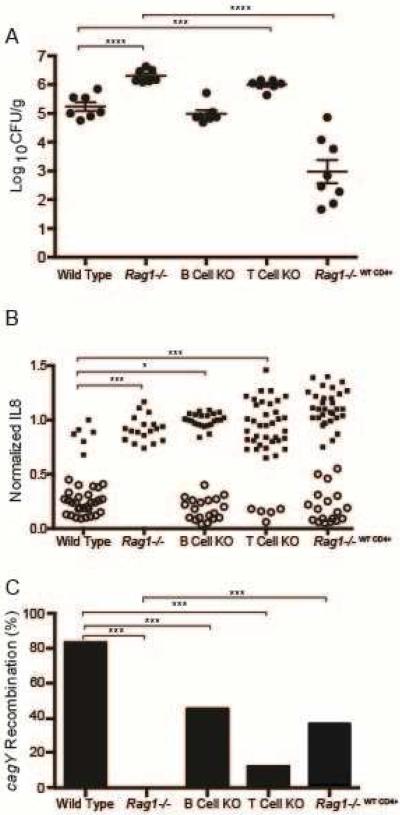
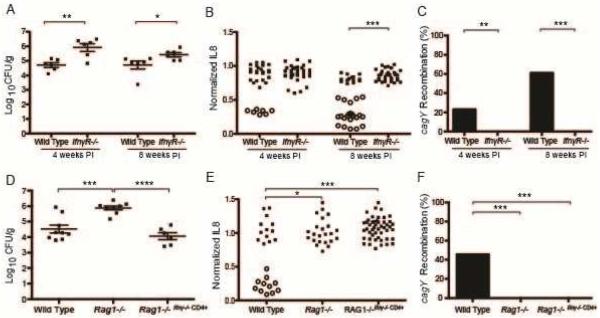
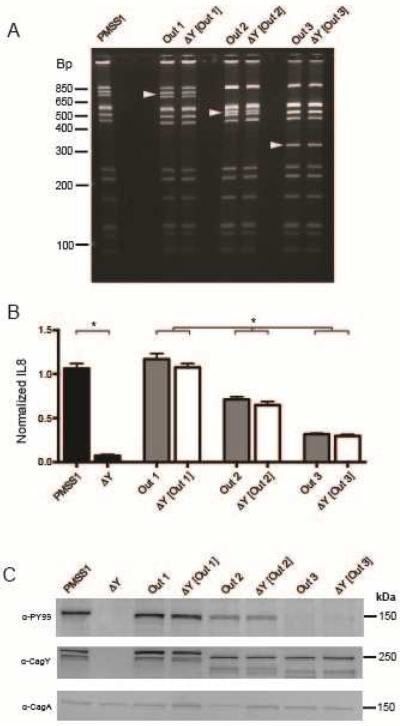
H pylori T4SS function was assessed by measuring CagA translocation and the capacity to induce interleukin (IL)8 in gastric epithelial cells. cagY recombination was determined by changes in polymerase chain reaction restriction fragment-length polymorphisms. T4SS function and cagY in H pylori from C57BL/6 mice were compared with strains recovered from Rag1-/- mice, T- and B-cell-deficient mice, mice with deletion of the interferon gamma receptor (IFNGR) or IL10, and Rag1-/- mice that received adoptive transfer of control or Ifng-/- CD4+ T cells. To assess relevance to human beings, T4SS function and cagY recombination were assessed in strains obtained sequentially from a patient after 7.4 years of infection.
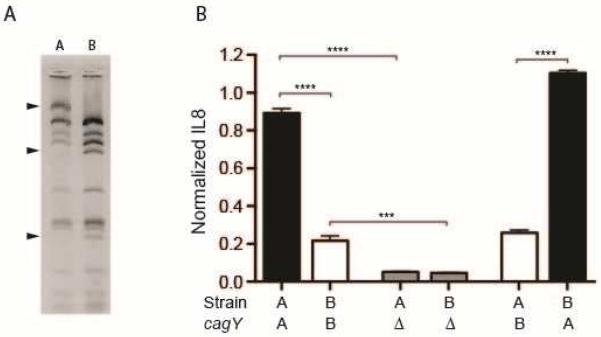
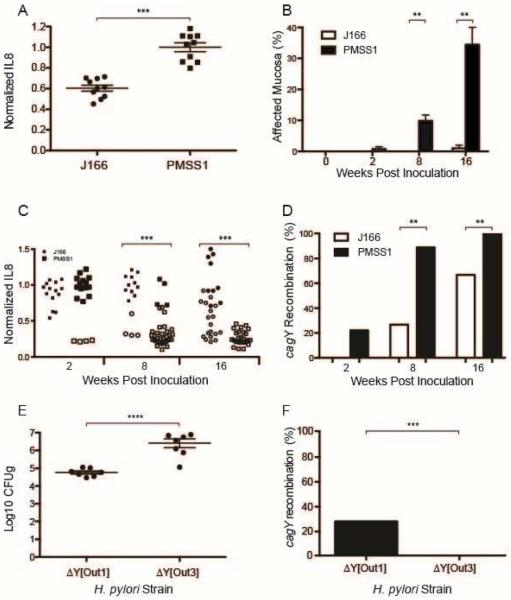
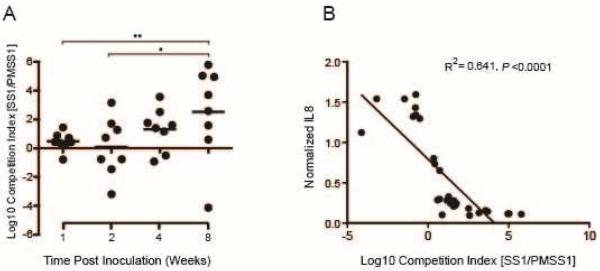
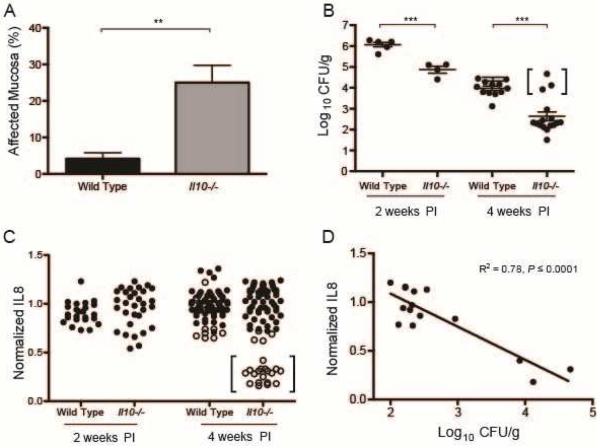
H pylori infection of T-cell-deficient and Ifngr1-/- mice, and transfer of CD4+ T cells to Rag1-/- mice, showed that cagY-mediated loss of T4SS function requires a T-helper 1-mediated immune response. Loss of T4SS function and cagY recombination were more pronounced in Il10-/- mice, and in control mice infected with H pylori that expressed a more inflammatory form of cagY. Complementation analysis of H pylori strains isolated from a patient over time showed changes in T4SS function that were dependent on recombination in cagY.
Analysis of H pylori strains from mice and from a chronically infected patient showed that CagY functions as an immune-sensitive regulator of T4SS function. We propose that this is a bacterial adaptation to maximize persistent infection and transmission to a new host under conditions of a robust inflammatory response.
消化性溃疡疾病和胃癌最常由携带cag致病岛的幽门螺杆菌菌株引起,该致病岛编码一种IV型分泌系统(T4SS),可将CagA癌蛋白注入宿主细胞。cagY是T4SS中的一个必需基因,具有不寻常的DNA重复结构,可预测框内插入和缺失。这些cagY重组事件通常会导致小鼠和灵长类动物模型中T4SS功能的降低。我们研究了免疫反应在cagY依赖性调节T4SS功能中的作用。
通过测量CagA易位和诱导胃上皮细胞中白细胞介素(IL)-8的能力来评估幽门螺杆菌T4SS功能。通过聚合酶链反应限制性片段长度多态性的变化来确定cagY重组。将C57BL/6小鼠的幽门螺杆菌菌株的T4SS功能和cagY与从Rag1-/-小鼠、T和B细胞缺陷小鼠、干扰素γ受体(IFNGR)或IL10缺失的小鼠以及接受对照或Ifng-/- CD4+ T细胞过继转移的Rag1-/-小鼠中分离出的菌株进行比较。为了评估与人类的相关性,在感染7.4年后从一名患者身上依次获得的菌株中评估T4SS功能和cagY重组。
T细胞缺陷小鼠和Ifngr1-/-小鼠的幽门螺杆菌感染,以及将CD4+ T细胞转移到Rag1-/-小鼠,表明cagY介导的T4SS功能丧失需要辅助性T细胞1介导的免疫反应。在Il10-/-小鼠以及感染了表达更具炎症形式cagY的幽门螺杆菌的对照小鼠中,T4SS功能丧失和cagY重组更为明显。对一名患者随时间分离出的幽门螺杆菌菌株进行的互补分析表明,T4SS功能的变化取决于cagY中的重组。
对小鼠和一名慢性感染患者的幽门螺杆菌菌株的分析表明,CagY作为T4SS功能的免疫敏感调节因子发挥作用。我们提出,这是细菌的一种适应性变化,以便在强烈炎症反应的条件下最大限度地实现持续感染并传播给新宿主。