Lab of Viral Diseases, NIAID, NIH, Bethesda, MD, USA.
Sci Rep. 2016 Sep 8;6:33028. doi: 10.1038/srep33028.
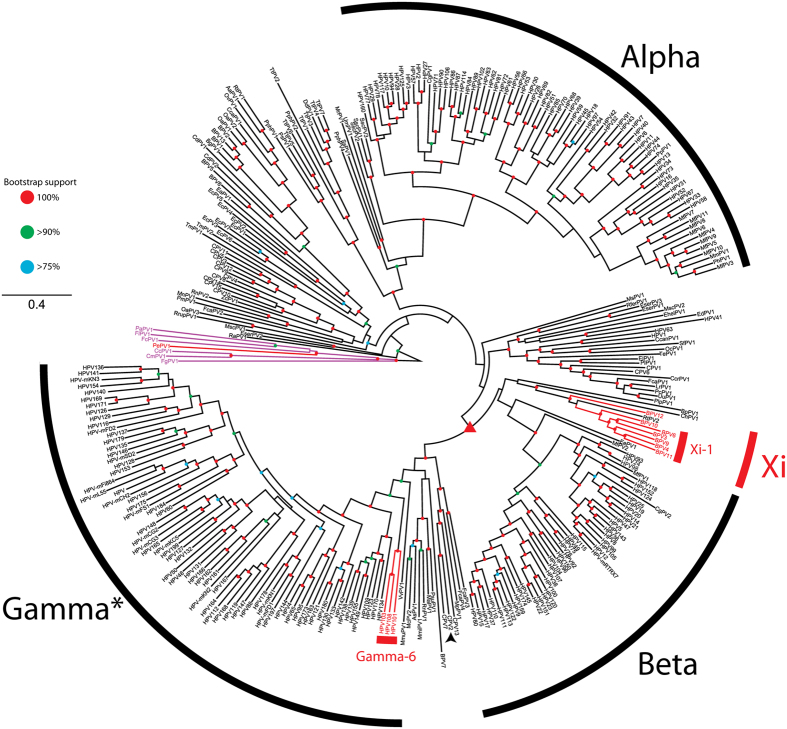
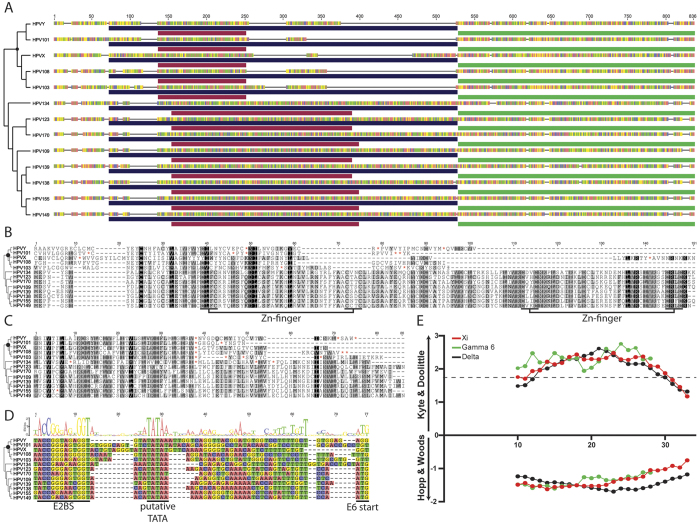
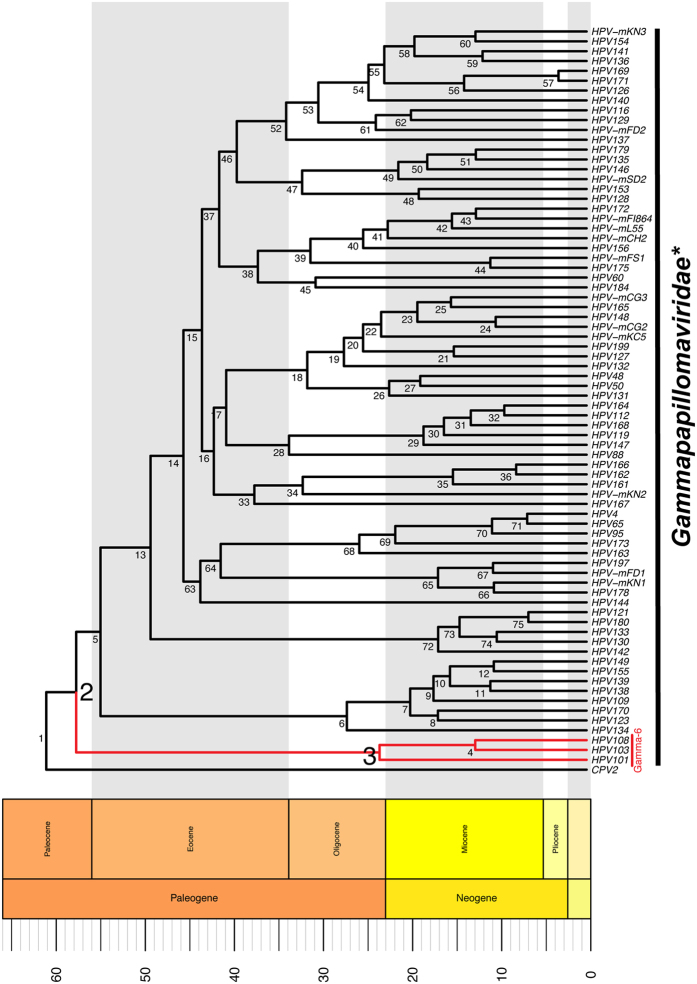
It is becoming clear that, in addition to gene gain, the loss of genes may be an important evolutionary mechanism for many organisms. However, gene loss is often associated with an increased mutation rate, thus quickly erasing evidence from the genome. The analysis of evolutionarily related sequences can provide empirical evidence for gene loss events. This paper analyzes the sequences of over 300 genetically distinct papillomaviruses and provides evidence for a role of gene loss during the evolution of certain papillomavirus genomes. Phylogenetic analysis suggests that the viral E6 gene was lost at least twice. Despite belonging to distant papillomaviral genera, these viruses lacking a canonical E6 protein may potentially encode a highly hydrophobic protein from an overlapping open reading frame, which we designate E10. Evolutionary pressure working on this alternative frame, may explain why, despite having lost the E6 open reading frame between 20 and 60 million years ago, evidence of an E6-like protein is conserved.
很明显,除了基因获得之外,基因的丢失也可能是许多生物体的一个重要进化机制。然而,基因丢失通常与突变率的增加有关,从而迅速从基因组中抹去证据。进化相关序列的分析可为基因丢失事件提供经验证据。本文分析了 300 多种遗传上不同的乳头瘤病毒的序列,并为某些乳头瘤病毒基因组进化过程中基因丢失的作用提供了证据。系统发育分析表明,病毒 E6 基因至少丢失了两次。尽管属于不同的乳头瘤病毒属,但这些缺乏典型 E6 蛋白的病毒可能潜在地从重叠的开放阅读框编码一种高度疏水性蛋白,我们将其指定为 E10。作用于这个替代框架的进化压力可以解释为什么尽管在 2000 万至 6000 万年前就丢失了 E6 开放阅读框,但仍能保守 E6 样蛋白的证据。